
Singapore is building a brand-new MRT line that will cut across almost the entire island, and it’s shaping up to be the most transformative rail project the city-state has seen in decades. The Cross Island Line (CRL) will eventually span from Changi in the east to Jurong in the west, connecting dozens of estates that currently have no MRT access.
- What exactly is the Cross Island Line?
- How many phases does the Cross Island Line have?
- Which existing lines will the CRL interchange with?
- Who will operate the Cross Island Line?
- What will CRL trains look like?
- What does the CRL mean for your daily commute?
- What is the latest news on the Cross Island Line in 2026?
- How does the CRL compare to Singapore's other MRT lines?
- Before you tap in
- FAQ
What exactly is the Cross Island Line?
The Cross Island Line is a fully underground MRT line that will run east to west across Singapore, linking towns that previously relied on long bus journeys or multiple train transfers. According to the Land Transport Authority (LTA), the CRL will be around 50 kilometres long in its full form, making it the longest MRT line in the network when complete.
The line is coded CRL and colour-coded teal on the system map. It will interchange with virtually every existing MRT line. That’s the whole point. Right now, if you live in Hougang or Ang Mo Kio and need to get to Clementi or Jurong, you’re looking at at least two changes and a solid 45 minutes on a good day. The CRL cuts through that friction directly.
You can see how it fits into the full network on our complete list of MRT stations in Singapore, which is updated regularly as new stations are confirmed.
Getting around Singapore? Find any station on the interactive MRT map, or save the PDF map to use offline.
How many phases does the Cross Island Line have?
The CRL is being built in three phases, each targeting different parts of the island and serving communities with different transport needs. Here’s the breakdown.
Phase 1: The main east-west spine
Phase 1 is the backbone of the entire line. It runs from Aviation Park (near Changi Airport) westward through Loyang, Pasir Ris, Defu, Hougang, Serangoon North, Ang Mo Kio, Teck Ghee, and Buangkok, before terminating at Bright Hill. That’s 12 stations, and almost every one serves an area currently without easy MRT access.
Bright Hill will be a major interchange with the Thomson-East Coast Line (TEL). If you already use the Thomson-East Coast Line, you’ll know how useful that corridor is. Adding a CRL interchange there opens up huge numbers of cross-island journey options without going through the CBD.
Phase 1 is expected to open in the early 2030s. Civil works are well underway as of August 2026, with tunnelling and station box construction ongoing at multiple sites.
Phase 2: The spur to Clementi
Phase 2 branches off from the main Phase 1 corridor, running from Bright Hill southward through King Albert Park and then westward to terminate at Clementi. This phase specifically targets the Bukit Timah corridor, an area historically underserved by rail despite being densely populated.
Phase 2 will interchange with the Downtown Line (DTL) at King Albert Park, which already serves Beauty World, Botanic Gardens, and Bukit Panjang. Residents of Clementi will also gain a second MRT line, complementing their existing access on the East-West Line (EWL).
Phase 2 is scheduled to open later than Phase 1, with 2032 as the current general target.
Phase 3: The new western extension
This is the latest news. In late July 2026, LTA confirmed that Phase 3 will add four new stations to serve Taman Jurong and the western industrial estates. The new stations will include interchanges with the East-West Line and the upcoming Jurong Region Line (JRL), creating a proper western terminus for the CRL and a genuine multi-modal hub for Jurong’s industrial and residential communities.
For workers commuting to the western industrial estates around Gul Circle and Jurong Pier, this matters. That part of Singapore has relied entirely on bus services, which can be slow and infrequent during off-peak hours. Our dedicated article on the four new CRL stations serving Jurong Pier and Gul Circle has more detail on exactly which areas will benefit. Phase 3 is targeted for completion by the late 2030s.
Which existing lines will the CRL interchange with?
The Cross Island Line is designed as a connector, and the interchange count reflects that. Here’s a summary of the planned interchanges across all three phases.
| CRL Station | Connecting Line(s) | Phase |
|---|---|---|
| Pasir Ris | East-West Line (EWL) | Phase 1 |
| Hougang | North East Line (NEL) | Phase 1 |
| Serangoon North | North East Line (NEL) at Serangoon | Phase 1 |
| Ang Mo Kio | North South Line (NSL) | Phase 1 |
| Bright Hill | Thomson-East Coast Line (TEL) | Phase 1 |
| King Albert Park | Downtown Line (DTL) | Phase 2 |
| Clementi | East-West Line (EWL) | Phase 2 |
| Taman Jurong area (TBC) | EWL + Jurong Region Line (JRL) | Phase 3 |
That’s remarkable connectivity. For context, the Circle Line (CCL) was transformative when it opened because it let people bypass the city centre. The CRL does something similar, but specifically for east-to-west cross-island journeys, which the Circle Line doesn’t really address.
Who will operate the Cross Island Line?
As of August 2026, the operating contract for the CRL hasn’t been awarded yet. What is confirmed is that SMRT has teamed up with a Chinese rail operator to submit a joint bid for the right to run the line, according to The Straits Times (5 August 2026). Our article covering the SMRT and Chinese rail operator joint bid for the Cross Island Line explains what this partnership could mean for how the line is eventually run.
Singapore’s operating licence model follows the government’s Rail Financing Framework, where the government owns the assets and the operator pays a licence fee. This keeps fare structures within LTA’s oversight and links them to the national distance-based fare system used across every other MRT line.
What will CRL trains look like?
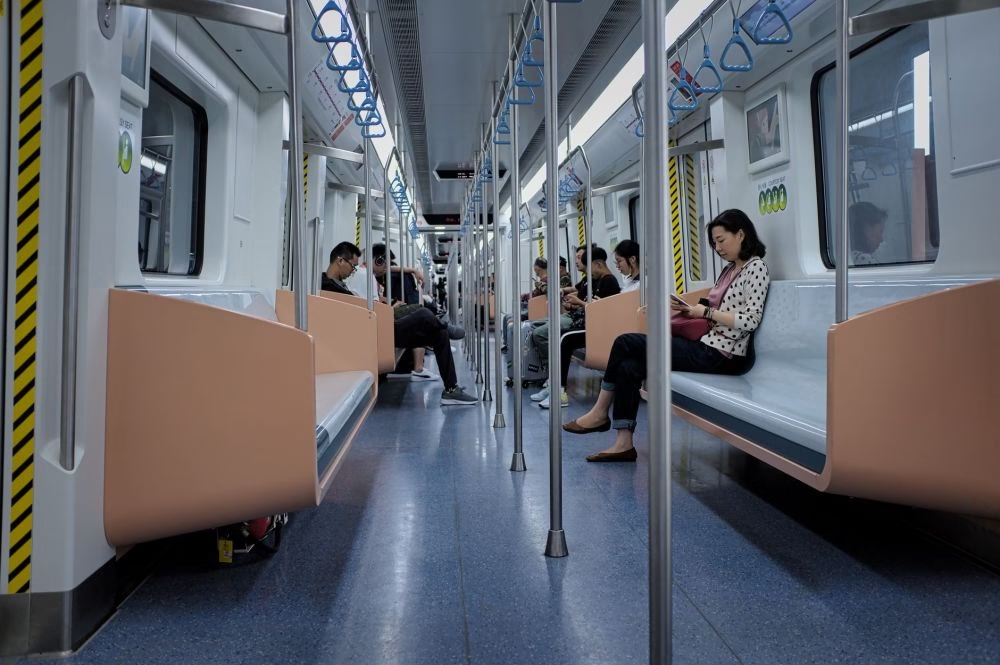
The Cross Island Line will use a new fleet of trains purpose-built for the line. LTA has confirmed the trains will be driverless, similar to the Downtown Line and Thomson-East Coast Line. The trains are being designed for higher capacity and improved accessibility features, including wider doors and better priority seating layouts. Our article on the three key features of the new Cross Island Line trains covers the design details announced so far.
Stations are being built to handle high volumes of commuters, with multiple lift access points at every station to meet accessibility standards. Given that many CRL stations will sit beneath existing HDB estates and expressways, engineering the station footprints has required significant planning around underground utilities and road diversions.
What does the CRL mean for your daily commute?
For anyone living in the estates the CRL passes through, the change will be real and measurable. Residents of Ang Mo Kio currently need to take the North South Line (NSL) into town and then transfer to get westward. With the CRL, a direct east-west route bypassing the city centre entirely becomes possible. That’s potentially 15 to 25 minutes shaved off certain commutes, depending on origin and destination.
Workers heading to Changi Business Park or the airport from the western side of Singapore face an even more dramatic improvement. Today, that journey involves the EWL to Tanah Merah, or bus connections that are slow and subject to traffic. Phase 1 creates a direct rail link to Aviation Park for the first time.
For residents of Hougang and Buangkok, connecting to the North East Line at Hougang remains useful, but the CRL gives a second option that didn’t previously exist. Two lines serving one area generally means shorter wait times, more route flexibility, and less crowding on any single line during peak hours.
What is the latest news on the Cross Island Line in 2026?
As of August 11, 2026, the CRL continues to dominate Singapore rail headlines. Beyond the SMRT operator bid and the Phase 3 confirmation, infrastructure contracts are being placed. Gaon Cable, a South Korean firm, has won the first contract for the MRT power grid project related to new line construction, as reported in early August 2026. You can read more about that in our coverage of the Gaon Cable Singapore MRT power grid contract win, which signals that physical infrastructure work for the CRL’s electrical systems is moving forward.
Construction timelines are always subject to revision, and the CRL is a complex underground project crossing beneath built-up residential and industrial areas. That said, Phase 1 has been in active construction for several years and is broadly on track for an early 2030s opening based on LTA’s most recent public statements.
How does the CRL compare to Singapore’s other MRT lines?
Singapore currently operates six MRT lines: the North South Line (NSL), East West Line (EWL), North East Line (NEL), Circle Line (CCL, now fully complete after Stage 6 opened in July 2026), Downtown Line (DTL) and Thomson-East Coast Line (TEL). The Jurong Region Line (JRL) is still being built. The CRL will be the eighth.
What makes the CRL different is its sheer span. Most existing lines follow a relatively linear corridor. The CRL deliberately crosses multiple existing lines at interchange points rather than running parallel to them. In planned length, around 50 kilometres across all three phases, it will exceed any single existing line in the network. The full Singapore MRT line overview on this site is a good reference point if you want to compare routes and coverage side by side.
The CCL was originally conceived as the connecting ring; the CRL is conceived as the connecting chord cutting through the middle of that ring. Together they’ll allow an enormous range of cross-network journeys that don’t require a trip through Raffles Place, City Hall, or Dhoby Ghaut.
Before you tap in
The Cross Island Line is still a few years away from opening, but the decisions being made now, about operators, train design, station layouts, and western extensions, will shape how millions of Singaporeans commute for decades. If you are planning around a property purchase, scoping out where to work, or just curious about what the future MRT network looks like, it pays to follow the CRL closely. For a broader view of the full Singapore rail network as it stands today, our interactive Singapore MRT map is updated as each phase and station is confirmed, so bookmark it and check back as the line takes shape.