
Gaon Cable Wins Its First Singapore MRT Power Grid Contract
Most of us only think about MRT power when the lights flicker or a train crawls between stations. But behind every smooth commute is a vast web of underground cables, substations, and electrical infrastructure that almost nobody notices until a South Korean manufacturer lands a major contract supplying it.
- Gaon Cable Wins Its First Singapore MRT Power Grid Contract
- Who Is Gaon Cable and Why Should You Care?
- How Does the MRT Power Grid Actually Work?
- What Does This Mean for the Cross Island Line?
- Singapore's MRT Reliability Push: Why Power Infrastructure Matters Most
- Key MRT Infrastructure Milestones in 2026
- What Other Infrastructure Work Is Happening Right Now?
- What's Next for Singapore's Rail Expansion?
- Before You Tap In
- FAQ
On 6 August 2026, thelec.net reported that Gaon Cable, a South Korean cable manufacturer, had secured its first MRT power grid contract here. For a country with over 200 kilometres of MRT track spread across six lines, keeping the power infrastructure modern and sufficient isn’t optional. It’s critical. Every new station, every new tunnel segment, every line extension needs dedicated power supply work. And right now, with the Cross Island Line in full construction and other projects running simultaneously, demand for qualified cable suppliers has never been higher.
Getting around Singapore? Find any station on the interactive MRT map, or save the PDF map to use offline.
Who Is Gaon Cable and Why Should You Care?
Gaon Cable is a South Korean industrial cable manufacturer with a track record supplying railway and utility projects across Asia. Winning a foothold in Singapore’s MRT power grid matters because Singapore’s Land Transport Authority (LTA) has a reputation for demanding procurement standards and thorough vendor vetting. It’s not an easy market to crack.
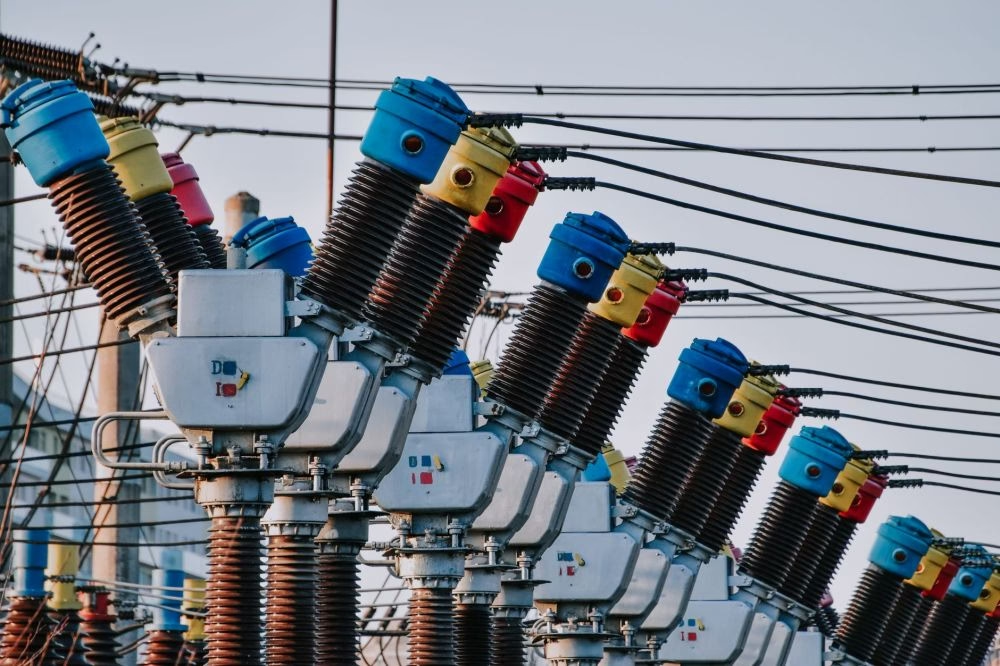
For you as a commuter, the manufacturer’s name on the cable hardly matters. What matters is what the cables actually do. MRT power cables are not the kind you find in a hardware store. These are high-voltage systems that feed traction power to the third rail or overhead lines, supply station lighting and ventilation, and back up signalling systems. Get them wrong, and train reliability suffers. Passenger safety becomes an issue.
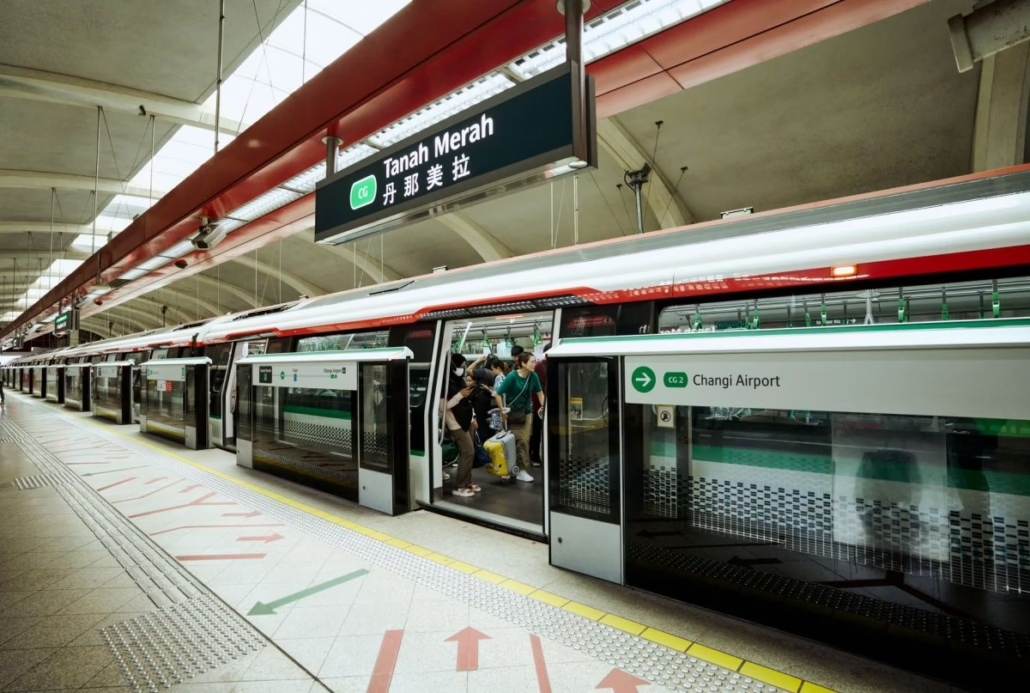
As of August 2026, Singapore’s MRT network is in one of its most active expansion phases in decades. The Cross Island Line is deep in construction. The Thomson-East Coast Line (TEL) has opened most of its stations, with Stage 5 (Bedok South and Sungei Bedok) due in the second half of 2026. Circle Line Stage 6 closed the loop just last month in July 2026. Each new kilometre of tunnel and each new station requires its own dedicated power infrastructure. That is a lot of cable to procure and install.
How Does the MRT Power Grid Actually Work?
Singapore’s MRT runs on a traction power system that draws electricity from the national grid and steps it down through dedicated substations before feeding power to the trains. On most lines, trains get their power through a third rail at ground level inside the tunnel, running at around 750 volts DC. Newer lines, including sections of the TEL and the upcoming CRL, use more modern, energy-efficient power supply configurations that are easier to maintain.
Every station and tunnel segment has its own power supply requirements. Escalators, lifts, platform screen doors, signalling equipment, air-conditioning in underground stations, and emergency lighting all draw from dedicated electrical circuits. A cable fault in any one of these systems can cascade quickly if redundancy is designed poorly. That’s precisely why LTA specifies cables with such care, and why landing such a contract is a credible engineering credential for any supplier.
The exact scope of Gaon Cable’s initial contract hasn’t been publicly itemised by LTA. What is clear is that Singapore is actively bringing in qualified international suppliers to handle the sheer procurement volume across multiple simultaneous rail projects.
What Does This Mean for the Cross Island Line?
The Cross Island Line is almost certainly the primary beneficiary of new power grid contracts being awarded right now. When fully complete, the CRL will be Singapore’s longest MRT line at around 50 kilometres, stretching from Changi in the east through to Jurong in the west. Phase 1, covering stations from Aviation Park to Bright Hill, is targeting an opening in the early 2030s.
As we covered in our earlier piece on the new Cross Island Line trains, the CRL is being built to the latest specifications with features that place significant demands on electrical supply systems. The trains themselves are designed for higher energy efficiency. But that only works if the traction power network feeding them is equally well-engineered.
Just a day before the Gaon Cable news broke, on 5 August 2026, the Straits Times reported that SMRT has teamed up with a Chinese rail operator to bid for the CRL operating contract. You can read the full story in our article on SMRT’s joint bid for the CRL. The power infrastructure contracts and the operator bidding process are separate, but they’re happening in parallel. It’s a sign of how much groundwork is being laid all at once right now.
Singapore’s MRT Reliability Push: Why Power Infrastructure Matters Most
There’s a direct line between power grid quality and the reliability numbers that actually matter to commuters. On 5 August 2026, SMRT announced that its trains had achieved stronger reliability and financial performance, with mean kilometres between failures figures placing Singapore among the world’s top-performing metro systems for three consecutive months. SMRT has also been rolling out AI-enabled maintenance systems to predict faults before they happen, as we detailed in our piece on Singapore using AI on the metro network.
But no amount of predictive AI can save you from degraded cable insulation or an undersized power substation. The physical infrastructure has to be solid first. That’s why contracts like Gaon Cable’s matter to you, even if the connection isn’t obvious when you tap in at Bishan or alight at Raffles Place.
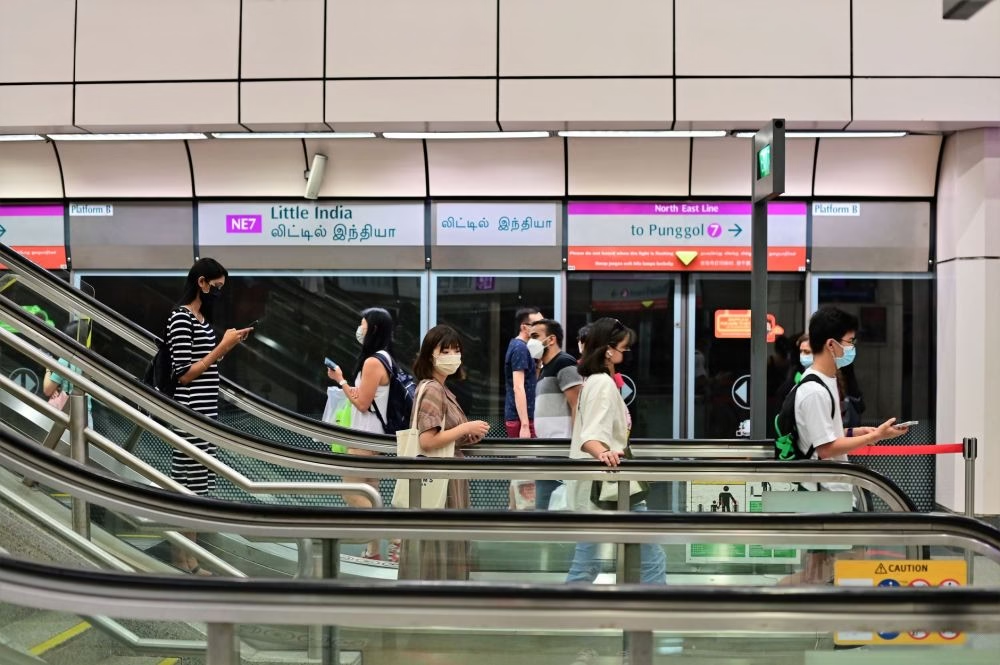
The current run of high reliability has taken years to build, through incremental upgrades to rolling stock, signalling, and power supply systems. Replacing ageing cables, upgrading substations, and installing redundant power feeds across the existing network has been a quiet but sustained programme running alongside the headline-grabbing new line openings.
Key MRT Infrastructure Milestones in 2026
| Development | Date | Significance |
|---|---|---|
| Gaon Cable wins first MRT power grid contract | 6 Aug 2026 | South Korean supplier enters Singapore rail supply chain |
| SMRT records third consecutive month above 2 million train-km MKBF | Aug 2026 | Reliability at record levels across the network |
| Circle Line Stage 6 (CCL6) opens, closing the loop | Jul 2026 | New stations require dedicated power supply connections |
| Cross Island Line trains testing on track confirmed by LTA | 31 Jul 2026 | Live train testing requires energised traction power systems |
| SMRT-Chinese operator joint bid for CRL operations submitted | 5 Aug 2026 | Operator selection proceeding in parallel with infrastructure build |
What Other Infrastructure Work Is Happening Right Now?
Power cables are just one part of a much larger picture of infrastructure work happening across Singapore’s rail network in 2026. The LTA confirmed on 31 July 2026 that Cross Island Line trains are already testing on track, which means live traction power is flowing through sections of the new line. That’s a solid sign of how far construction has progressed.
Technology upgrades are also happening at the station level. A facial recognition fare payment trial is currently running at Punggol Coast MRT, as we covered in detail in our piece on the Punggol Coast facial recognition trial. These smart gantry systems have their own dedicated power and data infrastructure requirements, adding yet another layer to the grid demands that suppliers like Gaon Cable are helping to meet.
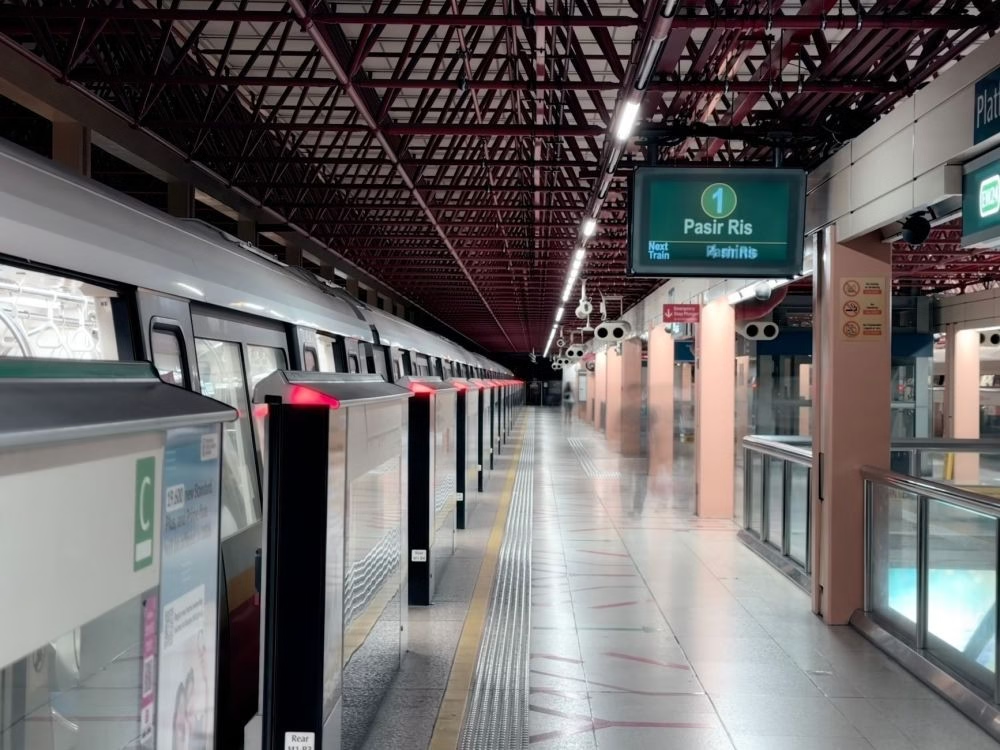
Right now, across the entire MRT network, you’re looking at simultaneous expansion and modernisation. New lines being built, existing lines being upgraded, smart technologies being layered on top. Every single one of those workstreams eventually touches the power grid.
What’s Next for Singapore’s Rail Expansion?
Gaon Cable’s contract win signals that Singapore continues to attract competitive international bids for rail infrastructure work. That competition is good news for the public purse and for quality standards. When multiple qualified suppliers are bidding for power cable contracts, LTA has both pricing leverage and a higher floor on technical specifications.
Singapore’s approach to rail procurement has generally favoured international open tendering, which is why you see components from South Korea, Japan, Germany, and China across the network. The full MRT station network now stretches across more than 130 stations as of 2026, with dozens more to come on the CRL alone. That pipeline of infrastructure work will sustain contractor and supplier interest for the better part of a decade.
SMRT’s push for AI-enabled predictive maintenance, as reported by Global Railway Review on 6 August 2026, also points toward a future where the power grid itself becomes smarter. Sensors embedded in cable runs and substations can flag thermal anomalies or voltage irregularities before they become faults. The cables Gaon Cable is supplying today may eventually be the ones that AI systems monitor in real time a few years from now.
Before You Tap In
Gaon Cable’s first Singapore MRT power grid contract is the kind of news that quietly shapes the commutes of millions without ever appearing on the departure board. The investment going into Singapore’s rail power infrastructure right now, driven by the Cross Island Line build and wider network modernisation, is substantial and happening across multiple fronts at once. Keep an eye on our MRT news blog for the latest updates as more infrastructure and operator contracts are awarded in the coming months.