North East Line (Purple Line MRT)
HarbourFront to Punggol
View the North East Line map in full screen at Google
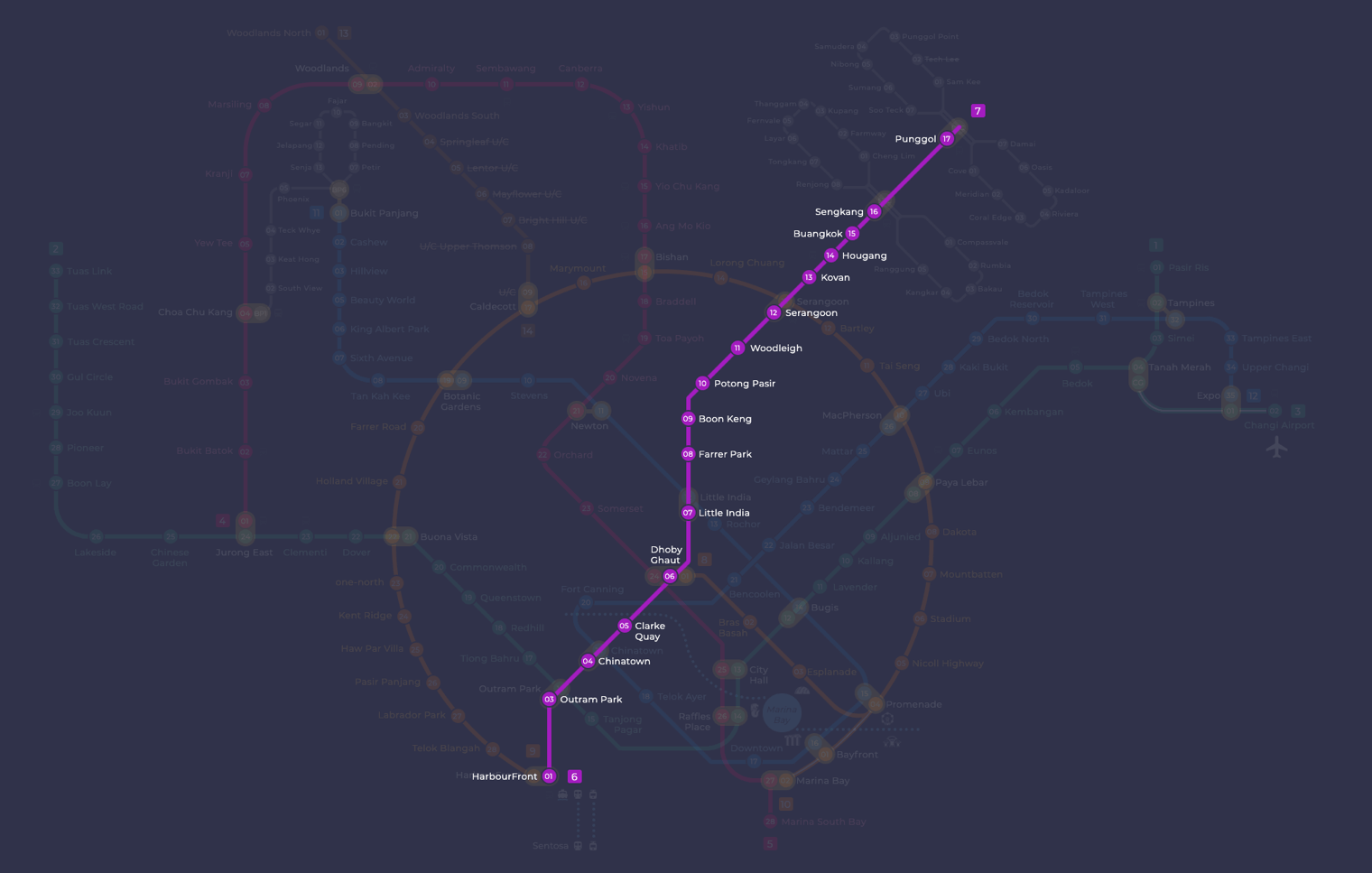
Highlighted North East Line map

Last updated . Facts checked against LTA announcements.
View the North East Line map in full screen at Google
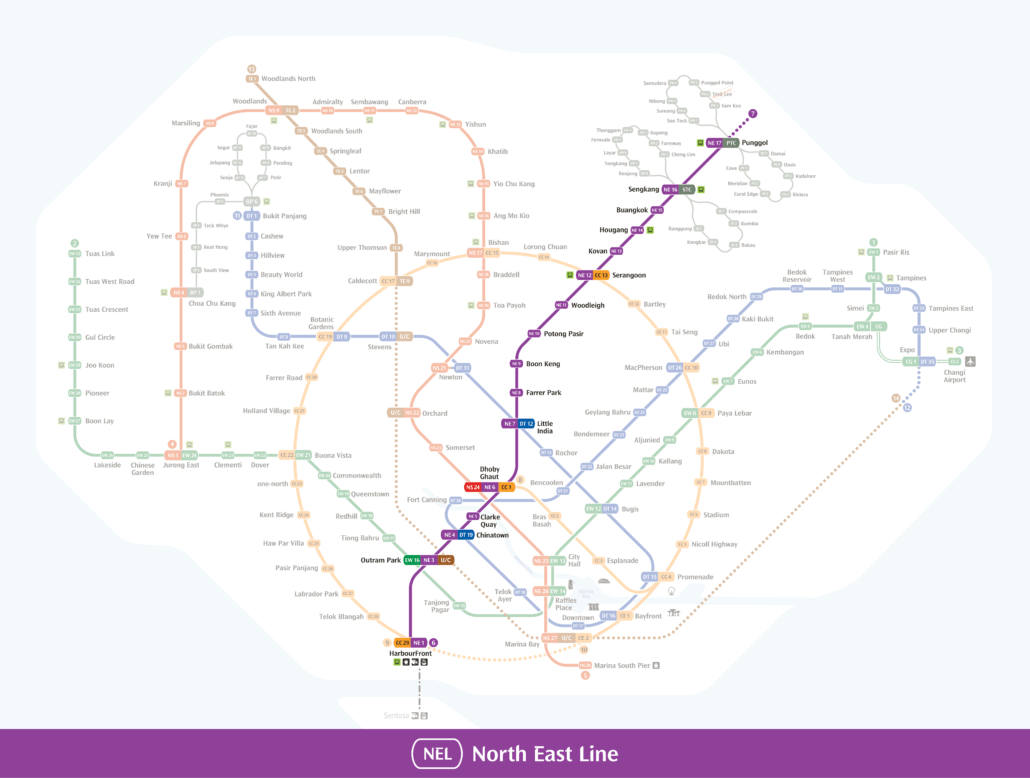
The North East Line (NEL) is one of Singapore’s busiest MRT lines, running through dense residential towns and key city destinations. It is operated by SBS Transit and colour-coded purple on the network map.
The NEL runs from HarbourFront in the south-west to Punggol Coast in the north-east, covering about 20 kilometres across 17 stations. Along the way it crosses several other MRT lines, making transfers between different parts of the network straightforward.
Some of the more notable stations along the route:
The route map below shows the full line, including all stations and interchange points.
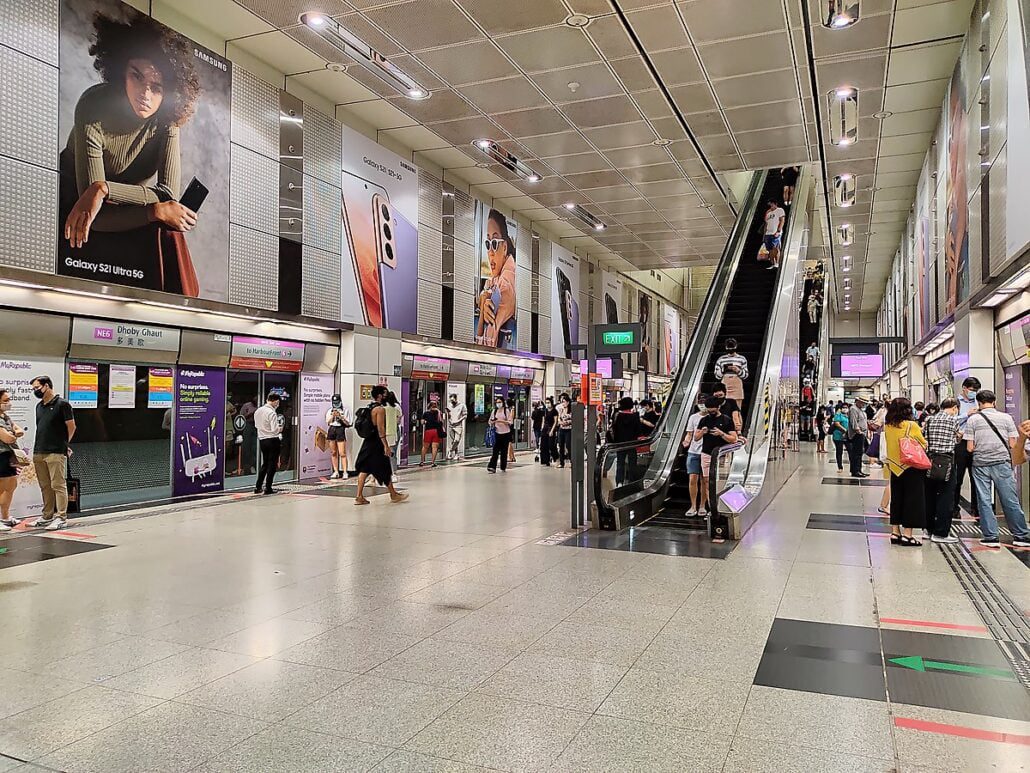
Taking the NEL means skipping road traffic entirely. The line connects major residential towns in the north-east with commercial and entertainment areas in the city centre, making it a practical choice for daily commuters, students and anyone passing through.
The NEL runs fully underground, which keeps it fast and reliable regardless of surface conditions. For the communities along its corridor, it is often the quickest way in and out of the city.
The line links several interchange stations where you can switch to other lines, making it a useful part of any cross-town journey. Knowing where those interchanges sit will help you plan your trips more efficiently.
The NEL map gives you a clear picture of the full route, from HarbourFront in the south to Punggol Coast in the north-east, including all 17 stations and interchange points. A quick look will tell you where to board, where to change lines and how many stops you need to go.
The NEL map is straightforward once you know what to look for. Here are the key things to understand before you travel.
Once you are comfortable reading the map, planning your journey is simple. Follow these steps.
| Station | Interchange/ Connections |
|---|---|
| HarborFront | North-East Line, Circle Line |
| Outram Park | North-East Line, East-West Line, Downtown Line |
| Chinatown | North-East Line, Downtown Line |
| Clarke Quay | North-East Line |
| Dhoby Ghaut | North-East Line, North-South Line, Circle Line |
| Little India | North-East Line, Downtown Line |
| Potong Pasir | North-East Line |
| Woodleigh | North-East Line |
| Serangoon | North-East Line, North-East Line Extension (Punggol) |
| Ang Mo Kio | North-East Line |
Table: Notable Stations on the North East Line (NEL)
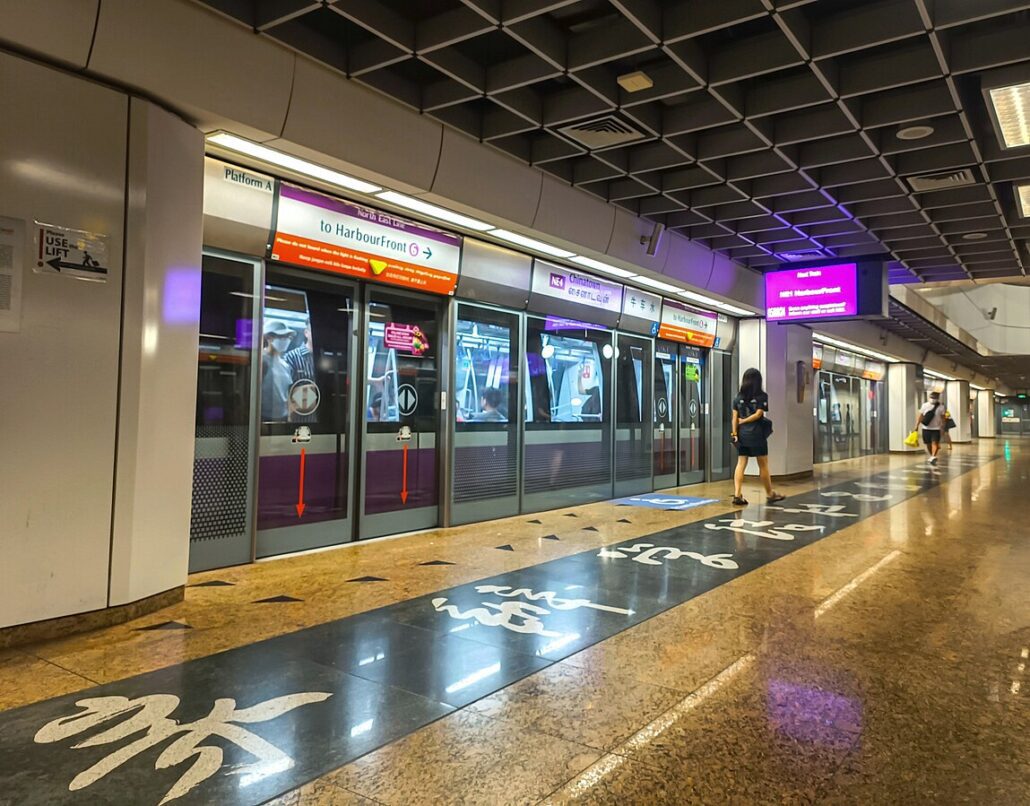
Knowing when trains run and how frequently they come makes planning your journey on the North East Line much easier. The NEL operates early morning through to past midnight, so there is coverage for most travel needs across the day.
Here is a summary timetable of NEL train timings:
| Timings | Weekdays | Weekends and Public Holidays |
|---|---|---|
| First Train | 5:30 AM | 5:30 AM |
| The Last Train from HarbourFront | 12:10 AM | 11:40 PM |
| Last Train from Punggol | 11:43 PM | 11:11 PM |
| Intervals Between Trains | 5-8 minutes | 5-10 minutes |
The times shown are a general guide. Schedules can shift slightly due to maintenance or unexpected disruptions, so check the SBS Transit website or the official train operator app before you head out, especially if you are catching a first or last train.
Train frequency on the NEL is generally good. During weekday peaks, trains come every 2 to 3 minutes. Off-peak and at weekends, expect a wait of around 4 to 7 minutes. Either way, waits are rarely long.
If you are travelling late or very early, it is worth double-checking the last train times for your specific station, particularly from interchange stations like HarbourFront or Dhoby Ghaut where transfer options may affect your plans. Timings can also change during planned engineering works, usually overnight on weekends.
Each station along the North East Line sits in its own distinct neighbourhood, with different things to eat, see and do nearby. Here is a look at some of the more notable stops on the route.
Dhoby Ghaut is an underground interchange connecting the North East Line with the North South Line and the Circle Line, making it one of the busier transfer points on the network. The area around the station has plenty to keep you occupied, with Plaza Singapura and The Cathay for shopping, and the Singapore Art Museum and National Museum of Singapore within walking distance.
Step off at Little India and you are straight into one of Singapore’s most lively ethnic enclaves. The Sri Veeramakaliamman Temple is nearby, and the surrounding streets are packed with shops and eateries serving Indian cuisine, from banana leaf rice to freshly made roti prata.
Chinatown MRT Station puts you right in the middle of one of Singapore’s most historically rich districts. Wander the shophouse-lined streets, visit the Buddha Tooth Relic Temple, or grab a meal at Maxwell Food Centre, which is just a short walk away.
Serangoon is an interchange station linking the North East Line to the Circle Line, so it is a useful connection point if you are heading across town. The surrounding area is well known for its food scene, with Chomp Chomp Food Centre and Serangoon Garden Market and Food Centre both a short distance away.
Punggol MRT Station is the northern terminus of the NEL and gives you easy access to the Punggol waterfront area. You can walk or cycle along Punggol Waterway Park, or find a spot at one of the al-fresco restaurants nearby.
The North East Line was planned by the Land Transport Authority as a key part of Singapore’s expanding rail network. The idea took shape in the early 1990s, with construction beginning in 1997.
The full line opened on 20 June 2003, just under six years after construction started. It connected parts of the island that had limited rail access before, linking the south of Singapore to the growing towns in the north-east.
The NEL runs about 20.2 km and serves 17 stations, from HarbourFront in the south up to Punggol Coast in the north. It passes through a mix of residential estates, commercial areas and cultural districts.
Each station has its own character, with distinctive architecture and artworks that draw on local heritage. The line also helped accelerate development in several neighbourhoods along its route.
More than two decades since opening, the North East Line carries millions of journeys every year and remains a core part of Singapore’s rail network.
Fares on the NEL are distance-based, so what you pay depends on how far you travel. You can plan ahead using the fare calculator on the official SBS Transit or LTA journey planner websites: enter your start and end stations and you will get an estimate.
Each journey is priced according to the distance between your boarding and alighting stations. The further you travel, the higher the fare, calculated in distance-based increments across the network.
Work out your fare before you travel using the official fare calculator. Select your origin and destination stations and it will return an estimated fare for that journey.
The NEL accepts several ways to pay, so you can choose what suits your trip.
Fares can change, so check the TransitLink website or ask at any station for the latest information.
The NEL is a core part of Singapore’s rail network, carrying hundreds of thousands of commuters every day between the north-east and the city centre. The line has grown steadily since it opened, and its most recent addition, Punggol Coast (NE18), opened on 10 December 2024, bringing the total to 17 stations from HarbourFront to Punggol Coast.
The NEL runs from HarbourFront in the south to Punggol Coast in the north, serving a mix of residential towns, commercial areas and leisure destinations along the way. The 17 stations are listed below.
| Station | Interchange |
|---|---|
| HarbourFront | North East Line, Circle Line |
| Outram Park | North East Line, East West Line |
| Chinatown | North East Line, Downtown Line |
| Clarke Quay | North East Line |
| Dhoby Ghaut | North East Line, North South Line, Circle Line |
| Little India | North East Line, Downtown Line |
| Potong Pasir | North East Line |
| Woodleigh | North East Line |
| Serangoon | North East Line, Circle Line |
| Kovan | North East Line |
| Hougang | North East Line |
| Buangkok | North East Line |
| Sengkang | North East Line |
| Punggol | North East Line |
The NEL connects with several other MRT and LRT lines, so most journeys across Singapore involve at most one interchange. You can change to the North South, East West, Circle, Downtown and Thomson-East Coast lines at various points along the route.
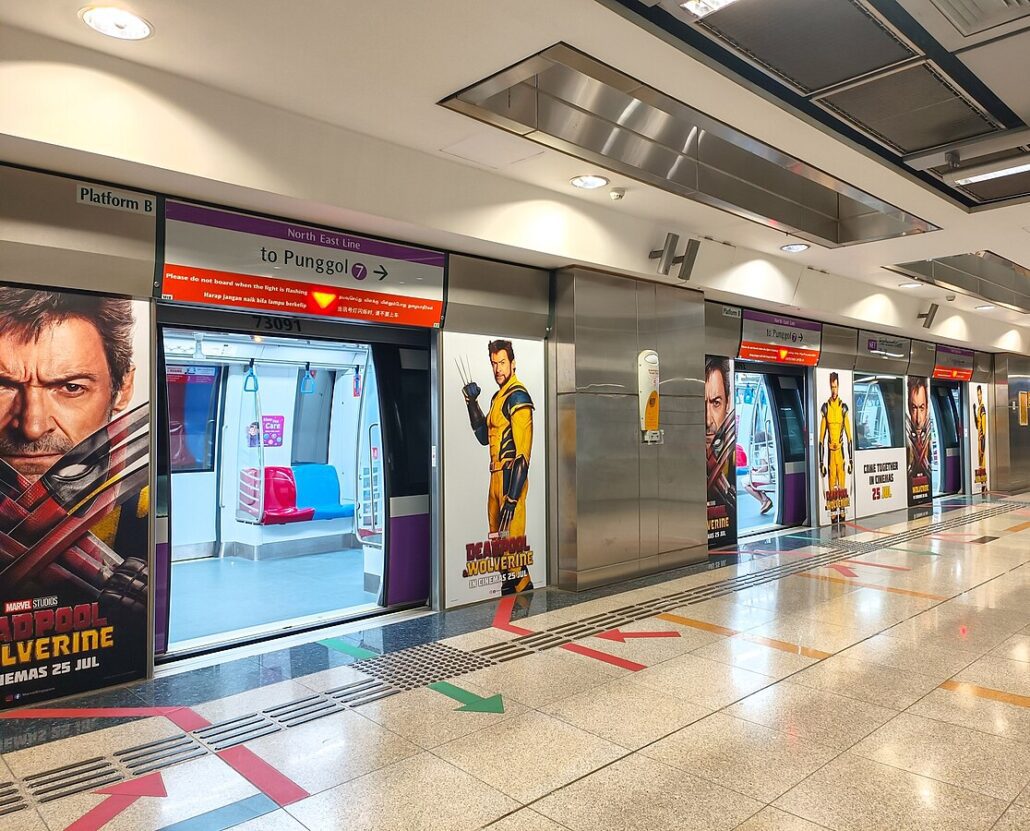
The North East Line gained one more station on 10 December 2024, when Punggol Coast (NE18) opened as the new northern terminus. It serves the Punggol Digital District and the Singapore Institute of Technology campus. The line now covers 17 stations from HarbourFront to Punggol Coast.
No further NEL extensions have been announced. Punggol will gain an additional rail connection when the Cross Island Line Punggol extension opens, currently targeted for 2032.
Service disruptions on the NEL are rare but do happen. When they do, station staff will be on hand to direct you, and announcements will keep you informed of what to do next. If you are ever asked to evacuate a train or station, follow the crew’s instructions and stay calm.
For real-time updates, check the Land Transport Authority (LTA) website or their social media channels. They post advisories on delays, alternative travel options and estimated recovery times as situations develop.
The MyTransport.SG app is also worth having on your phone. It shows live train timings and flags any active disruptions across the network, so you can adjust your route before you leave.
If you are travelling during peak hours or on public holidays, build a little extra time into your journey. Planned maintenance work occasionally causes short delays, and trains are busier, so allow yourself some buffer.
Keeping an eye on NEL service updates before you travel means you are rarely caught off guard.
| Date | Incident | Affected Stations | Updates |
|---|---|---|---|
| August 10, 2022 | Signal Failure | Sengkang to Punggol | Bus bridging is in effect. Engineers fixing the problem Expected reactivation time: 3 hours. |
| September 5, 2022 | Track Maintenance | Hougang to Dhoby Ghaut | The trains will run with greater gaps between them. Deployed more shuttle buses. The maintenance works are anticipated to conclude on 12th September 2022. |
| November 20, 2022 | Power Failure | Potong Pasir to Serangoon | Temporarily no train service. Regular and bridging bus services are provided freely. |
The North East Line runs from HarbourFront in the south to Punggol Coast in the northeast, covering 17 stations along the way. It links residential towns like Hougang and Sengkang directly to city-centre interchanges, which makes it a practical choice for daily commuters.
The line connects well with the rest of the network, including the Circle Line, Downtown Line, Thomson-East Coast Line and North South Line at various interchange stations. If you need to get across the city from the northeast, the NEL is usually your quickest option.
Operated by SBS Transit, the NEL has a solid reputation for reliability. Whether you are heading to work, going home, or exploring a part of Singapore you have not been to before, it is a dependable line to be on.
The North East Line is the purple line on the Singapore MRT map. It runs 17 stations from HarbourFront, the gateway to Sentosa, up through Chinatown, Little India and Serangoon to Punggol and Punggol Coast. It was the first fully driverless heavy rail line in the world when it opened in 2003, and it is operated by SBS Transit rather than SMRT, which is why its signs and announcements look a little different from the red and green lines. Station codes start with NE.
The purple line is the North East Line (NEL), with station codes NE1 HarbourFront to NE18 Punggol Coast. It is run by SBS Transit and is fully automated.
The North East Line is operated by SBS Transit. SBS Transit also runs the Downtown Line and the Sengkang and Punggol LRT networks.
The North East Line has 17 stations, running from HarbourFront (NE1) in the south-west to Punggol Coast (NE18) in the north-east. Punggol Coast, the newest station, opened on 10 December 2024.
Punggol Coast (NE18) opened on 10 December 2024, extending the North East Line beyond Punggol and making it the current northern terminus of the line.
You can pay with an EZ-Link or SimplyGo card, a contactless bank card, or a mobile wallet. Visitors can also use the Singapore Tourist Pass, which covers unlimited rides on the MRT and bus network.
At HarbourFront you can transfer between the North East Line (NE1) and the Circle Line (CC29). With the Circle Line now a full loop since July 2026, HarbourFront connects you to stations all the way around to Marina Bay.
Want the whole route on one page? Open the North East Line map to see every station and interchange along the line.