Welcome to the Ultimate Singapore MRT Map (2026 Edition)
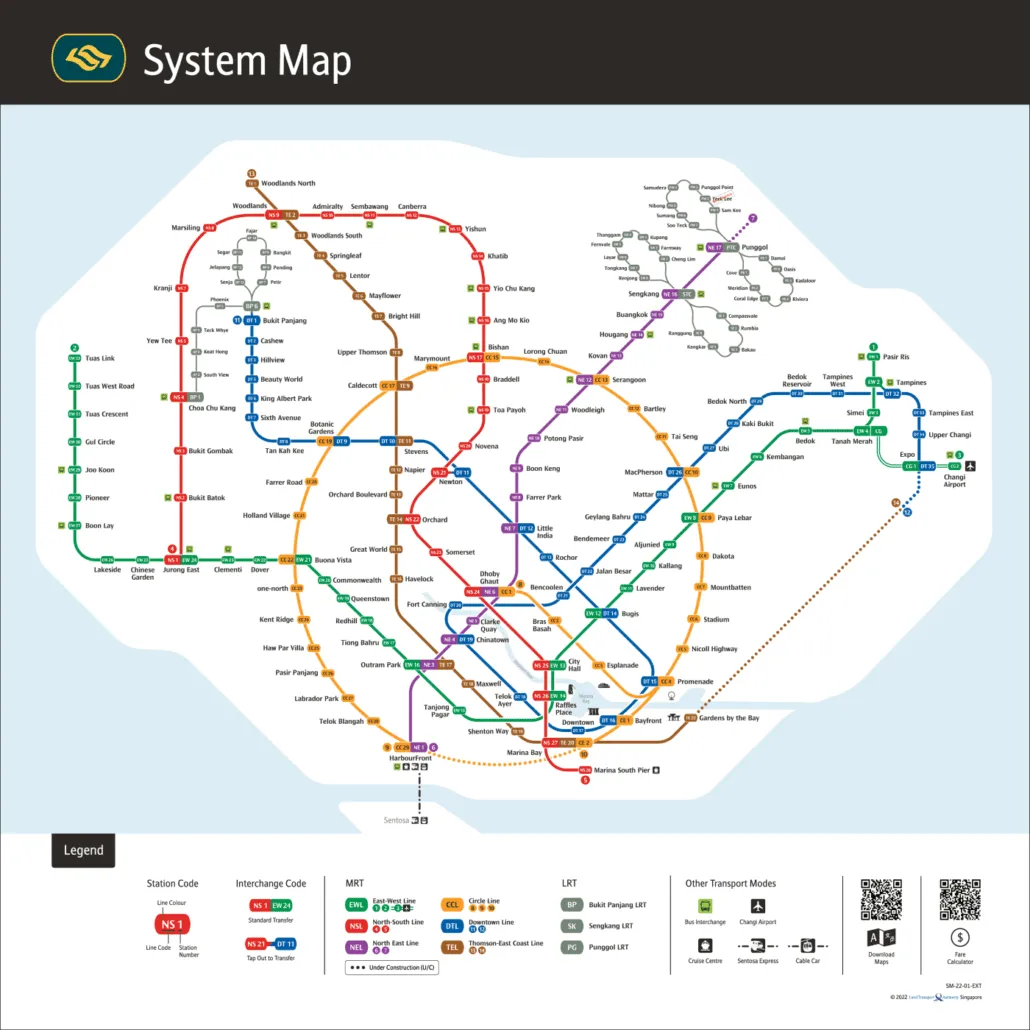
Navigating the Lion City has never been easier. Whether you are a daily commuter or a tourist exploring for the first time, our interactive 2026 Singapore MRT and LRT map is your ultimate transit guide. Fully updated to reflect the latest Land Transport Authority (LTA) network expansions—including the newest Thomson-East Coast Line (TEL) stations and the completed Circle Line loop—this map helps you find the fastest route to your destination.
Pro Tip: Bookmark this page or download our high-resolution
Singapore MRT Map PDF
for offline use while traveling underground!
The Singapore Land Transport Authority’s (LTA) website hosts official maps in multiple languages, available for download as PDFs. You can explore various metro maps, including the Metro Map for Washington, D.C., the Stockholm Metro Map in Sweden, or the renowned London Underground tube map. The Singapore Land Transport Authority (LTA) website offers official maps in multiple languages, which are available for download in PDF format..
Other Types of Transportation on the SMRT Map
All other transport alternatives are displayed on the MRT map for public transportation and taxi services in Singapore
directions_bus Bus Services
The MRT trains provide convenient transportation to all regions of the island and encompass the majority of Singapore.
Changing from underground trains to green-coloured public buses at the interchange stations, which are indicated on the map by green bus markers, is a straightforward process if you require transportation to other, more specific locations.
tramCable Car
The 15-minute trip and breathtaking views of the Keppel Harbour region can be combined with the Singapore Cable Car, the ideal mode of transportation for tourists. It is the perfect transportation method for tourists.
directions_boatFerries
You can change to the Ferries at the HarbourFront MRT station to travel by ocean routes.
The Harbourfront Center and the Singapore Cruise Centre are located here, and ferries depart from both of them to the numerous nearby islands as well as other nearby locations in Malaysia and Indonesia.
local_taxiTaxi Services
In Singapore, there are numerous taxi services to choose from. Use Grab, Southeast Asia’s equivalent of Uber. SMRT Taxi is another excellent local taxi choice for getting around quickly.
directions_subwaySentosa Express
Take the Sentosa Express monorail from the Singapore mainland to Sentosa Island to reach Universal Studios Singapore and its stunning beaches.
For transportation on the island besides the monorail, there are the orange Sentosa buses and the Beach Shuttle. More details are available at: sentosa.com.sg
flightChangi Airport
The Changi Airport is a destination in and of itself. If you are going or departing from Singapore, you should plan to visit the magnificent gardens and other sights.
Mrt Map Singapore
Sights around Marina Bay
Easy access to Marina Bay and Singapore’s famous landmarks is provided by four of the six MRT lines. A few years from now, this area will also be traversed by the Thomson East Coast line.
See the amazing city sunsets and nighttime skyline by visiting the Marina Bay Sands’ sky bar and restaurant Ce La Vie, even if you are not staying there.
Marina Bay Sands is instantly connected to the Bayfront Station on the Circle Line and Downtown Line of the Mass Rapid Transit rail system.
The best place to get a bird’s eye perspective of Singapore is from the enormous observation wheel by the river. The nearest MRT station is Promenade, which is reachable by the Downtown Line and the Circle Line.
There are other entertaining things at the place besides the observation wheel.
The Merlion
Just a short walk from the Raffles Place MRT station, the Merlion Park seashore in Fullerton boasts Singapore’s most iconic monument.
Remember also stopping by or booking a night at the famous Fullerton Hotel, a stunning 1928 neoclassical landmark near the Merlion.
Bayside Gardens
An incredible 250-acre nature park in the middle of the Bay Area, with many gardens and the world-famous Supertree Grove Trees is an absolute must-see for any visitor to this extraordinary city-state.
Be sure to see the Flower Dome and Cloud Forest, two spacious conservatories.
Bay Area Theaters
Also known as Esplanade. “Step into our vibrant performing arts centre, where creativity knows no bounds. Immerse yourself in a world of artistic wonders that will inspire, enchant, and move you in ways you never thought possible.”
Your nearest MRT stations are Esplanade on the Circle Line and City Hall on the North-South or East-West lines.
River & Marina Bay
The blue dots on the MRT map that link to the blue Marina Bay circle represent the Singapore River.
The river is perfect for cruises to view landmarks and other sites. Or travel to your destination in style by taking a leisurely river taxi and avoiding gridlock on the highways.
About Singapore’s MRT map
What led to the creation of Singapore’s Mass Rapid Transit (MRT) system, and what does its future hold? Now, let’s explore some fascinating information regarding the network as a whole and the SMRT map in particular.
The MRT’s inception dates back to the early 1980s. On November 7, 1987, the first segment of the MRT, a portion of the red North-South line, began operating. This leg covered a distance of six kilometers, or around 3.7 miles, and included five stations. Twenty more stations were built by the end of 1988, and the first plan was completed two years ahead of schedule on July 6, 1990, with the opening of the Boon Lay station on the East-West line.
East-to-west and north-to-south were the two main routes shown on Singapore’s first MRT map. Before the Woodlands Extension was opened in 1996, there was another branch line connecting Jurong East and Choa Chu Kang. After that, it united with the North-South line.
The MRT system in Singapore is a remarkable achievement with a long history that continues to reshape the city’s transportation landscape. These facts provide an overview of the system.
Would you like to learn more about Singapore’s MRT system? We recommend seeing this insightful video. Watch this educational video on “The World’s Most Innovative Metro System” on YouTube, produced by the RMTransit channel. It’s an excellent approach to discovering more about this state-of-the-art transportation system.
Two public transit operators share the MRT system in Singapore. SBS Transit (SBS) and SMRT Corporation Ltd. (SMRT). During the same operational hours, the system is always in operation, including on weekends, from 5:30 am to midnight.
During peak hours, trains depart every two to three minutes; during off-peak hours, every five to seven minutes.
Train service between Woodlands North and South on the Thomson-East Coast Line will terminate early every day, Monday through Sunday, at 9:00 pm. On weekends (Saturday and Sunday), services will start 1 hour later, at 6.30 am.
Singapore MRT Lines
Six lines and more than 120 stations make up the lines, which have a combined length of more than 200 kilometers (124 miles). By 2040, it is anticipated that the MRT lines will have doubled in length, reaching a total of close to 400 kilometers (about 250 miles). The present six lines will be increased by three new lines to achieve this.
Singapore’s MRT is the most costly, congested, well-established, and longest-running MRT system in Southeast Asia when all of its lines are combined. In addition, it is well known for having the longest stretch of fully automated railway lines with driverless trains in the entire globe.
Travelers can find it easier to navigate Singapore’s MRT stations by using codes in addition to names, which are based on the line names and the stations’ locations on a map for that specific line and itinerary. Finding stations where you can change trains and move to another MRT or LRT line is also made easier by the interchange codes. (The codes are explained on this page higher up.)
Most visitors and Singaporeans usually know the name of the station they need to visit. They may not know, though, that a few of the station names have interesting histories and origins that explain why they are called what they are now. For example, the Dakota Station on the Circle Line was named after the many commercial Dakota DC-3 aircraft operating in the Dakota region. If you’re interested, locomole.com has an article about these stations.
The fact that most of the underground stations are strong, sufficiently deep to serve as bomb shelters, and built to withstand aerial bombing strikes is another amazing feature of the stations.
Tickets, fares, and services
Tickets for MRT fares can be purchased using a few different methods. Tickets are easily obtained at all stations via the General Ticketing Machines (GTM) with a Visa or MasterCard.
Another option for tourists is the Singapore Tourist Pass, a special EZ-Link stored value card. You can purchase the card for 1, 2, or 3 days, and during that period you can use the MRT and other public transit as often as you’d like. There is also the equivalent NETS FlashPay card, which may be used for both travel and shopping.
There are additional smartphone app service options available for your Android and iPhone devices. One option is SimplyGo. In addition, transit information is available through the SMRTConnect app for both Android and iPhone.
See the Singapore Tourism Board’s homepage for information on transportation in Singapore. You may find helpful step-by-step instructions on YouTube for purchasing MRT tickets, as well as advice on navigating the system.
When exploring the vibrant city of Singapore, navigating its efficient and extensive transportation network is a breeze with the Singapore MRT map. The Singapore Mass Rapid Transit (MRT) system is renowned for its punctuality and accessibility, making it the preferred choice for both locals and tourists. The MRT Map Singapore showcases an intricate web of train lines that connect key destinations, ensuring that you can effortlessly reach popular attractions, business districts, shopping centers, and more. With its user-friendly layout and clear color-coded lines, the MRT map simplifies your travel experience, allowing you to plan your routes with ease. Whether you’re looking to savor the cultural delights of Chinatown, indulge in shopping sprees on Orchard Road, or immerse yourself in the lush greenery of the Singapore Botanic Gardens, the MRT map serves as your trusty guide. Beyond its practicality, the MRT system also offers a glimpse into the city’s commitment to cutting-edge urban development. So, hop aboard the Singapore MRT, and let the well-designed MRT map be your ticket to discovering the captivating wonders of this cosmopolitan metropolis. Experience the convenience, efficiency, and connectivity that the Singapore MRT map brings, ensuring a seamless journey as you uncover the treasures of this remarkable city. For sharing info, check out our Privacy Policy
Singapore’s Mass Rapid Transit (MRT) system is globally recognized as a benchmark for public transit efficiency, cleanliness, and connectivity. As the island nation continues to grow, the Singapore MRT Map 2026 reflects one of the most sophisticated, fully integrated rail networks in the world.
Whether you are a daily commuter traveling to the Central Business District (CBD) or a tourist heading to Marina Bay, understanding this dynamic network transforms how you navigate the Lion City.
Source Wikipedia
I. The Evolution of Singapore’s Transit Network
The 2026 Singapore MRT map is the result of decades of visionary urban planning by the Land Transport Authority (LTA). From its humble origins in 1987 with just five stations, the system has evolved into a sprawling, multi-line network. The 2026 map highlights the most recent mega-infrastructure milestones, including the completion of the Thomson-East Coast Line (TEL) and the highly anticipated Circle Line (CCL) Loop, bridging the final gap between HarbourFront and Marina Bay.
II. Core Advantages of the Singapore MRT
Why do millions of residents and international visitors rely on the MRT daily? The advantages extend far beyond mere convenience:
Unmatched Accessibility: With stations strategically located across residential heartlands, shopping districts, and commercial hubs, the MRT ensures the city is entirely barrier-free and highly accessible for both locals and tourists.
Beating the Traffic: Singapore’s proactive approach to public transit drastically reduces road congestion, allowing commuters to bypass expressway traffic jams during peak hours.
Cost-Effective Travel: With distance-based fare calculations, the MRT remains one of the most affordable public transport networks in the developed world.
Championing Sustainability: As a cornerstone of the Singapore Green Plan 2030, the electrified MRT network drastically reduces the city’s carbon footprint, offering an eco-friendly alternative to private vehicles.
III. Seamless Multi-Modal Integration
The 2026 MRT Map is not just about trains; it represents a holistic transit ecosystem. The map visually details seamless integration with Light Rail Transit (LRT) networks in neighborhoods such as Bukit Panjang, Sengkang, and Punggol, as well as perfectly timed connections to major bus interchanges. This multi-modal approach ensures true “first-mile, last-mile” connectivity.
IV. Smart Tech & The Commuter Experience
In 2026, the MRT experience is powered by cutting-edge smart city technology:
The SimplyGo Revolution: Traditional ticketing is a thing of the past. Commuters simply tap in and out at the fare gantries using contactless Visa, Mastercard, NETS, or mobile wallets like Apple Pay and Google Pay.
Real-Time Digital Alerts: Through the official MyTransport.At the SG app and interactive station screens, passengers receive live updates on train arrivals, platform crowding levels, and predictive maintenance alerts.
Inclusive Design: Tactile guidance routes, widened fare gates, and priority cabin spaces ensure that differently-abled commuters, seniors, and parents with strollers can travel with absolute ease.
V. Economic Impact and Urban Growth
The MRT system does more than move people; it drives Singapore’s economy. Transit-Oriented Developments (TOD),where shopping malls, offices, and residences are built directly above or connected to MRT stations (such as Paya Lebar Quarter and Jurong East), boost local businesses’ exposure. Furthermore, the continuous expansion, maintenance, and operation of the network creates thousands of sustainable jobs.
VI. Challenges, Solutions, and the Future
Operating a world-class transit system comes with its hurdles, but Singapore tackles them with innovation:
Managing Peak Hour Crowds: To combat overcrowding, the LTA continuously upgrades signaling systems to enable trains to run at higher frequencies (every 2-3 minutes) during morning and evening rush hours.
Looking Ahead: Even in 2026, the LTA is building for the future. The upcoming Cross Island Line (CRL) and Jurong Region Line (JRL) are already highly anticipated, promising to further decentralize the urban core and connect emerging industrial and residential zones.
Decoding the Visual Language of the SMRT & SBS Transit Map
For a newcomer, the sprawling web of the MRT map might look intimidating. But behind the vivid colors and intersecting lines is a masterpiece of user experience design.
The map is a unified point of reference. Every color represents a distinct artery of the city: the vibrant Red of the North-South Line, the vital Green of the East-West Line, and the scenic Brown of the newer Thomson-East Coast Line.
VIII. Overcoming Transit Challenges with Smart Innovation
Operating one of the world’s busiest rail networks naturally presents logistical hurdles, but the Land Transport Authority (LTA) and operators like SMRT and SBS Transit tackle them with cutting-edge technology:
Managing Peak-Hour Crowding: To ease congestion during morning and evening rush hours, the network has been extensively upgraded with Communications-Based Train Control (CBTC) signaling. This allows automated, driverless trains to run closer together safely, pushing train frequencies to as low as every two minutes.
Predictive Maintenance: Gone are the days of unexpected, prolonged breakdowns. By using real-time sensors and data analytics, engineers can detect and track anomalies and wear and tear before they cause disruptions, ensuring the MRT maintains an incredible 99.9% reliability rate.
IX. Community Engagement and Master Planning
The expansion of the Singapore MRT is not done in a vacuum; it is driven by the very people who use it. Through the Land Transport Master Plan (LTMP), the government actively seeks public feedback to gauge commuter needs. This participatory planning ensures that upcoming mega-projects such as the Cross Island Line (CRL) and the Jurong Region Line (JRL) are built exactly where high-density heartlands need them most, with barrier-free access, additional elevators, and intuitive wayfinding for the elderly and disabled.
X. A Global Benchmark for Urban Mobility
Singapore’s MRT has earned worldwide respect, consistently ranking alongside systems in Tokyo, Taipei, and Hong Kong for absolute transit excellence. Urban planners from across the globe study Singapore’s model of Transit-Oriented Development (TOD)—a system that flawlessly integrates public transport hubs directly with retail malls, residential estates, and commercial office towers to maximize land use in a dense city-state.
XI. Leading the Charge in Sustainability
Aligning with the Singapore Green Plan 2030, the MRT is the backbone of the nation’s eco-friendly urban vision. Taking the train is the most carbon-lite way to travel across the island.
Energy-Efficient Fleets: Newer train models are equipped with smart LED lighting and regenerative braking systems that feed electricity back into the rail network when trains slow down.
Green Depots: Massive train depots and above-ground stations are increasingly being fitted with solar-panel roofs and natural-ventilation designs to drastically cut energy consumption.
XII. The Government Vision: “45-Minute City, 20-Minute Towns”
At its core, the Singapore MRT relies on robust government policy and heavy infrastructure investment. The ultimate goal driving the 2026 transit map and beyond is the LTA’s vision of a “45-Minute City and 20-Minute Towns.” This ambitious initiative ensures that, no matter where you live on the island, you can reach the Central Business District (CBD) in under 45 minutes and access immediate neighborhood amenities in under 20 minutes. By continually expanding the rail footprint, public transport isn’t just an alternative to driving—it is the absolute preferred, fastest, and most comfortable mode of commuting, keeping Singapore’s economy humming and its streets uncongested.
Source Wikipedia
XIV. Conclusion
As a result, this is the Singapore 2026 MRT system we will see built as evidence that good urban planning and innovation come from every class of citizen. With its countless advantages and continued enhancements, HS2 is becoming a world leader in environmentally sound public transportation. The same map is also present in the Singapore MRT Map 2026 PDF.
What is the Smrt network map?
All the fumblings about a city charged with electricity and depictions of buildings can confuse even seasoned soothsayers. But despair not, for amidst the oh-so-postmodern chaos of our metropolis, there is a unifying element; an essential point of reference – as any poor Kurt-less Slaughterhouse 5 can tell you with his tragic so-it-goes: The SMRT network map. Embark on your journey through the colorful patchwork of nodes that compose Singapore’s transportation network, and you will find yourself at home with the SMRT map, handsomely decked in its purposeful lines and lively hues.
The first thing that grabs your attention is the map’s artistry. It is not just a handy map of paths but also an unfolding narrative about the movement within a city. These lines are bold, slithering through the heart of the urban landscape to tell a story of connectivity. The colors are not merely bizarre shades to my eyes. Each color represents a feeling, andall of them are feelings I belong to and am familiar with. It is a harmonious map that creates the perfect harmony for people to follow and move.
As your finger follows the winding routes, you feel a sense of reverence and amazement. The SMRT network map – your guide to man-made progress. The vast infrastructure that now exists atop what was before simple transportation is a direct result of the ongoing work of planners and engineers. As long as trains are plunging through its veins, the map will continue to reflect people’s dreams and propel all citizens ahead.
However, it is more than just the lines and colors; every station bears an embedded story. Every dot on the map is a portal to something new and an embodiment of what this city does best – its myriad diversities. The SMRT network map offers myriad possibilities, from the hustle and bustle of Orchard’s streets to the vast landscapes of Jurong. A show of good faith, reminding you that wherever you stand, there is always a path to the next step or discovery.
In a world of chaos and uncertainty, the SMRT network map represents reliability. It serves as a guiding light in an otherwise treacherously stormy sea of relentless uncertainty. Seemingly inactive while the commotion of people unfolds around you: connectivity and convenience in map form. Download the 2026 MRT map as a PDF for offline Safari visiting guides.
SMRT Network Map Conclusion
In other words, it is way more than just a map – an answer to the soul of a city. Visually enticing, a sensual journey that calls to the soul. Therefore, the next time you easily navigate the urban maze in Singapore, let it be guided by this SMRT network map, which is a light of hope and a cauldron of endless opportunities.
What is the longest MRT line in Singapore?
That is the MRT line which we will focus on today – The East-West Line. Its route spans 57km, linking Pasir Ris in the east with Tuas Link at the western end. With its long route, this MRT line offers commuters quick access to different parts of the city, making it one of the city-state’s longest MRT lines.
Is MRT 24 hours in Singapore?
The short answer is no: the Singapore MRT does not run 24 hours a day. Standard operating hours are from approximately 5:30 AM to midnight. While it is not a 24/7 service, trains run frequently throughout the day, providing commuters with a highly convenient, efficient, and dependable public transport option for their daily travel needs.
FAQs
Is the MRT map easy to understand for tourists?
The color-coded lines and symbols make it tourist-friendly.
How do I know which ticket to buy?
You can consult the fare matrix at each station or use the MRT app.
Are there any discounts for using an EZ-Link card?
Yes, frequent travellers enjoy fare discounts with the card.
What time does the MRT system operate?
Most lines start around 5:30 AM and run until midnight.
Is it wheelchair accessible?
Yes, most stations have facilities to accommodate passengers with disabilities.