Downtown Line (Blue Line MRT)
Expo to Bukit Panjang
View the Downtown Line in full screen at Google.
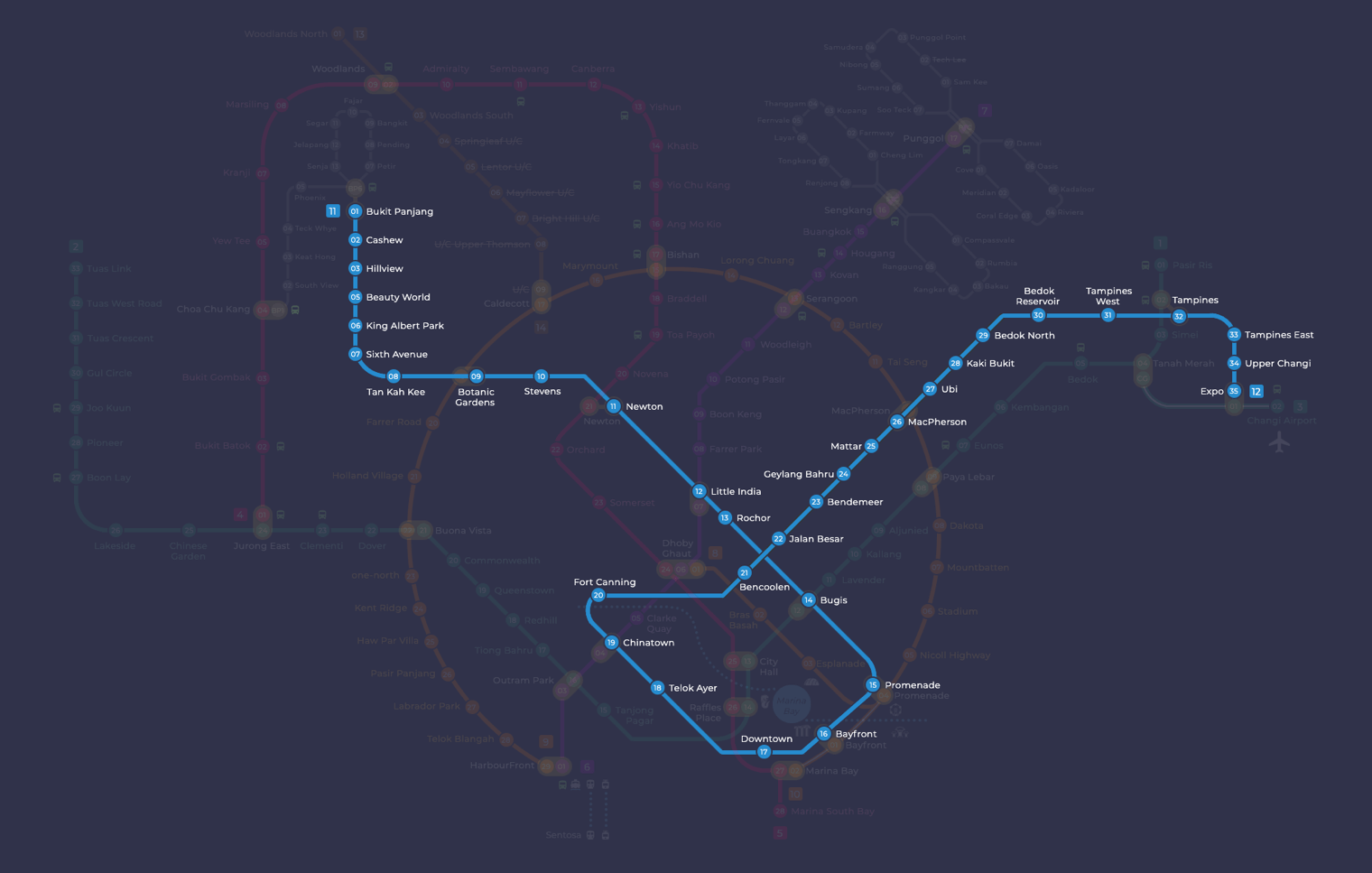
Highlighted Downtown Line Map Singapore

Last updated . Facts checked against LTA announcements.
View the Downtown Line in full screen at Google.
The Downtown Line is Singapore’s blue MRT line. It links the north-west of the island with the east, and takes a loop through the city centre on the way. Its station codes all start with DT, running from DT1 at Bukit Panjang to DT35 at Expo. If you look at a downtown line map, you will see that the route does not run in a straight line. It heads south-east along the Bukit Timah corridor, curves through the Central Area past Bugis, Marina Bay and Chinatown, and then turns north-east and east towards Tampines and Expo.
The line is run by SBS Transit and was the fifth MRT line to open on the network. There are 35 stations open, all of them underground, along 41.9 kilometres of track. This makes it the longest automated MRT line in Singapore. Trains are driverless and run in a three-car formation, so the Downtown Line is classed as a medium-capacity line. It serves residential towns such as Bukit Panjang, Bukit Timah, MacPherson, Bedok North and Tampines, as well as the offices and shops of the city centre.
The north-western end of the line is at Bukit Panjang (DT1), where you can change to the Bukit Panjang LRT. From here trains run south through Cashew, Hillview and Hume, the newest station on the line. Beauty World (DT5) follows, then King Albert Park, Sixth Avenue and Tan Kah Kee. This stretch follows the Upper Bukit Timah and Bukit Timah Road corridor, which the line was originally planned to relieve of road traffic. At Botanic Gardens (DT9) the line meets the Circle Line, and at Stevens (DT10) it meets the Thomson-East Coast Line.
The line then enters the city. Newton (DT11) connects with the North South Line, and Little India (DT12) with the North East Line. After Rochor comes Bugis (DT14), a busy change point for the East West Line. The loop through the Central Area continues via Promenade (DT15) and Bayfront (DT16) into the Marina Bay business district, then Downtown and Telok Ayer before reaching Chinatown (DT19). A downtown line map makes this loop easy to follow: Bugis and Chinatown sit on opposite sides of it, and the line passes Fort Canning and Bencoolen as it turns back north.
From Bencoolen the route heads north-east through Jalan Besar, Bendemeer, Geylang Bahru and Mattar to MacPherson (DT26), where it crosses the Circle Line again. The eastern section serves Ubi, Kaki Bukit, Bedok North and Bedok Reservoir before reaching Tampines West and Tampines (DT32), a major interchange with the East West Line. The final stops are Tampines East, Upper Changi and Expo (DT35), where the line ends beside the East West Line’s Changi Airport branch. A full trip from one end to the other takes about 69 minutes.
The Downtown Line brought together three earlier plans: the Bukit Timah Line, the northern part of the Eastern Region Line, and a proposed Downtown Extension of the Circle Line. The government combined them into a single line in 2007, and work started with a groundbreaking at Chinatown in February 2008. The line was then built and opened in three stages. Stage 1, the short city section between Bugis and Chinatown, opened on 22 December 2013. Stage 2, from Bugis to Bukit Panjang, followed on 27 December 2015. Its opening went ahead even though the main contractor for three of its stations had gone bankrupt during construction. Stage 3, from Fort Canning to Expo, opened on 21 October 2017 and completed the route seen on today’s downtown line map.
Ridership grew quickly as each stage opened. Weekday trips rose from 83,000 in October 2015 to 250,000 by July 2016, as more passengers from the North South and North East lines switched to the Downtown Line to reach the city. By February 2018 the figure had reached 470,000. One more station was added later: only the shell of Hume was built during the original works, and after calls from local residents it was completed and opened on 28 February 2025. Hume was the first underground infill station in Singapore. The line has also had a strong reliability record and was the most reliable MRT line by distance between failures from 2021 to 2024.
Two extensions are planned, one at each end of the line.
Until these sections open, the line ends at Bukit Panjang and Expo, and new stations will only appear on the downtown line map once they start service.
The Downtown Line (DTL) is the blue line on the Singapore MRT map, with station codes starting with DT. It runs from Bukit Panjang in the northwest, through Bukit Timah and the city centre, to Expo in the east. The entire line is underground and trains run without drivers.
Main interchanges on the blue line:
To plan a trip on the blue line, open the interactive Singapore MRT map 2026 and search for your station, or save the Singapore MRT map PDF for offline use.
The Downtown Line is operated by SBS Transit. It is one of two MRT lines SBS Transit runs, the other being the North East Line, and the company also operates the Sengkang and Punggol LRT systems.
No, the two new stations, Xilin (DT36) and Sungei Bedok (DT37), are not open yet and are due in the second half of 2026. Once open, Sungei Bedok will also connect with the Thomson-East Coast Line.
Hume (DT4) opened on 28 February 2025, slotting in between Hillview (DT3) and Beauty World (DT5) on the blue line. It was a late addition to the Downtown Line and brings the current total to 35 stations.
The Downtown Line currently has 35 stations, running from Bukit Panjang (DT1) in the north-west to Expo (DT35) in the east. Two more stations are planned for the second half of 2026, which will bring the total to 37.
You can pay your fare using an EZ-Link or SimplyGo card, a contactless bank card, or a mobile wallet. Visitors can also use the Singapore Tourist Pass, which is accepted across the MRT and LRT network.
Want the whole route on one page? Open the Downtown Line map to see every station and interchange along the line.