
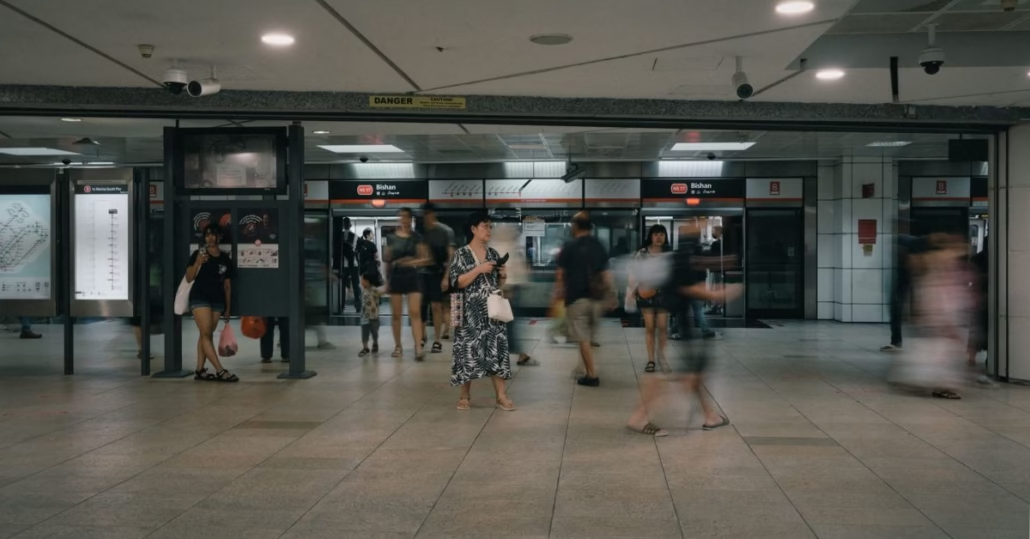
Most people alight at their stop, tap out, and rush off without a second glance at the walls around them. That is a pity, because Singapore’s MRT stations collectively house one of the largest commissioned public art programmes in Asia, and a good chunk of it is sitting right above your head.
- What is the Art in Transit programme?
- How did Art in Transit start?
- Which stations have the standout artworks?
- How are artworks selected and commissioned?
- What's new: Circle Line completion and fresh commissions
- Do LRT stations have Art in Transit works too?
- What's planned for future lines?
- Why does this actually matter for daily commuters?
- Planning your own art walk
- Before you tap in
- FAQ
What is the Art in Transit programme?
Art in Transit is Singapore’s official scheme to weave commissioned artworks permanently into MRT and LRT station architecture. The Land Transport Authority (LTA) conceived it in the early 1990s with a straightforward goal: to make public transport spaces culturally meaningful, not merely functional. Instead of blank walls and generic finishes, stations would carry original works by professional artists, many of them Singaporean, that reflect the identity and heritage of the surrounding neighbourhood.
The key word here is “integrated”. These are not framed prints or temporary installations bolted on after the fact. The artworks are designed alongside the station itself, often using the same materials as the architecture: mosaic tiles, cast glass panels, perforated metal screens, terrazzo floors, and large-format ceramic murals. Some span entire platform walls. A few are so thoroughly woven into the structure that most commuters never realise they are looking at commissioned art at all.
Getting around Singapore? Find any station on the interactive MRT map, or save the PDF map to use offline.
How did Art in Transit start?
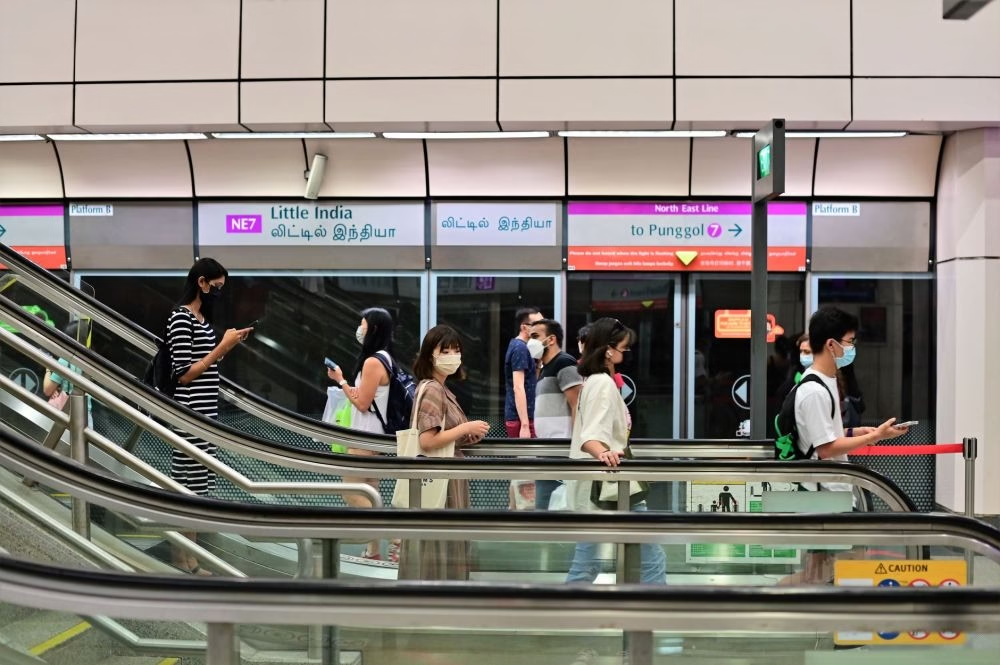
The programme traces its origins to the North-East Line (NEL), which opened in 2003 under SBS Transit. At that point, the idea of building a culturally curated MRT line was relatively novel in Singapore. Each station on the North East Line was given a distinct artistic identity tied to its community: the waterways heritage around Punggol, the Malay heritage at Farrer Park, the arts precinct at Little India.
From there, it expanded decisively. The Circle Line (CCL), which opened in stages from 2009, pushed the concept further. By the time the Downtown Line (DTL) launched between 2013 and 2017, Art in Transit had matured into a sophisticated curatorial process. The Downtown Line alone commissioned dozens of works across 35 stations, making it arguably the most art-dense MRT line in Singapore’s network. Artists were briefed on everything from the station’s catchment area to its geological surroundings, and given considerable creative freedom within those parameters.
The Thomson-East Coast Line (TEL) continued this tradition when it opened its first stage in 2020. Works along the Thomson-East Coast Line range from large abstract sculptures at Woodlands North to intricate digital-print panels that reference the natural heritage of the central catchment area.
Which stations have the standout artworks?
Every MRT line in Singapore participates in Art in Transit to some degree, but the density and ambition of the works vary significantly. The table below gives you a practical overview of what to expect on each line as of August 2026.
| MRT Line | Art in Transit Character | Standout Stations to Visit |
|---|---|---|
| North-East Line (NE) | Heritage and community focus; mosaic and ceramic heavy | Little India (NE7), Chinatown (NE4), Punggol (NE17) |
| Circle Line (CC) | Varied by precinct; strong architectural integration | Esplanade (CC3), HarbourFront (CC29/NE1), Caldecott (CC17) |
| Downtown Line (DT) | Most consistently curated; each station has a named artwork | Bencoolen (DT21), Beauty World (DT5), Telok Ayer (DT18) |
| Thomson-East Coast Line (TE) | Nature and history themes; large-format and sculptural | Woodlands North (TE1), Stevens (TE11), Tanjong Rhu (TE23) |
| North-South Line (NS) | Older stock; some works from original 1987 opening | Raffles Place (NS26/EW14), Jurong East (NS1/EW24) |
| East-West Line (EW) | Mix of eras; newer Tuas extension has fresher commissions | Boon Lay (EW27), Expo (CG1/DT35) |
How are artworks selected and commissioned?
The selection process for Art in Transit artworks is more rigorous than most people assume. The LTA does not simply put out an open call and pick whoever submits first. For each new station or line, a curatorial panel reviews proposals against a brief that covers the station’s geographical setting, the demographics of its catchment area, Singapore’s multicultural identity, and the practical constraints of the space: things like maintenance durability, how the work will look under fluorescent platform lighting, and whether it poses any safety considerations near fare gates or lift shafts.
Artists are typically shortlisted through a combination of open submission and direct invitation. Many are Singaporeans or Singapore Permanent Residents, though international artists have also been commissioned, particularly for anchor stations with a higher public profile. The final works must be durable enough to withstand decades of daily exposure to tens of thousands of commuters, humidity, cleaning chemicals, and the occasional accident. This is not a casual brief.
Once selected, the artist works closely with the station architect. This is the part that makes Art in Transit genuinely unusual: the artwork is not an afterthought but a design constraint. Structural engineers sometimes have to accommodate a large ceramic panel or a suspended glass installation before the station shell is finalised. When it works well, you get a station where art and architecture feel like they grew from the same idea.
What’s new: Circle Line completion and fresh commissions
The completion of the Circle Line Stage 6 (CCL6) in July 2026 brought three new stations online: Keppel (CC30), Cantonment (CC31), and Prince Edward Road (CC32). All three carry fresh Art in Transit commissions, and they are worth the trip even if your destination does not require those stops.
Keppel’s artwork engages the station’s proximity to the former Tanjong Pagar Railway Station and the Greater Southern Waterfront precinct. Cantonment draws on the colonial military history of the area. Prince Edward Road, sitting close to the Singapore General Hospital campus, explores themes of care, community, and the natural landscape of the Queenstown neighbourhood. You can read a deeper look at all three in our coverage of the CCL6 stations and what they mean for the completed Circle Line.
The timing is significant. As of August 2026, the Circle Line is now fully connected, running as a true loop. That means you can board at any CC station and ride continuously without backtracking, which actually makes an Art in Transit tour of the entire line a realistic afternoon outing. Budget around two to three hours if you want to alight at the more artwork-rich stations rather than just glance through the train window.
Do LRT stations have Art in Transit works too?
Yes, though with less consistent coverage than the main MRT network. The Bukit Panjang LRT (BPLRT), Sengkang LRT, and Punggol LRT systems include some commissioned artworks and design elements, but they tend to be smaller in scale and simpler in ambition compared to major interchange stations. Our LRT stations guide covers the network in detail if you want to explore these lines.
The Bukit Panjang LRT stations have some decorative tile work and graphic treatments that reflect the residential character of the western heartlands, but they are quite understated. The Sengkang LRT and Punggol LRT have a cleaner, more contemporary visual style that suits their newer HDB estate surroundings. Do not expect a Downtown Line-level art experience, but there are pleasant surprises if you look carefully.
What’s planned for future lines?
The Cross Island Line (CRL), Singapore’s upcoming eighth MRT line, is expected to continue the Art in Transit tradition. According to the LTA, CRL Phase 1 is on track for completion around 2030, and the line’s stations have been designed with cultural programming in mind from the start. Our dedicated guide covers everything you need to know about the Cross Island Line, including its planned station locations.
CRL Phase 3, announced in late July 2026, will add four more stations to serve Taman Jurong and western industrial estates, including interchanges with the East-West Line (EWL) and the upcoming Jurong Region Line (JRL). You can read our full breakdown of the Cross Island Line Phase 3 stations and interchange details. Whether those western industrial catchments will inspire particularly evocative artworks remains to be seen, but the LTA has historically treated even utilitarian-area stations as legitimate cultural venues.
Why does this actually matter for daily commuters?
There is a practical argument here beyond cultural enrichment. Urban design research consistently shows that well-designed public spaces reduce perceived wait times and lower stress levels. Standing on a platform watching a ceramic mural for two minutes genuinely feels different from staring at a blank grey wall for two minutes, even if the train arrives at the same time.
Singapore’s MRT reliability has been running impressively high in 2026, with the network achieving over two million train-kilometres between delays for three consecutive months. But even on a reliable system, there are waits. Art in Transit gives you something genuinely worth looking at during those moments, which is quietly one of the better quality-of-life investments the LTA has made in the commuter experience.
There is also a social dimension. Artworks that reference local heritage (a mural depicting kampung life near Bishan, or a glass installation evoking the old Rochor canal near Jalan Besar) quietly tell commuters that their neighbourhood’s history is worth preserving and celebrating. That is not nothing, especially in a city that moves fast and builds fast.
Planning your own art walk
You do not need a guided tour to appreciate the programme. The most practical approach is to pick a single line and ride it end to end, alighting at two or three stations where the artwork guide flags something substantial. The Downtown Line between Bugis (DT14) and Bukit Panjang (DT1) is probably the best single-line art experience in the network right now, with consistently high-quality commissions throughout.
If you prefer an interchange-heavy route, try starting at Dhoby Ghaut, changing to the Circle Line, and working your way around to HarbourFront. That loop takes in works from three different curatorial eras and gives you a sense of how the programme has evolved. Check our full MRT stations guide to plan exit and transfer points before you set off.
For payment, a standard adult fare on a contactless bank card or EZ-Link card through the SimplyGo system is the most straightforward option. Fares across an end-to-end line ride typically range from around S$1.19 to S$2.37 for adults depending on distance, as of 2026. More detail on payment options is in our guide to paying for the Singapore MRT.
Before you tap in
Art in Transit is one of those things that rewards commuters who slow down, even briefly. The next time you are waiting on a platform or walking through a concourse, look at the walls properly. There is a good chance someone spent months making what you are looking at, and it was put there specifically for you. Check our Singapore MRT blog for more coverage on what is happening across the network, or start with the interactive Singapore MRT map to plan your next journey.