
What Happened at Buangkok MRT on 29 July 2026?
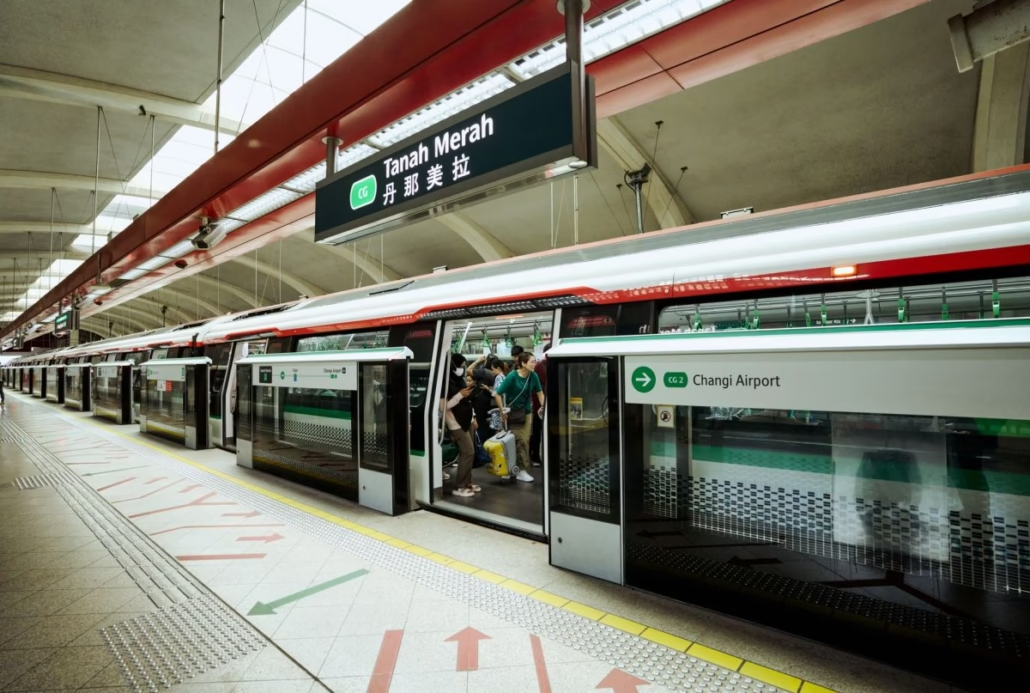
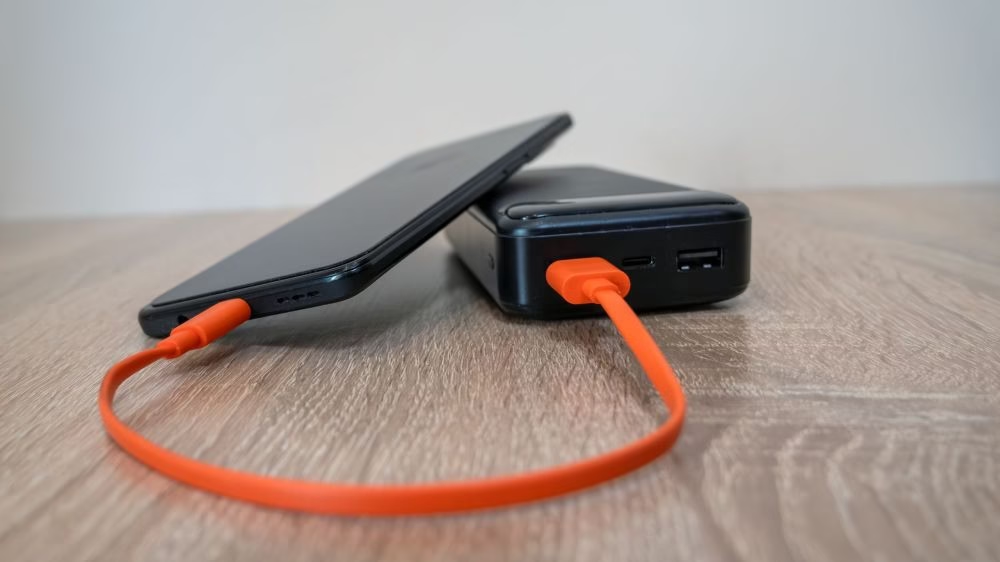
A power bank inside a commuter’s backpack caught fire at Buangkok MRT station on the morning of 29 July 2026, forcing an evacuation and triggering a joint response from the Singapore Police Force and the Singapore Civil Defence Force (SCDF). No one was hurt, but the incident jolted commuters on what had started as an ordinary Tuesday.
- What Happened at Buangkok MRT on 29 July 2026?
- Why Did the Power Bank Catch Fire?
- How Did Station Staff and Emergency Services Respond?
- Which Station Is Buangkok, and How Does It Fit Into the Network?
- What Are the Rules on Carrying Power Banks on Singapore MRT?
- Is This Part of a Wider Pattern of Battery Fires on the MRT?
- What Should Commuters Do If They Spot Smoke on an MRT Train?
- What Happens Next? Will LTA Tighten the Rules?
- Before You Tap In
- FAQ
Buangkok is a North East Line (NEL) station between Hougang and Sengkang in the northeastern heartlands. The platforms serve a large residential catchment of HDB estates, so they’re typically crowded during the morning rush. When something like this happens mid-commute, with smoke filling the immediate area, the evacuation can be disorienting for passengers caught in the middle.
According to The Straits Times and AsiaOne on 29 July, the power bank started emitting smoke while the commuter was in transit. Mothership’s follow-up the next day confirmed the device had actually caught fire, not just smouldered. That’s why police were called alongside SCDF. Train passengers were evacuated from the affected coach as a precaution.
Getting around Singapore? Find any station on the interactive MRT map, or save the PDF map to use offline.
Why Did the Power Bank Catch Fire?
Lithium-ion batteries catch fire through thermal runaway, a chain reaction where heat inside the battery cell builds uncontrollably. Physical damage, manufacturing defects, overcharging, or plain age can all trigger it. Power banks are particularly vulnerable because they get jostled around in bags, dropped regularly, and left in warm pockets or car seats.
This isn’t Singapore’s first lithium-ion scare on the rails. Earlier in 2026, a power bank fire at Woodlands MRT station raised similar alarm bells. Two incidents within months suggests a pattern rather than bad luck.
Power banks sold in Singapore should comply with the Consumer Protection (Safety Requirements) Regulations and carry a Safety Mark from the Singapore Safety Mark scheme. The rules cap power bank capacity at 20,000 mAh for air travel. But there’s currently no specific cap for MRT travel. That distinction matters. A high-capacity power bank carries far more stored energy and proportionally greater fire risk if something goes wrong.
How Did Station Staff and Emergency Services Respond?
Station staff evacuated affected passengers quickly, following standard SBS Transit emergency protocols for smoke or fire incidents on the North East Line. Staff are trained to isolate the source and move passengers away from any potential hazard before emergency services arrive.
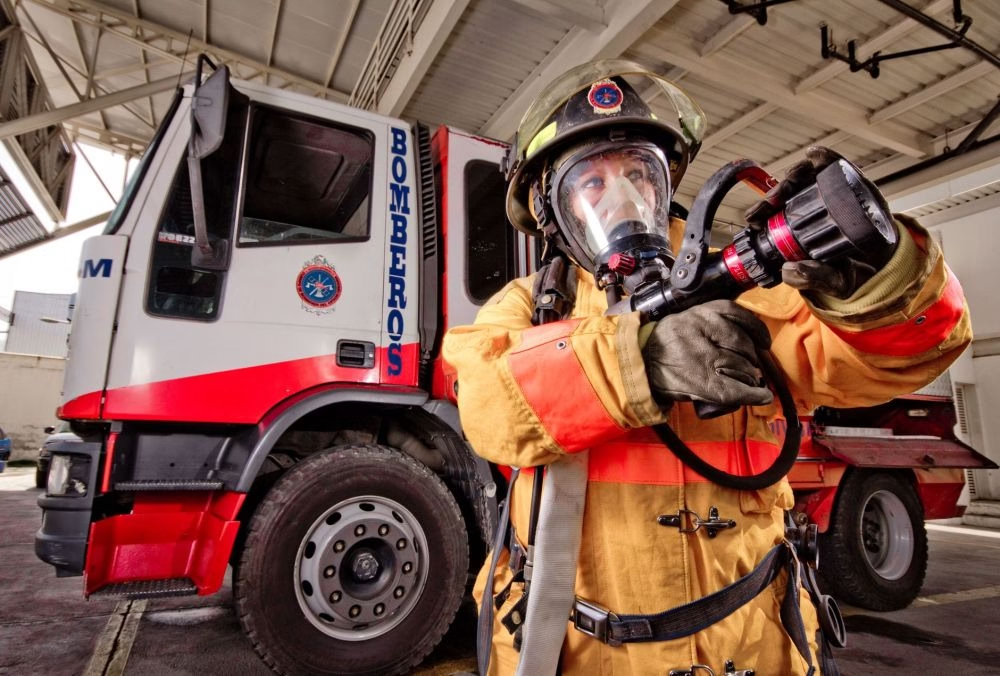
SCDF officers arrived to assess and handle the burning device. Police presence at such incidents is routine in Singapore when there’s a potential public safety risk, even if no crime is suspected. The commuter whose bag held the power bank would likely have been questioned as part of the fact-finding process.
The outcome was good: nobody was injured. The evacuation worked as intended, and the fire stayed contained within the device itself. Singapore’s rail stations have fire suppression equipment and clearly marked emergency exits. This incident is a stark reminder of why those systems exist.
Which Station Is Buangkok, and How Does It Fit Into the Network?
Buangkok MRT (NE15) sits on the North East Line, one stop south of Sengkang and one stop north of Hougang. It serves the Buangkok estate and parts of Sengkang, and gets particularly packed during school term when students from nearby institutions add to the morning crowd. For the full station listing and line map, check our North East Line guide.
The NEL runs from HarbourFront (NE1) in the south all the way to Punggol Coast (NE18) in the north. It connects major interchanges including Dhoby Ghaut, Little India, Farrer Park, Serangoon, and Sengkang. If you commute through Buangkok regularly, you’ll know the platform fills up fast between 7.30am and 9am. Any evacuation at peak hour creates a significant knock-on effect across the entire line.
The NEL also connects at Sengkang to the Sengkang LRT, which feeds several smaller residential loops. Commuters transferring between the LRT and the NEL at Sengkang would have felt the ripple of any service disruption caused by the Buangkok incident on 29 July.
What Are the Rules on Carrying Power Banks on Singapore MRT?
As of July 2026, the Land Transport Authority (LTA) doesn’t explicitly prohibit power banks on MRT trains, but does ban any item that poses a fire or safety hazard. Under the Rapid Transit Systems Act, passengers cannot carry dangerous goods, flammable materials, or anything that could endanger others. A visibly damaged, leaking, or overheating power bank clearly falls into that category.
The rules break down like this:
| Item | Status on MRT | Notes |
|---|---|---|
| Power bank (intact, undamaged) | Permitted | No capacity limit on MRT currently |
| Power bank (visibly damaged, swollen) | Not permitted | Constitutes a fire hazard |
| Spare lithium-ion batteries (loose) | Not permitted | Must be in original packaging or device |
| E-scooters / PMDs | Not permitted | Banned following earlier fire incidents |
For the latest list of prohibited items, check directly with the Land Transport Authority. Rules change, especially after incidents like this one.
Is This Part of a Wider Pattern of Battery Fires on the MRT?
Yes. Battery-related incidents on Singapore’s public transport have been rising in line with the proliferation of high-capacity portable electronics. E-scooter fires were the catalyst for the personal mobility device (PMD) ban on public transport in 2019. Power banks represent the next frontier of this problem.
The Buangkok fire follows the Woodlands MRT power bank incident from earlier in the year. Two incidents on the same network within months of each other is a pattern, not a coincidence. Transport operators and the LTA will be watching closely. It wouldn’t be surprising if new regulations or clearer guidelines on power bank carriage emerged in the coming months.
It’s worth noting that Singapore’s MRT network has otherwise been performing exceptionally well. The network logged its third consecutive month of high reliability in July 2026, with no major delays since November 2025, according to CNA. Read more on that milestone in our MRT reliability coverage. A power bank fire doesn’t count as a train service delay in the reliability metrics, but it absolutely disrupts commuters’ journeys in real terms.
What Should Commuters Do If They Spot Smoke on an MRT Train?
The correct immediate action is to alert the train captain using the intercom panel inside the carriage, move away from the smoke source, and wait for instructions. Don’t try to open the train doors between stations. When the train reaches a platform, alight promptly and follow staff directions.
Once on the platform, head towards the station exits rather than crowding the platform edge. Stations like Buangkok have clearly marked exits, and station staff are trained to guide you. If you’ve tapped in and need to tap out at a different station due to an evacuation, approach the station control centre window. Staff will typically process an exit override for you without charging a fare penalty.
For regular commuters through the northeastern network, it’s worth knowing your alternatives. From Buangkok, you’re within reasonable bus distance of Sengkang Bus Interchange, which connects across the northeast. Sengkang itself connects to the Sengkang LRT loops, giving you additional flexibility if the NEL is disrupted.
What Happens Next? Will LTA Tighten the Rules?
As of 31 July 2026, neither LTA nor SBS Transit has announced new restrictions on power banks following the Buangkok incident. But the transport authority has a track record of acting decisively after safety incidents. The PMD ban, airbag requirements for e-scooters before that ban, and the ongoing review of platform screen door systems all show a regulator ready to move when risk accumulates.
Public pressure tends to speed that up. Incidents at busy stations get noticed fast, and two power bank fires within months will sharpen the conversation around capacity limits, mandatory damage inspections, or even designated fire-containment bags for lithium-ion devices. Other transit systems globally have explored sealed bags for lithium-ion items. Whether Singapore adopts something similar remains to be seen.
If you want to stay up to date with policy changes affecting your commute, our Singapore MRT blog covers LTA announcements and safety developments as they happen. You can also check the full list of MRT stations in Singapore to plan alternative routes in case of service disruptions at any point on the network.
Before You Tap In
The Buangkok power bank fire on 29 July 2026 is a timely reminder that what you carry in your bag affects everyone on an enclosed train. Check your devices, know the emergency procedures, and stay aware when you’re commuting through busy stations. For a full picture of the network and to plan your journey with confidence, start with our interactive Singapore MRT map, or read our earlier coverage on the initial smoke report at Buangkok MRT for a timeline of how the situation unfolded.
FAQ
Earlier updates on this story
Power Bank Smoke at Buangkok MRT: What Happened (30 Jul 2026)
It only takes seconds for a commute to go very wrong. On the evening of 29 July 2026, a power bank in a commuter’s backpack began emitting smoke on a train at Buangkok MRT station, triggering an evacuation and a swift response from station staff. Nobody was hurt, but the incident raised concerns about a growing hazard on Singapore’s trains.
Just eight days earlier, a power bank caught fire at Woodlands MRT on the Thomson-East Coast Line (TEL), with staff putting it out before any serious damage occurred. Two incidents in under two weeks is a pattern worth taking seriously.