
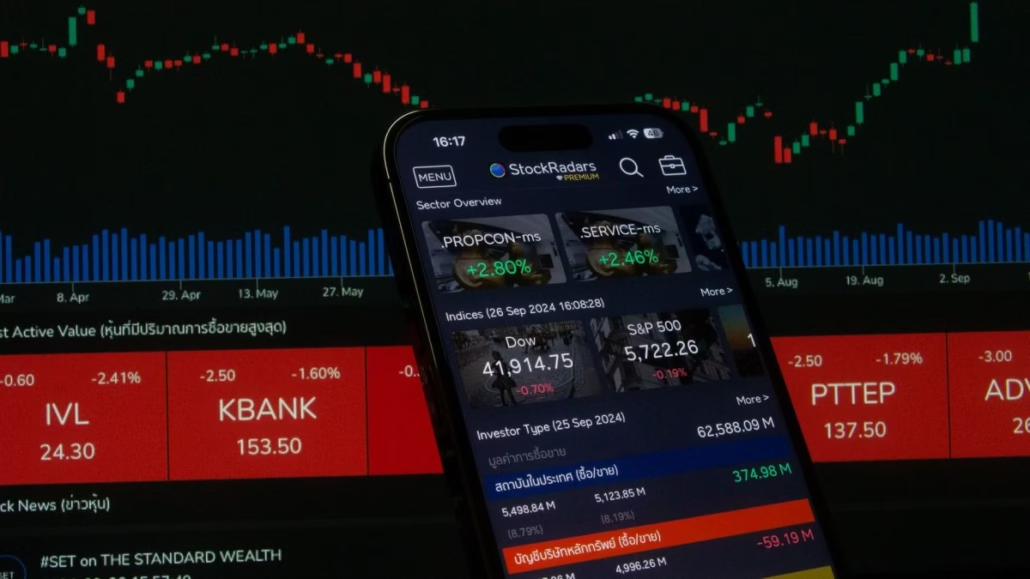
If you checked your brokerage app this week and felt a little confused about what was actually moving the market, you’re not alone. The week ending 25 July 2026 packed in some genuinely interesting corporate updates, plus a fresh round of inflation data that will matter for how the Monetary Authority of Singapore (MAS) thinks about policy in the months ahead. Let’s unpack it all in plain language.
- What Is Happening With Metro Holdings?
- How Did Singapore Exchange Perform This Week?
- What Is Mi Technovation and Why Does It Matter?
- What Does Singapore's Latest Inflation Data Tell Us?
- How Do These Four Stories Connect for a Singapore Investor?
- What Should Singapore Investors Watch in the Coming Weeks?
- A Quick Note on Research and Due Diligence
- Before You Make Your Next Move
- FAQ
What Is Happening With Metro Holdings?
Metro Holdings has confirmed it will close two of its remaining department stores in 2026, completing a strategic exit from brick-and-mortar retail that the company has been signalling for several years. The closures mark an end to Metro’s role as one of Singapore’s recognisable department store names, though the group has been pivoting towards property investment and management for some time now.
For investors, the retail exit is not necessarily bad news. Metro’s property portfolio, which includes stakes in commercial real estate in Singapore and China, is the part of the business that generates the steadier income. With the department store segment consistently weighing on margins, removing that drag could improve the group’s overall return profile. The question most analysts are asking is what Metro does with the freed-up capital and how it manages any lease-exit costs.

You can read more about the specifics of Metro’s store closures in our earlier piece on Metro Singapore closing two department stores in 2026, which covers the locations and timelines in detail. From a pure investment standpoint, watch for the group’s next results announcement to see whether property income is already offsetting the retail revenue loss.
Getting around Singapore? Find any station on the interactive MRT map, or save the PDF map to use offline.
How Did Singapore Exchange Perform This Week?
Singapore Exchange (SGX) posted quarterly revenue that came in ahead of some market expectations, driven by stronger derivatives trading volumes and a pickup in securities market activity. As of July 2026, SGX continues to benefit from its dual role as both a regional equities venue and one of Asia’s more active derivatives markets, particularly for currency and equity index contracts.
The derivatives segment is arguably SGX’s most durable income stream. Unlike equity commissions, which move directly with retail sentiment and trading volumes, derivatives revenue holds up reasonably well even when local retail investors are sitting on the sidelines. This week’s numbers reinforced that structural advantage.

Dividend investors will note that SGX has a reasonably consistent payout history. As of recent years, the stock has offered a yield in the mid-single-digit percentage range, though you should always verify the latest declared dividend against SGX’s own investor relations announcements before making any decisions. The broader context here is that rising interest in Asian capital markets, partly driven by geopolitical shifts in global supply chains, has been directing more institutional flow through Singapore as a financial hub.
What Does SGX’s Performance Mean for the Straits Times Index?
SGX is itself a component of the Straits Times Index (STI), which means a strong SGX showing tends to have a modest positive knock-on effect on the index. More importantly, a healthy SGX signals confidence in Singapore’s capital markets infrastructure. For everyday investors who hold STI exchange-traded funds (ETFs) through platforms like POEMS or FSMOne, this is quietly good news even if it doesn’t show up dramatically in a single week’s index movement.
What Is Mi Technovation and Why Does It Matter?
Mi Technovation is a Malaysia-listed semiconductor company that operates in the back-end of the chip supply chain, specifically in integrated circuit (IC) programming and testing equipment. It is not a Singapore-listed stock, but it receives regular coverage from Singapore-focused investment publications because many Singapore retail investors access Malaysian-listed counters, and the semiconductor theme crosses both markets.
This week’s update from Mi Technovation was broadly positive. The company pointed to improving order visibility from customers in the consumer electronics and automotive chip segments. After a difficult 2024 and parts of 2025 when the global semiconductor cycle was correcting, a recovery in order books is the signal investors have been waiting for.

The semiconductor story connects to Singapore more directly than it might seem. Singapore hosts major wafer fabrication facilities operated by companies including GlobalFoundries and TSMC’s local joint ventures, and the health of the broader chip supply chain has real implications for Singapore’s manufacturing output and industrial property demand. If you hold industrial REITs with Singapore logistics or hi-tech park exposure, Mi Technovation’s order book trend is worth watching as a leading indicator.
What Does Singapore’s Latest Inflation Data Tell Us?
Singapore’s consumer price index (CPI) data for June 2026, released in the week ending 25 July, showed headline inflation remaining in relatively contained territory compared to the sharp spikes seen in 2022 and 2023. Core inflation, which strips out accommodation and private transport costs, is the figure MAS watches most closely when calibrating its exchange-rate-based monetary policy.
Food prices, which matter enormously to most households doing their weekly grocery run or eating at the hawker centre, have moderated compared to the post-pandemic highs. That said, services inflation, including things like dining out, medical costs and education fees, has proven stickier. This split picture is important: it means the inflation you feel at the supermarket may be easing, while the inflation you experience in your monthly bills might not be moving as fast.
| Inflation Category | Trend (as of June 2026) | Investor Implication |
|---|---|---|
| Headline CPI | Contained, moderating | Less pressure on MAS to tighten further |
| Core CPI (excl. accommodation, transport) | Gradually easing | Favourable for rate-sensitive REITs and bonds |
| Food inflation | Moderating from highs | Positive for consumer discretionary sector |
| Services inflation | Sticky, slow to ease | Ongoing cost pressure for service businesses |
For Singapore investors, contained inflation with a gradually easing core reading is generally constructive. It reduces the likelihood of further MAS tightening via Singapore dollar appreciation, which in turn supports export-oriented companies and gives rate-sensitive instruments like Singapore Government Securities (SGS) and Singapore Savings Bonds (SSB) a slightly more attractive backdrop.
How Does Inflation Connect to MRT Fare Adjustments?
Here’s a connection that often gets missed. Singapore’s public transport fare review formula, administered by the Land Transport Authority (LTA), includes a component linked to core consumer price index changes. When core inflation moderates, it creates a less aggressive environment for upward fare adjustments in subsequent review cycles. If you commute daily on the North South Line or the Downtown Line, the inflation trajectory is not just a macro abstraction. It has a modest but real bearing on what you pay each time you tap in at the fare gates.

How Do These Four Stories Connect for a Singapore Investor?
Taken together, this week’s highlights sketch a market that is cautiously optimistic but still sorting through structural changes. Metro’s retail exit is a microcosm of the broader shift away from physical retail in Singapore’s heartlands and town centres. SGX’s steady performance reflects Singapore’s enduring relevance as a financial centre, even as regional competition from exchanges in other Asian cities grows. Mi Technovation’s improving order book points to a semiconductor cycle that may finally be turning after a prolonged correction. And the inflation data gives MAS more room to hold its current policy stance rather than tighten further.
None of these individually is a dramatic catalyst. But together they suggest a market environment where quality companies with predictable cash flows, particularly those benefiting from Singapore’s infrastructure and financial ecosystem, remain worth holding. Income investors, in particular, should find the combination of stable inflation and an active SGX derivatives market reasonably supportive.
It’s also worth remembering that Singapore’s broader economic picture is shaped significantly by its connectivity. The recent completion of the Circle Line with the opening of Stage 6 stations in July 2026 is a good example. Better transit access expands the effective catchment area for commercial properties, which feeds back into the real estate investment trust (REIT) earnings that many Singapore retail investors depend on for dividend income. You can check out our full coverage of Circle Line Stage 6 completing in July 2026 for more on how the new stations at Keppel, Cantonment and Prince Edward Road fit into the wider transport and property picture.
What Should Singapore Investors Watch in the Coming Weeks?
The next few weeks will bring more second-quarter 2026 earnings releases from Singapore-listed companies. REITs will be particularly in focus given the interest rate and inflation backdrop. Watch for any commentary on office occupancy rates in the Central Business District (CBD) and retail mall traffic, both of which feed into distribution-per-unit figures that income investors care about most.
For those tracking the semiconductor theme through counters like Mi Technovation, the next data point to watch is order book guidance for the third quarter. If momentum holds, the recovery trade in this sub-sector has more room to run. And for SGX specifically, the exchange’s own monthly statistics releases, which come out around the middle of each month, give you a current read on trading volumes without waiting for the quarterly results.
Singapore’s transport infrastructure is also an active investable theme. With the Circle Line now fully operational and the Thomson-East Coast Line (TEL) continuing its phased rollout, the Land Transport Authority and operators like SMRT and SBS Transit are managing a network that is both expanding and being upgraded with new technology. A backup signalling system currently being trialled, as reported in late July 2026, aims to allow quicker service recovery during faults, which reduces disruption risk for the millions of commuters who rely on the network daily. That kind of infrastructure resilience has indirect positive effects on the commercial real estate values along affected corridors.
A Quick Note on Research and Due Diligence
Nothing in this article is financial advice. The Smart Investor’s original summary and the analysis here are meant to give you context and a starting framework, not a buy or sell signal. Always verify the latest figures from company announcements on SGX’s website, and consult a licensed financial adviser if you’re making significant portfolio decisions. Singapore’s regulatory environment for retail investors is well-developed, and the resources available through MAS, SGX and licensed advisory firms are genuinely useful.
For a fuller picture of how Singapore’s public transport network fits into the city’s economic and property landscape, our blog covers transport developments, infrastructure updates and their wider context regularly. And if you want to understand how the MRT network as a whole is structured and how each line connects, the complete list of MRT stations in Singapore is a good place to start.
Before You Make Your Next Move
This week’s stock market highlights are a reminder that Singapore’s investment landscape and its physical infrastructure are more intertwined than they might appear at first glance. Metro’s property pivot, SGX’s derivatives engine, the semiconductor cycle recovery, and moderating inflation all point in a cautiously constructive direction as of late July 2026. Keep an eye on the August earnings season and the next MAS monetary policy statement for the signals that will shape the second half of the year. Check our Greater Southern Waterfront MRT access guide for a closer look at how new transit infrastructure is shaping one of Singapore’s most closely watched property corridors right now.