

A smoking bag on a busy MRT platform is not something you expect on a Monday evening. Yet on 21 July 2026, that is exactly what happened at Woodlands MRT station, when a power bank inside a commuter’s bag entered what engineers call thermal runaway, igniting a small but very real fire right there on the concourse.
In this guide
- What happened at Woodlands MRT on 21 July 2026?
- Why do power banks catch fire?
- How did station staff extinguish it so quickly?
- Can you carry a power bank on the Singapore MRT?
- What should you do if you spot a smoking device on the MRT?
- Is this the first lithium battery incident at a Singapore MRT station?
- What does this mean for everyday commuters?
- Before you tap in
- FAQ
If you travel through Woodlands regularly, or if you’re one of the many commuters who carries a power bank in your bag, this incident is worth a closer look. It wasn’t a dramatic explosion, but it was a sharp reminder that the same device keeping your phone alive can turn dangerous with very little warning.
What happened at Woodlands MRT on 21 July 2026?
According to AsiaOne, the fire started when a power bank inside a commuter’s bag began to overheat and caught alight at Woodlands MRT station. The station is a major interchange on the North South Line (NS9), sitting at the edge of the Woodlands Regional Centre and serving a high volume of commuters travelling between the northern heartlands and the city.
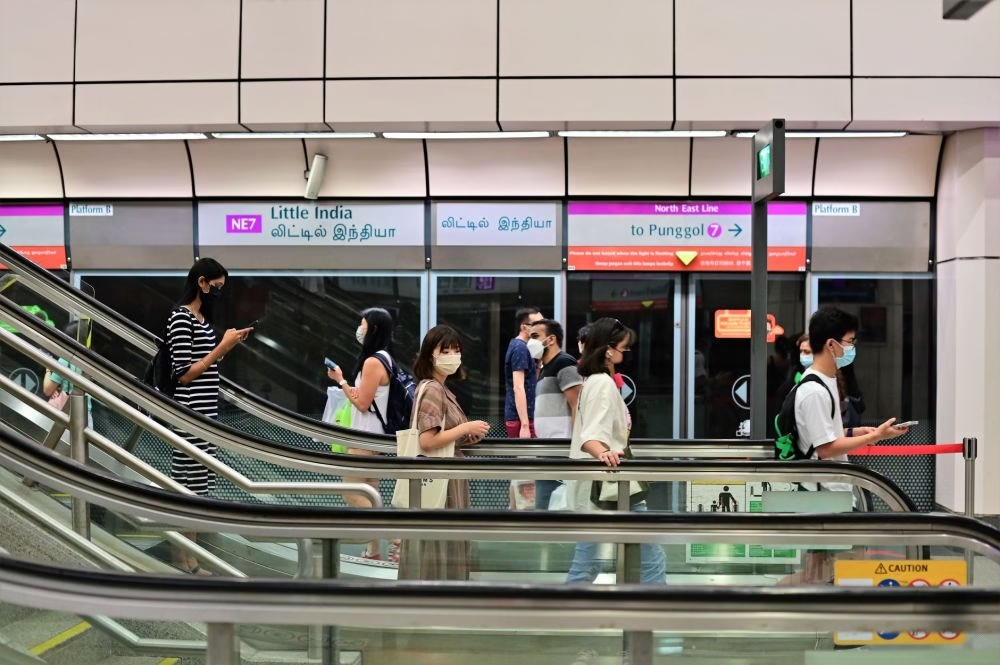
Station staff responded quickly. Rather than waiting for the Singapore Civil Defence Force (SCDF) to arrive, they stepped in and extinguished the fire themselves using on-site equipment. That fast response is almost certainly what kept the situation contained. There were no reports of serious injuries, and North South Line services continued running without significant disruption.
The specific circumstances that caused the power bank to fail have not been officially detailed as of 22 July 2026. But this wasn’t a freak event. Lithium-ion battery failures in personal electronics are a documented hazard worldwide, and Singapore’s transport authorities have been increasingly alert to the risk.
Getting around Singapore? Find any station on the interactive MRT map, or save the PDF map to use offline.
Why do power banks catch fire?
Thermal runaway is the core problem. It happens when lithium-ion cells inside a battery overheat, triggering a self-reinforcing chemical reaction that generates even more heat. Once it starts, the process can escalate fast, producing smoke, flames, and in severe cases, an explosion.
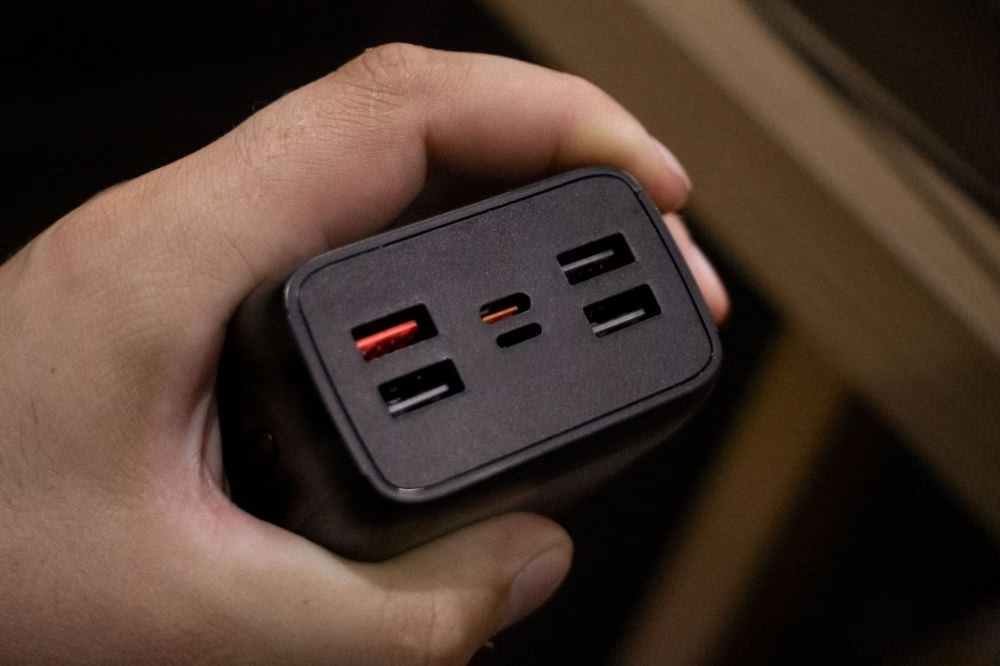
Several conditions can trigger it. A power bank that’s been physically damaged, even slightly crushed at the bottom of a heavy bag, is at risk. Counterfeit or uncertified products with cheap internal components are particularly prone to failure. Overcharging and exposure to high ambient temperatures also raise the danger. Singapore’s heat and humidity don’t help. A bag left in a warm spot, say sitting on a sun-heated seat near a train window, can push temperatures higher than the battery was designed for.
The danger isn’t unique to budget products either. Even reputable brands can fail if the cells are old, degraded, or if the battery management circuitry develops a fault. A power bank that feels unusually warm to the touch, is swelling slightly, or smells faintly chemical should be treated as a hazard and disposed of properly at an e-waste collection point.
How did station staff extinguish it so quickly?
SMRT station staff are trained in emergency response procedures, and Woodlands is a heavily staffed station given its role as a key node on the North South Line and its proximity to the Johor-Singapore Causeway corridor. The station sees enormous through-traffic of workers, students, and travellers heading to and from the Woodlands Checkpoint.
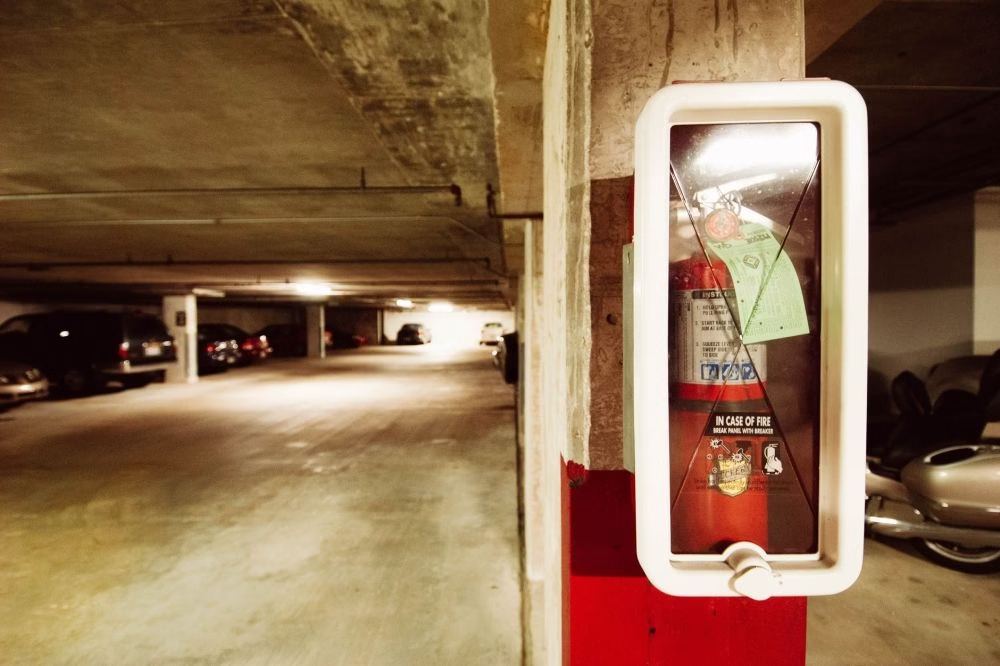
Fire suppression equipment, including portable extinguishers suited to electrical and chemical fires, is positioned throughout MRT stations. Staff are drilled on how to use them and, critically, when to act versus when to evacuate and wait for SCDF. In this case, the fire was contained enough that staff could tackle it directly. That judgment call made a real difference.
This incident also highlights something that doesn’t get enough credit: the human layer in MRT safety. There’s been a lot of well-deserved attention on the network’s impressive technical reliability lately. The Land Transport Authority (LTA) confirmed in July 2026 that the MRT had gone through its third consecutive month with no delays exceeding 30 minutes, the longest such streak since records began in 2011. You can read more about that milestone on our MRT reliability coverage. But frontline staff who notice a smoking bag and act on it are just as much a part of the safety picture.
Can you carry a power bank on the Singapore MRT?
Yes, carrying a power bank on the MRT is permitted, but with specific conditions set by SMRT and the LTA. As of July 2026, power banks must not exceed a capacity of 20,000 mAh for personal carry-on items. They must be stored in your hand luggage and must not be checked into any baggage system. Damaged or swollen power banks are prohibited outright.
| Item | Status on Singapore MRT | Key Condition |
|---|---|---|
| Power bank (up to 20,000 mAh) | Allowed | Must be in carry-on bag; not damaged |
| Power bank (above 20,000 mAh) | Check with operator | May require special arrangement |
| Swollen or damaged power bank | Prohibited | Fire hazard; dispose at e-waste points |
| E-scooter / personal mobility device | Prohibited on MRT | Lithium battery fire risk |
The rules around personal mobility devices (PMDs) with lithium batteries are much stricter. They’re banned from MRT trains and buses entirely, a policy introduced after a string of e-scooter fires in HDB estates and public spaces. The Woodlands incident suggests that personal-scale lithium batteries in everyday bags warrant similar vigilance, even if the current rules haven’t changed.
What should you do if you spot a smoking device on the MRT?
Alert staff immediately. Every MRT station has a station manager’s office and emergency intercoms on the platform. If you’re on a train when you spot smoke, use the emergency intercom at the end of each coach to contact the train captain. Do not try to smother a burning lithium battery with your clothing or hands; the chemical reaction produces toxic fumes and the battery can flare up again even after it appears to have gone out.
If the device is in your own bag, get it out if you can do so safely and place it on a hard, non-flammable surface away from other people. Alert staff immediately. Do not put a burning power bank in a rubbish bin, where it could ignite other materials. SCDF recommends immersing a small lithium fire in water if there’s no other option, which is counterintuitive but chemically correct for small lithium-ion cells. Your safest move is always to get professional help fast.
At a busy station like Woodlands, there will almost always be a staff member within shouting distance. Don’t hesitate to shout. Public embarrassment is a very small price versus the alternative.
Is this the first lithium battery incident at a Singapore MRT station?
No, it’s not the first fire-related incident involving batteries in Singapore’s public transport network, though confirmed power-bank-specific fires at MRT stations have been relatively rare. Incidents involving e-bikes and e-scooters with lithium battery packs have been the more common concern, which is part of why PMDs were banned from the network. The Woodlands incident on 21 July 2026 appears to be one of the more notable cases involving a personal carry-on power bank specifically at a station concourse.
Singapore has been grappling with lithium battery fire risks across many contexts, from HDB residential fires to incidents in logistics facilities. The SCDF has repeatedly issued advisories urging residents to buy certified products and to charge devices only when awake and nearby. The same logic applies to what you carry in your bag on the MRT every day. You can check the official guidelines and safety advisories at the Land Transport Authority website.
For operational updates and safety incidents, SMRT publishes information through its official channels at smrt.com.sg.
What does this mean for everyday commuters?
For the vast majority of people, the practical change is minor but worth making. Check your power bank before you leave home. If it’s warm, bloated, or has been rattling around in the bottom of your bag taking knocks for the past three years, retire it. E-waste recycling bins are available at most community centres, Singtel shops, and various supermarkets around Singapore.
The broader MRT network is in genuinely good shape right now. As covered in our MRT reliability report, the network has logged over 2 million train-kilometres per failure for three consecutive months, a record-breaking run. The system is performing better than it has in years. It would be a shame for that reliability record to be complicated by something as preventable as a faulty battery in a commuter’s bag.
Woodlands is one of the highest-traffic stations on the entire North South Line, connecting the northern towns of Woodlands and Sembawang with the city centre via stations like Yishun, Bishan, and Toa Payoh, all the way down to Raffles Place and Marina Bay. During peak hours, the concourse is extremely packed. An uncontrolled fire in that environment could have had very different consequences. The fact that it didn’t is a credit to the staff, but it should also prompt every commuter to think about what’s actually in their bag.
It’s also worth knowing that Singapore’s MRT network spans well over 200 stations across six main lines: the North South Line, East West Line (EW), Circle Line (CC), North East Line (NE), Downtown Line (DT), and Thomson-East Coast Line (TE). You can see the full picture on our complete list of MRT stations in Singapore. Every one of those stations has staff on duty, and every one of them is better equipped to help you in an emergency than you might realise.
Before you tap in
The Woodlands power bank fire on 21 July 2026 ended well, thanks to fast-acting staff and a bit of luck. Make sure the next incident at any station, whether it involves your bag or someone else’s, ends just as cleanly. For more on MRT safety, station guides, and the latest news from Singapore’s rail network, browse our transport blog or pull up the interactive Singapore MRT map to plan your next journey.