
A screwdriver, a restricted cabin door, and two boys under 13. That combination set off an onboard alarm and a police investigation that has since put MRT security firmly back in the spotlight.
In this guide
- Key facts at a glance
- What exactly did the boys do on the MRT train?
- What is a conditional warning, and is it serious?
- Which MRT line did this happen on?
- How secure are restricted areas on Singapore MRT trains?
- Why does this matter beyond two boys making a bad decision?
- How does this compare to other MRT safety incidents?
- What should parents and young commuters take from this?
- What is the current state of MRT safety and security in Singapore?
- Before you tap in
- Frequently Asked Questions
Key facts at a glance
- The two boys were aged 11 and 12 at the time of the incident.
- They allegedly used a screwdriver to forcibly open the door to the train’s back cabin, a restricted area not meant for passengers.
- An onboard alarm was triggered during the intrusion.
- Both boys were subsequently issued conditional warnings by the Singapore Police Force.
- A conditional warning is not a criminal conviction, but a reoffence within the stipulated period can result in prosecution.
- The incident has reignited discussion about MRT security measures and passenger safety culture.
Getting around Singapore? Find any station on the interactive MRT map, or save the PDF map to use offline.
What exactly did the boys do on the MRT train?
The boys forcibly entered the back cabin of an MRT train, a compartment strictly off-limits to the public. According to reports from CNA and Mothership, a screwdriver was used to open the door, suggesting it was deliberate rather than accidental. Once inside, an onboard alarm activated immediately, alerting train staff and eventually bringing police to the scene.
The back cabin of an MRT train is a restricted space for good reason. On driverless lines, it typically houses emergency controls, technical equipment, and communications systems. Unauthorized access isn’t just rule-breaking. It’s a genuine safety risk: even unintentional interference with these systems could disrupt train operations or put everyone on board in danger.
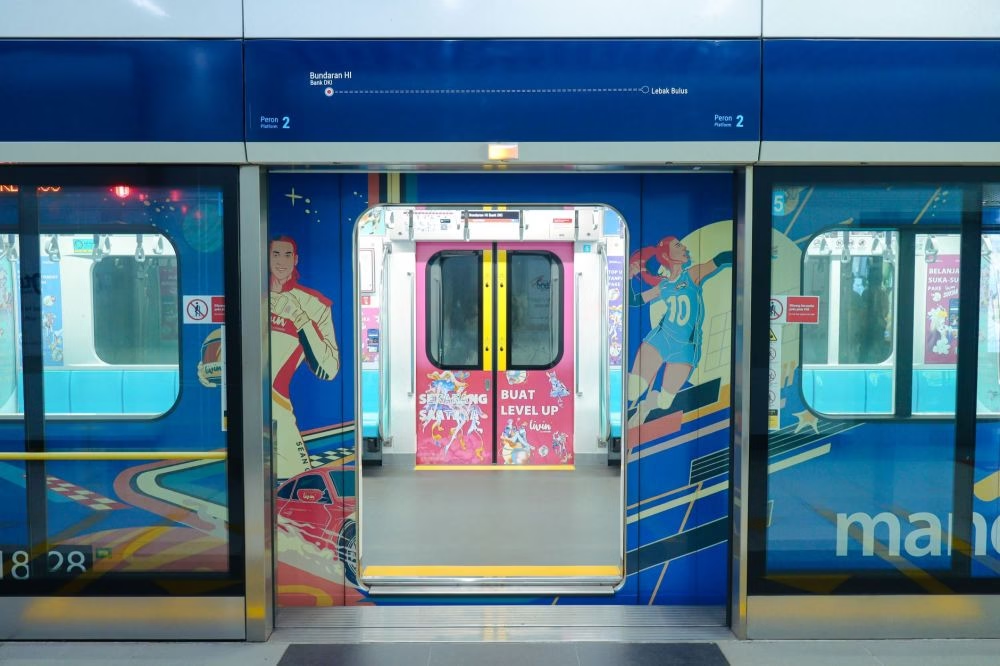
Stomp reported a video circulating online showing a youth appearing to use a screwdriver on what looked like an MRT driver’s cabin door, describing it as “super dangerous”. Whether that footage relates directly to this same incident hasn’t been officially confirmed, but the public reaction was swift and concerned.
What is a conditional warning, and is it serious?
A conditional warning is a formal police measure used in Singapore, particularly for younger or first-time offenders, as an alternative to prosecution. It’s not a slap on the wrist. The warning goes on record, and if the person reoffends within the specified period, both the original offense and the new one can be brought to court together.
Both boys are below 16, which means the Youth Court and the Children and Young Persons Act govern how the law treats them. The decision to issue conditional warnings rather than pursue charges reflects their age and, presumably, clean prior records. But make no mistake: this goes on record, and a reoffence within that window changes everything.
The relevant offense here is likely trespassing into a restricted area. Under the Rapid Transit Systems Act, unauthorized access to train operational areas carries penalties, including fines. The Land Transport Authority (LTA) has consistently reinforced that restricted zones on the MRT network exist purely to protect both passengers and operations. You can review official rules via the LTA website.
Which MRT line did this happen on?
The specific line has not been officially confirmed in public reports as of early July 2026. What is known is that the train had a back cabin accessible via a door that the boys reportedly forced open. This setup is common across several lines on the Singapore MRT network, particularly on driverless lines, where the end cabins house operational equipment rather than a human driver.
Singapore currently operates multiple lines, each managed by SMRT or SBS Transit under the LTA’s network-wide framework. You can check the full MRT lines overview for details on how each line operates, or refer to the complete list of MRT stations in Singapore if you need to identify a specific station in connection with a report.
How secure are restricted areas on Singapore MRT trains?
Singapore’s MRT trains are fitted with multiple layers of security. CCTV coverage on platforms and inside carriages is comprehensive. Onboard alarm systems, as this incident demonstrates, activate when restricted doors are breached. Train control centers monitor operations in real time, and station staff respond to alerts quickly.
That said, this incident shows that physical deterrents alone aren’t always enough against determined individuals, even very young ones. The fact that a screwdriver was apparently used to gain entry raises legitimate questions about whether additional tamper-resistant features should be considered for vulnerable access points.
SMRT has not publicly detailed any immediate hardware changes following this incident. However, the operator has historically responded to security gaps by reviewing procedures. Commuters can expect internal reviews to be ongoing.
Why does this matter beyond two boys making a bad decision?
Incidents like this matter because the MRT isn’t just convenient. It’s critical infrastructure. On a typical weekday, Singapore’s MRT carries well over three million passenger trips. Even a brief disruption to one line cascades across the network, affecting commuters on the North South Line, the East West Line, and connecting services alike.
If a child accidentally triggered an emergency stop or disabled a safety system by interfering with cabin equipment, the consequences could extend far beyond their own carriage. That’s not hypothetical. It’s exactly why those doors are restricted in the first place.
There’s also a cultural dimension here. Singapore’s MRT works as well as it does partly because commuters generally follow the rules. The social contract around public transport depends on everyone respecting shared spaces. When that breaks down, even in a relatively minor incident involving children, it’s worth paying attention to.
How does this compare to other MRT safety incidents?
| Incident type | Risk level | Typical outcome |
|---|---|---|
| Unauthorized cabin entry | High (operational risk) | Police investigation, possible charges under the Rapid Transit Systems Act |
| Platform screen door obstruction | Medium | Verbal warning, possible fine |
| Eating or drinking on the train | Low | Fine of up to S$500 for the first offense |
| Activating the emergency brake without cause | High (network disruption) | Fine up to S$5,000 and/or imprisonment |
| Vandalism of MRT property | Medium | Fine, caning (for males), and/or imprisonment |
The penalties for MRT-related offenses in Singapore are genuinely serious. This isn’t a system that treats rail safety lightly. The conditional warning the two boys received is, in this context, a relatively lenient outcome given their age and carries an implicit expectation that it won’t happen again.
What should parents and young commuters take from this?
Young people grow up riding the MRT. For many kids in Singapore, it’s one of their first experiences of independent travel, heading to school, visiting friends across town, or exploring a new neighborhood on a Saturday afternoon. That independence is genuinely valuable.
But it comes with responsibility. The MRT network, including the Circle Line and its newly opened Stage 6 stations, the Thomson-East Coast Line, and every LRT branch connecting the heartlands, is a shared resource. Restricted zones exist for everyone’s protection, full stop.
Parents can use this incident as a conversation starter. What do your kids understand about why certain areas on the train are off-limits? Do they know what to do if they see someone else attempting something unsafe? It’s worth five minutes of chat.
What is the current state of MRT safety and security in Singapore?
By most measures, Singapore’s MRT remains one of the safest metro systems in the world. The network carries an enormous daily passenger load across more than 130 stations, and serious safety incidents are comparatively rare. The LTA and operators like SMRT maintain ongoing security programs, and the Transport Security Command deploys personnel across the network.
This incident is unusual precisely because it is unusual. Most commuters will go years without witnessing anything more alarming than someone eating a sandwich on the train. The response from authorities, including the police issuing formal conditional warnings rather than simply letting the matter drop, signals that even incidents involving children are taken seriously when MRT infrastructure is involved.
For context, Singapore’s rail network is continuing to expand. The Circle Line Stage 6 public preview took place on 4 July 2026, opening three new stations to commuters. You can read more about that milestone in our dedicated article on the Circle Line Stage 6 public preview and free rides. Growth in the network also means more stations, more trains, and more responsibility for everyone using the system.
Before you tap in
This incident is a good reminder that the MRT’s reliability depends on all of us treating the system with respect, at any age. If you want a full picture of the rules, fares, and best practices for riding the MRT, our 2026 Singapore MRT fares and ticketing guide covers everything you need to know before your next journey. Stay safe out there, and leave the screwdrivers at home.
Frequently Asked Questions
What did the two boys do on the MRT train?
The two boys, aged 11 and 12, forcefully opened the door to a restricted back cabin on a Singapore MRT train using what appeared to be a screwdriver. This triggered an onboard alarm and led to a police investigation. The restricted cabin is an operational area not meant for passengers.
What is a conditional warning in Singapore?
A conditional warning is a formal police measure used as an alternative to prosecution, typically for first-time or young offenders. It is recorded officially, and if the person reoffends within a specified period, the original offense may be prosecuted alongside the new one. It is not a criminal conviction, but it should be taken seriously.
What are the penalties for trespassing in a restricted MRT area in Singapore?
Unauthorized entry into restricted MRT areas can result in fines and potentially more serious charges under Singapore’s Rapid Transit Systems Act. The severity depends on the nature of the intrusion and whether safety systems were affected. Activating emergency systems without cause can attract fines of up to S$5,000 and possible imprisonment.
Which MRT line did the cabin break-in incident happen on?
The specific MRT line involved has not been officially confirmed in public reports as of July 2026. Reports from CNA, Mothership, and The Straits Times confirmed the incident and the conditional warnings but did not name the line. The setup described is consistent with several driverless lines on the Singapore MRT network.
Is it dangerous to enter an MRT train’s back cabin?
Yes, it is genuinely dangerous. The back cabins on MRT trains contain operational controls, emergency systems, and technical equipment. Interfering with this equipment, even accidentally, could disrupt train operations or compromise the safety of everyone on board. This is why these areas are firmly restricted and clearly marked.