
Most of us have fumbled for our EZ-Link card or phone at the fare gate while a queue builds up behind us. Singapore may be quietly working on making that moment disappear entirely.
- What is the facial recognition fare payment trial at Punggol Coast MRT?
- How does facial recognition fare payment actually work?
- Why Punggol Coast, and why now?
- What are the privacy concerns being raised?
- Could this replace your EZ-Link card one day?
- What does this mean for the broader MRT network?
- How does this fit into Singapore's wider push for smarter commuting?
- Before you tap in
- FAQ
The trial was reported on 4 August 2026, and it has sparked real debate online, with commuters and residents asking how far Singapore should go in collecting biometric data just to ride the train. Before we get to the bigger questions, let’s cover what is actually happening at Punggol Coast.
What is the facial recognition fare payment trial at Punggol Coast MRT?
The trial lets selected participants pay their fare simply by facing a camera at the fare gate. No card, no phone, no wallet. The system identifies your face, links it to a registered payment account, and deducts the fare automatically.
Punggol Coast sits at the northeastern end of the North East Line in the Punggol district. It is not one of the network’s busiest interchanges, which is likely deliberate: a controlled environment with a relatively defined pool of users, making it easier to test the technology without disrupting peak-hour crowds at somewhere like Woodlands or Raffles Place.
The trial participants are selected public officers, suggesting this is government-initiated rather than driven directly by SMRT or SBS Transit. Think of it as a sandbox: real commutes, real fares, but a limited group whose participation can be monitored and whose feedback collected systematically.
If you are travelling to or from Punggol regularly, our Punggol LRT map and guide covers the full station details and nearby LRT connections, showing how it links up with the broader northeastern network.
Getting around Singapore? Find any station on the interactive MRT map, or save the PDF map to use offline.
How does facial recognition fare payment actually work?
The system matches a live camera image of your face against a pre-enrolled biometric profile linked to a payment account, then deducts the appropriate distance-based fare when your journey ends.
In practice, here is how it would work. Before using the system for the first time, you enrol your face through a secure registration process, linking your biometric data to a payment account. Every time you approach the fare gate at Punggol Coast, the camera scans your face, the gate opens, and you walk through. When you alight at your destination, the same happens in reverse: the system calculates the fare based on distance travelled and charges your account.
Singapore’s existing fare structure is distance-based. Adult fares on the MRT typically start from around S$0.92 and can reach S$2.50 or more for longer journeys, depending on the number of stops and lines used. If facial recognition fare payment scales up, it would presumably plug into the same SimplyGo back-end that currently handles contactless bank card and mobile wallet payments, since SimplyGo already processes account-based ticketing without a stored-value card.
Why Punggol Coast, and why now?
Punggol Coast was chosen partly because of its location at the end of the NEL, serving a newer residential and mixed-use precinct where the commuter population skews younger and is generally more comfortable with technology. It is also a station without a heavy interchange burden, unlike a hub like Outram Park or Dhoby Ghaut, so any teething issues with the system would not disrupt major flows.
The timing matters too. Singapore has been steadily expanding its digital transport infrastructure throughout the mid-2020s. The Land Transport Authority (LTA) has been piloting various technology upgrades across the network, from the MRT axle box monitoring system being rolled out to all lines by end-2030 to AI-assisted operations. Facial recognition fits naturally into that roadmap, even if this trial is at a very early stage.
There is also broader policy thinking at work. Singapore has been exploring how artificial intelligence can improve public services, and the transport sector is an obvious candidate. Our earlier piece on Singapore putting AI to work on the metro network covers some of the background behind these experiments.
What are the privacy concerns being raised?
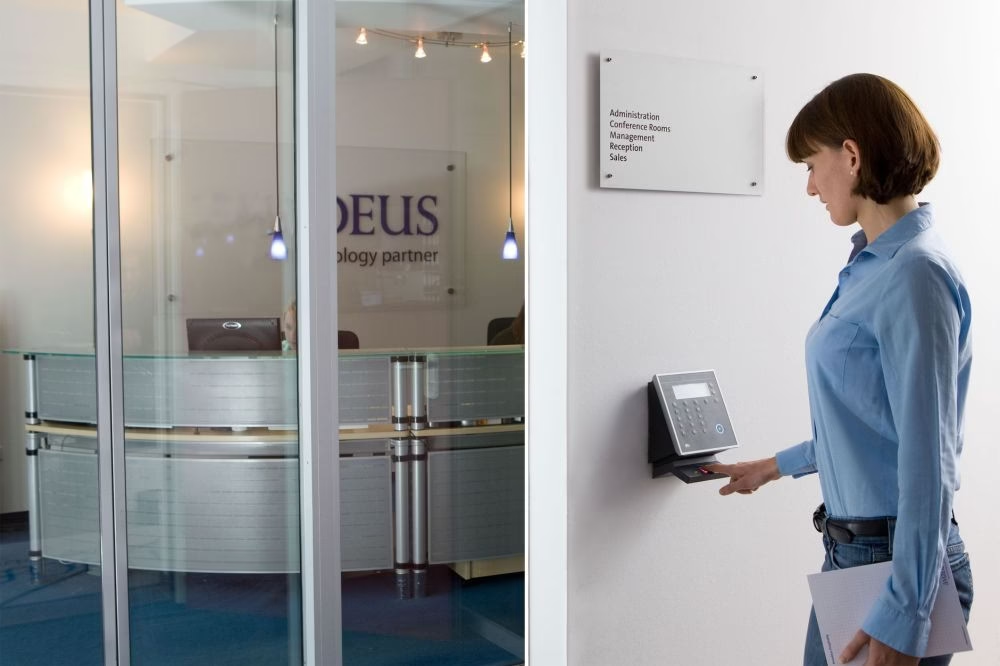
The most immediate concern is straightforward: facial recognition at fare gates means a government-linked system is collecting and storing biometric data about where you travel and when, every single day. A report from theindependent.sg on 3 August 2026 captured public sentiment well, with commenters describing the devices as “going too far.”
That reaction is understandable. Biometric data is fundamentally different from a card number. If your EZ-Link card is compromised, you get a new one. You cannot get a new face. Critics are asking what safeguards exist around data retention, who can access journey records linked to a biometric profile, and whether participation will remain genuinely voluntary if the system eventually scales up.
The trial is currently restricted to public officers who presumably consented to participate. But the concern is about precedent. Once the infrastructure is in place at one station and one population, the path of least resistance is to expand it.
| Payment Method | Requires Physical Item | Biometric Data Collected | Account-Based |
|---|---|---|---|
| EZ-Link / Stored Value Card | Yes (card) | No | No |
| SimplyGo (contactless bank card) | Yes (card or phone) | No | Yes |
| Mobile Wallet (Apple Pay, Google Pay) | Yes (phone or watch) | No (device-side only) | Yes |
| Facial Recognition (trial) | No | Yes (face scan) | Yes |
Singapore does have the Personal Data Protection Act (PDPA) and existing government data governance frameworks, but many commenters feel these were designed for a different era and may not fully address the specific risks of biometric transit data collected at scale. The Land Transport Authority has not, as of 5 August 2026, released a detailed public statement on the data handling protocols for this trial.
Could this replace your EZ-Link card one day?
Too early to say, but the direction is clear. Singapore has spent years nudging commuters away from cash and towards account-based, cardless payments. SimplyGo already handles a large share of transactions on the network, and the push has been towards reducing dependency on physical stored-value cards altogether.
Facial recognition is, in that context, simply the next logical step on the same spectrum. The real question is not whether it is technically feasible (it clearly is) but whether public trust can be built sufficiently to make adoption meaningful. A trial limited to public officers is a way of building an evidence base without triggering a mass privacy debate before the system is ready.
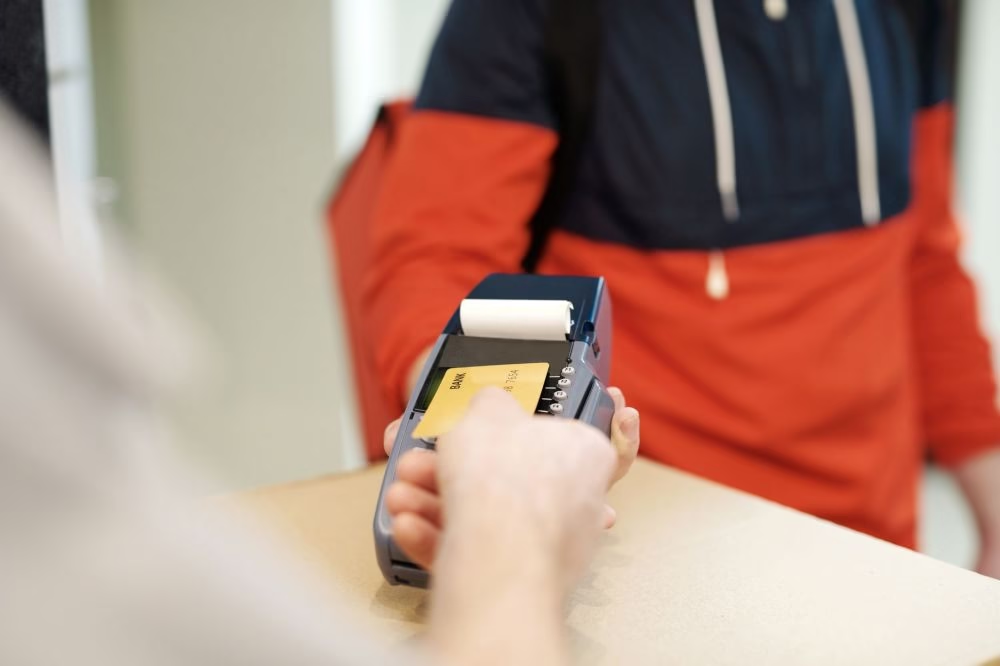
For now, the overwhelming majority of commuters will continue to tap in and out using their EZ-Link card, SimplyGo-linked contactless card, or phone. If you are unsure which payment option suits you best, our guide comparing the Singapore Tourist Pass, EZ-Link and SimplyGo is a good starting point, even for residents reassessing their setup.
What does this mean for the broader MRT network?
A single-station trial for a restricted group is a long way from a network-wide rollout, but it does signal where Singapore’s transport planners are pointing. The MRT network currently spans over 130 stations across multiple lines including the North South Line (NSL), East West Line (EWL), North East Line (NEL), Circle Line (CCL), Downtown Line (DTL), and the expanding Thomson-East Coast Line (TEL).
Deploying facial recognition fare gates across even a fraction of those stations would represent a massive infrastructure and data governance undertaking. It would also raise questions about parity: what happens to commuters who, for medical or personal reasons, cannot reliably use facial recognition? Any system at that scale needs a robust fallback, and that fallback is essentially the existing tap-in infrastructure.
The more realistic near-term scenario is a phased expansion of the trial to a slightly larger group, perhaps broadened to other public sector workers or to a specific catchment like the Punggol Digital District, before any decision is made on wider deployment. Singapore tends to iterate carefully on infrastructure changes rather than moving fast, and that measured approach is probably wise here given how sensitive biometric data is.
It is also worth noting that Singapore is not the first transit system to experiment with this. Cities in China have had facial recognition fare payment at metro stations for several years, and that experience has informed both the technical design and the public debate. Singapore will be watching those precedents closely, particularly around system accuracy rates and how edge cases like glasses, ageing, or changes in appearance are handled.
How does this fit into Singapore’s wider push for smarter commuting?
The facial recognition fare payment trial sits within a broader effort to use technology to improve the commuting experience in Singapore, covering everything from predictive maintenance to passenger information systems. As we covered in our piece on the push to better support commuters in public transport, the focus in 2026 has been on making journeys more reliable and less friction-heavy, especially during peak hours.
Biometric fare payment, if it works well and earns public trust, would reduce the small but genuinely annoying delays caused by people fumbling at the gate. Every second saved per commuter multiplies quickly across a system that carries millions of journeys daily. That is a real operational benefit, not just a tech showcase.
The privacy question, however, will not go away. And it shouldn’t. The fact that Singaporeans are asking hard questions about this trial is healthy. The best outcome would be a transparent public consultation before any large-scale rollout, clear legislation governing biometric transit data, and a system where opting out carries no practical penalty. Whether that happens will say a lot about how Singapore balances convenience against civil liberties in the years ahead.
Before you tap in
The facial recognition fare payment trial at Punggol Coast MRT is worth watching closely, even if it does not affect your daily commute right now. It is one of the most significant shifts in how we might pay for public transport in Singapore since SimplyGo launched, and the decisions made in this trial phase will shape the rules for much wider deployment down the line. Stay current with the latest on Singapore’s MRT network by browsing our transport news and guides, and check our North East Line map if you need the full picture of how Punggol Coast connects to the rest of the network.
FAQ
Keep exploring
- How to Pay for the Singapore MRT: Contactless Cards, Mobile Wallets, and Tickets
- Singapore Puts AI to Work on the Metro Network
- Thomson-East Coast Line (Brown Line) MRT Map