
Why efforts to support commuters matter right now
Singapore’s MRT and bus network carries millions of trips every single day. Most journeys are smooth, air-conditioned, and reliably on time. But as the network grows more complex and our ridership becomes more diverse, commuter support has moved firmly to the centre of the conversation in 2026.
- Why better commuter support in public transport matters right now
- The priority seat problem: who really should be sitting?
- Facial recognition at Punggol Coast: helpful tech or overreach?
- Cross Island Line expansion: four new stations for western Singapore
- Extended operating hours: the MRT goes the extra mile
- What does a genuinely commuter-friendly network look like?
- How commuter support compares across different situations
- What commuters can actually do right now
- Before you tap in
- FAQ
A viral video of a priority seat dispute captures the tension. A quiet extension of train services to accommodate a 2.30am marathon start shows the solution. The conversation around how we treat one another, and how the system treats us, has never been more active. And that matters, because discomfort aired publicly tends to produce change.
Getting around Singapore? Find any station on the interactive MRT map, or save the PDF map to use offline.
The priority seat problem: who really should be sitting?
Priority seats are reserved for elderly commuters, pregnant women, people with disabilities, and those carrying young children. The system relies entirely on goodwill and social awareness. As a viral incident from 2 August 2026 illustrated, that goodwill is not always present.
A man was filmed hurling vulgarities at a fellow commuter over a priority seat dispute. The video spread quickly, and the response followed a familiar pattern: widespread condemnation, calls for better enforcement, reminders that offenders can be reported to SMRT or the Land Transport Authority (LTA).
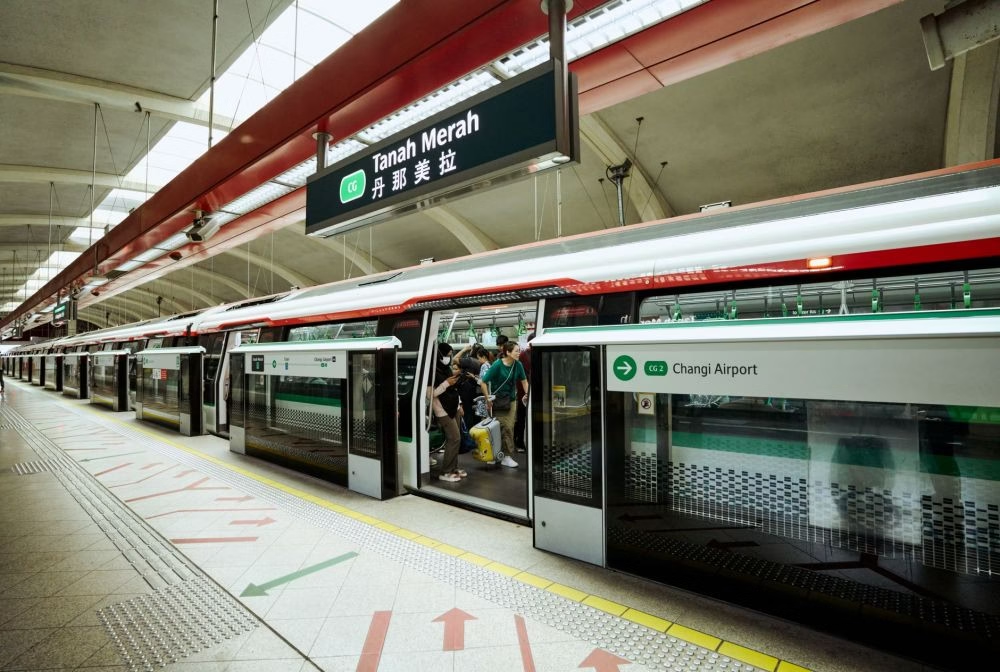
Aggressive confrontations over seating are actually quite rare. Far more common is the quiet discomfort of watching someone who looks fit and well sit in a priority seat while an elderly auntie grips a pole for 20 minutes. There is no law against it, but there is a social expectation. Singapore has been strengthening that expectation for years through campaigns, train announcements, and visible seat markings.
Better commuter support is not just about infrastructure and technology. It is about the thousands of small social decisions made every minute across the network. Campaigns help. Enforcement helps. But the culture on board is ultimately shaped by us.
Facial recognition at Punggol Coast: helpful tech or overreach?
Since late July 2026, facial recognition devices have been spotted near fare gates at Punggol Coast MRT, sparking curiosity and, predictably, concern. The trial sits at a sensitive intersection: the desire to make commuting smoother and safer, and the right to move through public space without being tracked.
The Land Transport Authority has not released full details of the trial scope or intended use cases as of writing. Possible applications discussed publicly include faster passenger flow through fare gates for registered users, improved security response, and accessibility support for commuters who struggle with standard tap-in systems. Whether any of these materialise will depend heavily on how data is collected, stored, and governed.
Singapore already uses a range of digital tools across the network, from AI-assisted maintenance scheduling to real-time crowd monitoring. Read more about how artificial intelligence is being applied across the network in our article on Singapore putting AI to work on the metro network. Facial recognition is simply the most visible and most personal iteration of that trend so far.
For daily commuters at Punggol, the trial is currently limited to one station. Normal SimplyGo, EZ-Link, and contactless bank card payments via the SimplyGo system remain the primary way to tap in and tap out. Nothing about your current routine needs to change.
Cross Island Line expansion: four new stations for western Singapore
The biggest structural announcement for commuter support in July 2026 was confirmation of four new stations for the Cross Island Line (CRL). According to LTA, these stations will extend the CRL westward to serve Taman Jurong and the western industrial estates, with interchanges planned at Jurong Pier and Gul Circle. Completion is targeted for the late 2030s.
This matters enormously for commuters currently stuck with limited direct rail access to the western end of the East-West Line corridor and the upcoming Jurong Region Line (JRL). The new CRL stations will create interchanges connecting two of the most significant future rail corridors in the country. That means faster journeys for residents in Taman Jurong, workers in the Jurong Island industrial zone, and those travelling to and from the western HDB estates.
For a full breakdown of all four stations and what each interchange means for your commute, our dedicated article on the four new Cross Island Line stations at Jurong Pier and Gul Circle has you covered. You can also check what the new CRL trains themselves look like in our piece on the three key features of the new Cross Island Line trains.
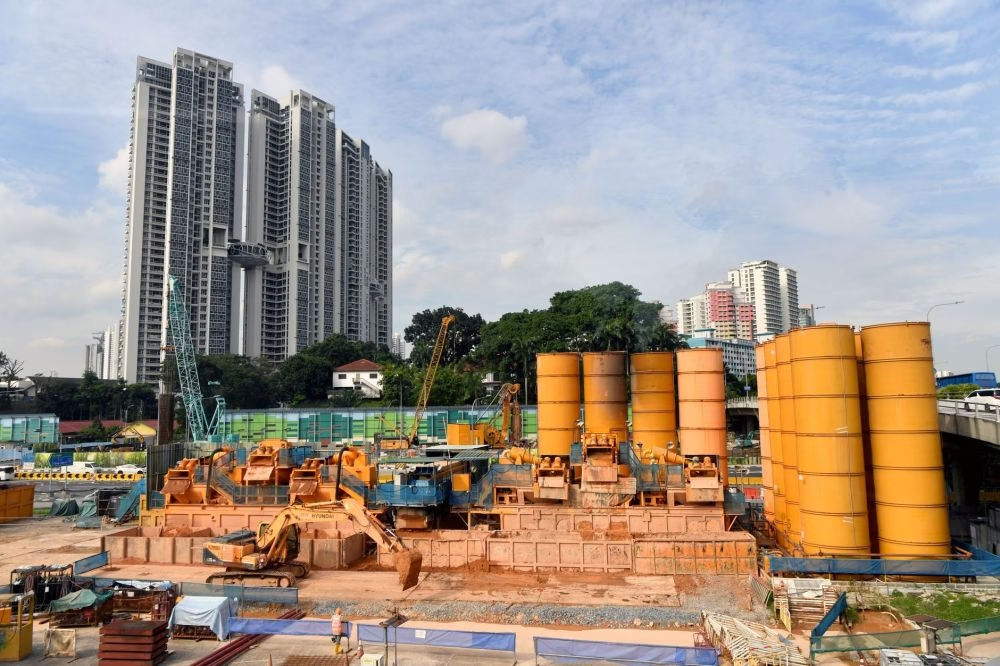
The CRL expansion signals a longer-term philosophy in Singapore’s transport planning: build the network outward to where people live and work, not just inward to the CBD. That is a meaningful shift in how commuter support is conceptualised at the planning level.
Extended operating hours: the MRT goes the extra mile
Supporting commuters means being available when commuters need you. For the 2026 BYD Singapore International Marathon, SMRT and SBS Transit extended MRT services to begin as early as 2.30am, with free rides offered to all passengers during that early window. Services ran through the extended period until normal operations resumed.
This is not a one-off gesture. Singapore has a consistent track record of extending train services for National Day, New Year’s Eve countdowns, and major sporting events. Check out how this service flexibility works in practice in our article on bus and train services extended on National Day Eve 2026. The Singapore MRT operating hours framework is actually more flexible than most commuters realise, and knowing this can save you a lot of money on late-night taxis.
For the marathon specifically, the 2.30am start time aligns with race wave departures. Participants travelling from the heartlands, including those coming from Punggol, Sengkang, or Jurong, could reach the start line by train rather than private hire car. That is a real, practical improvement in commuter support that deserves more attention.

What does a genuinely commuter-friendly network look like?
Put all the recent developments together, and a picture emerges. Singapore is working towards a network that is physically expansive, technologically smart, operationally flexible, and socially respectful. Each dimension requires a different kind of effort.
Physical expansion is the most visible. The CRL additions, the completed Circle Line Stage 6 (CCL6) which opened in July 2026, and the forthcoming JRL all extend the reach of the network to communities that previously depended heavily on buses. You can explore the full list of MRT stations in Singapore to see just how dense the network has become, or check our interactive Singapore MRT map to plan your own route with the latest station data.
Technological investment is accelerating. From AI maintenance tools to the facial recognition trial at Punggol Coast, operators are testing ideas at pace. Not all will stick, and some will face legitimate pushback. The direction of travel is clear though: use data to make the network more responsive to real commuter patterns.
Operational flexibility, as demonstrated by marathon and National Day extensions, is underappreciated. The network does not simply shut off at midnight and restart at 5.30am. It bends around the city’s social calendar. That is a form of commuter support that is easy to take for granted until the day you actually need a 3am train.
Social norms are the hardest to improve and the most important. The priority seat confrontation from August 2026 is a reminder that infrastructure alone cannot create a respectful commuting culture. Education campaigns, peer modelling, and yes, the occasional viral video calling out bad behaviour, all play a role. So does the willingness of bystanders to quietly offer help rather than wait for a confrontation to escalate.
How commuter support compares across different situations
| Situation | Current support available | Gaps or ongoing work |
|---|---|---|
| Elderly or mobility-impaired commuters | Priority seats, barrier-free access, lifts at all stations | Social enforcement of priority seats still inconsistent |
| Late-night event travellers | Extended hours for major events, free rides announced | Ad hoc rather than scheduled; commuters must check actively |
| Western industrial estate workers | East-West Line EW access; buses to Jurong Island | New CRL stations at Jurong Pier and Gul Circle targeted for late 2030s |
| Commuters concerned about safety | CCTV network, SMRT and LTA reporting channels | Facial recognition trial ongoing at Punggol Coast; outcomes pending |
| Payment and ticketing accessibility | SimplyGo, EZ-Link, contactless bank cards, Singapore Tourist Pass | Smooth across the board; facial recognition may add future option |
Looking at the table, some areas have mature, well-tested solutions. Others are very much works in progress. The western industrial corridor gap, for instance, will not close for well over a decade. That is a long time to wait if your daily commute involves a bus ride from Tuas to the MRT. Knowing what is in the pipeline at least helps you plan around it.
What commuters can actually do right now
Beyond waiting for policy and infrastructure to improve, there are things every commuter can do today. If you witness aggressive behaviour on the train, you can report it directly to SMRT or SBS Transit through their feedback channels. Both operators take these reports seriously, particularly when there is video evidence.
If you are unsure about fares, ticketing options, or how the distance-based fare structure works, our detailed guide on fares, ticketing and practical info for 2026 is the most complete resource on the site. Understanding your fare options, including the concession rates available for students, seniors, and persons with disabilities, is one of the most practical ways to make your commute cheaper and less stressful.
For commuters who frequently change lines or use LRT feeders in the north-east, keep our pages on the Punggol LRT and Sengkang LRT bookmarked. Those networks connect directly to the North East Line (NEL) and have their own service patterns worth knowing if you rely on them daily.
Before you tap in
The push to better support commuters in public transport is real, multi-layered, and ongoing. It shows up in big announcements like the CRL expansion, in quiet technology trials at a single station, in a free train ride at 2.30am, and in the social pressure that follows every viral priority seat video. None of these things alone is sufficient. Together, they add up to a network that is genuinely getting better at serving the full range of people who depend on it.
Check our interactive Singapore MRT map for the most current station and line information, and browse the blog for the latest updates as the network continues to evolve through 2026 and beyond.
FAQ
Keep exploring
- 4 New Cross Island Line Stations: Jurong Pier & Gul Circle
- Singapore MRT Operating Hours: First Train, Last Train, and Peak Hours Explained
- Circle Line Wayfinding Signs Upgraded After Passenger Feedback