
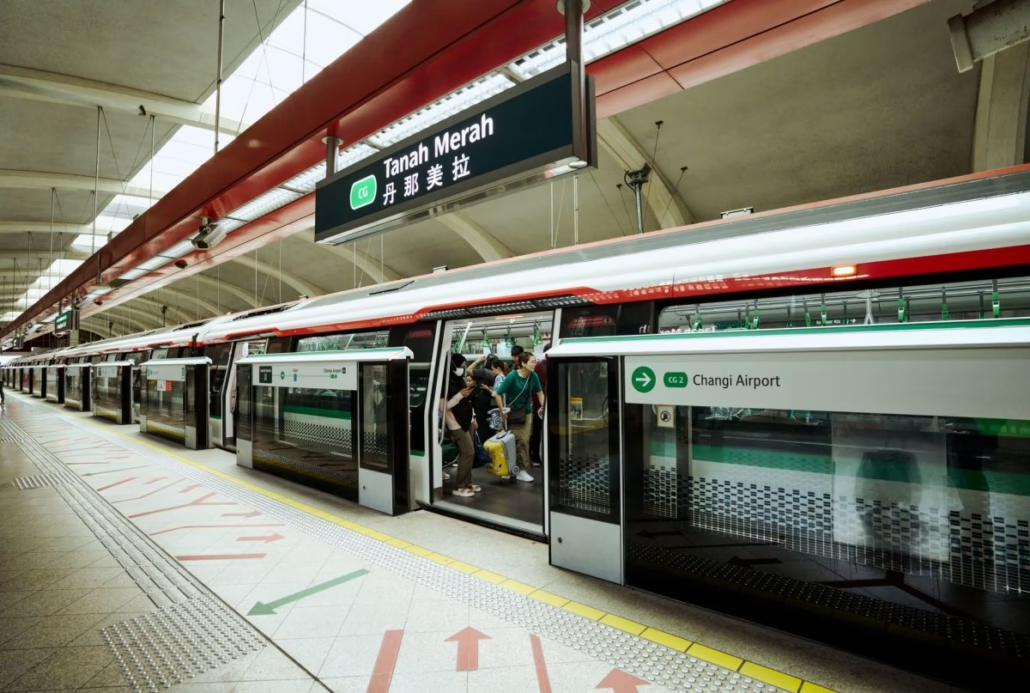
What Happened Near Marymount MRT Station?
On 24 September 2026, a video surfaced online showing a man allegedly using smart glasses to record female students from Raffles Institution near Marymount MRT station. The Singapore Police Force confirmed it is investigating. According to reports from Mothership and The Online Citizen, the suspect appeared to be deliberately following the students rather than simply passing by.
- What Happened Near Marymount MRT Station?
- What Are Smart Glasses and Why Are They Hard to Spot?
- Where Exactly Is Marymount MRT and Why Does Location Matter?
- Is This an Isolated Incident or a Wider Pattern?
- What Does Singapore Law Say About Covert Recording in Public?
- How MRT Stations Handle Safety Incidents Like This
- What Can Students and Parents Do Right Now?
- Stay Alert, Stay Connected
- FAQ
Marymount is a relatively quiet residential station on the Circle Line, sitting between Bishan and Caldecott. It serves a cluster of schools in the Upper Thomson and Bishan area, so the afternoon peak sees a steady flow of students in uniform alighting or transferring. That context matters, because it explains why someone lingering there with recording equipment would raise suspicions quickly among alert bystanders.
Getting around Singapore? Find any station on the interactive MRT map, or save the PDF map to use offline.
What Are Smart Glasses and Why Are They Hard to Spot?
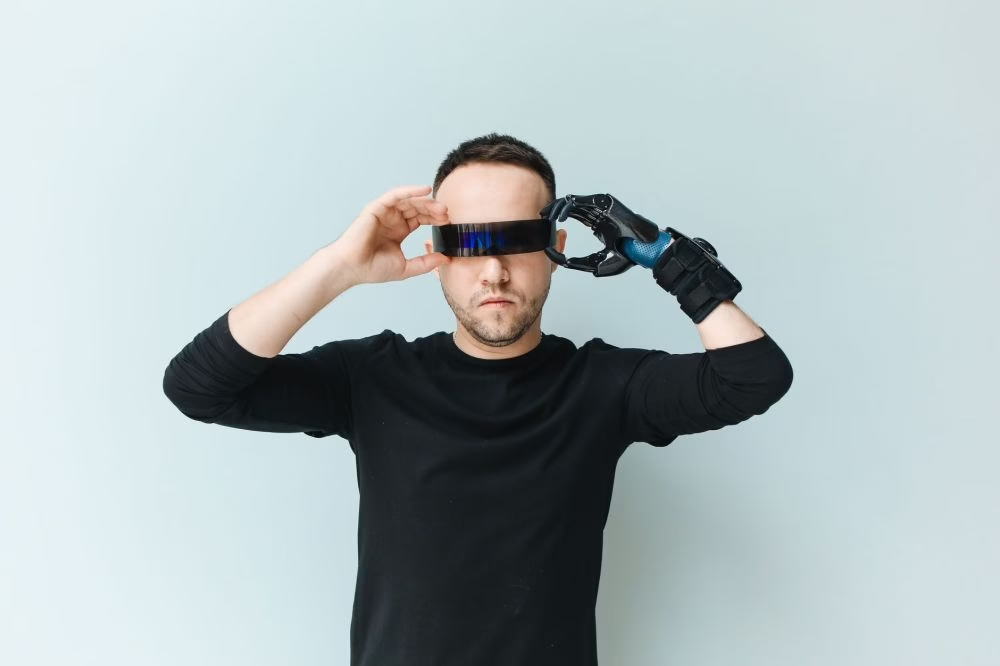
Smart glasses are wearable devices that look almost identical to ordinary spectacle frames but contain a miniature camera, sometimes paired with Wi-Fi or Bluetooth to stream footage directly to a phone or cloud account. Unlike a phone held up at eye level, the camera sits at face height and points wherever the wearer looks. That makes them extremely difficult for bystanders to notice.
Consumer models have been widely available since the early 2020s. Several brands ship units that record continuously in loops, saving only the last few minutes unless the wearer taps a button to keep a clip. Deletion of evidence is trivially easy. In this case, the footage captured by a concerned bystander on a regular smartphone became the key piece of evidence rather than anything retrieved from the alleged perpetrator’s device.
Singapore law is clear on this point. Section 377BB of the Penal Code criminalises voyeurism, including the use of equipment to observe or record a person in circumstances where that person has a reasonable expectation of privacy. A public street or MRT station may not feel obviously private, but courts have found that covertly recording someone without consent in a sexual manner still meets the threshold. Penalties can include a fine and up to two years’ imprisonment for a first offence.
Where Exactly Is Marymount MRT and Why Does Location Matter?
Marymount MRT (station code CC16) sits on the Circle Line between Caldecott (CC17) and Bishan (CC15). You can check the full network layout on our complete list of MRT stations in Singapore. The station has a single-island platform with two exits. Exit A leads directly towards Marymount Road and the pedestrian routes used by students heading towards Raffles Institution on Bishan Road, roughly a five to seven-minute walk away.
That walking route is largely residential and sheltered in parts, but there are stretches near the station entrance that are less trafficked in the late afternoon. It’s the sort of place where a lone individual following a group of students would eventually be noticed by the students themselves or by residents. In this case, a member of the public filmed the alleged behaviour and shared the footage, which then spread rapidly online.
| Detail | Information |
|---|---|
| Station name | Marymount MRT (CC16) |
| MRT line | Circle Line (yellow line) |
| Nearest school | Raffles Institution, Bishan Road (around 600 metres) |
| Exits | Exit A (Marymount Road side), Exit B |
| Interchange options | Change at Bishan for the North South Line (NSL) |
| Police status (as of 25 Sep 2026) | Active investigation confirmed by SPF |
For commuters who regularly use this stretch of the North South Line and Circle Line network to travel between Bishan, Caldecott, and the city, the area will feel very familiar. That familiarity can lull you into a false sense of security. Just because a route is routine doesn’t mean it’s risk-free.
Is This an Isolated Incident or a Wider Pattern?
Unfortunately, voyeurism cases linked to public transport corridors are not rare in Singapore. Earlier this year, we covered the case of a man jailed for 179 upskirt videos taken at MRT stations. Transit spaces attract opportunistic offenders partly because of the crowd density and the speed at which people move through. Smart glasses change the equation because the device is nearly invisible.
What’s shifted in 2026 is the technology available to ordinary people on both sides of this issue. Bystanders now have high-quality smartphone cameras and can share footage in seconds. The suspect in this case was identified and reported precisely because someone acted quickly and filmed what they saw. That’s exactly the kind of civic response the SPF encourages.

What Does Singapore Law Say About Covert Recording in Public?
Singapore’s voyeurism laws were significantly tightened in 2019 when Section 377BB was added to the Penal Code. Courts have since applied it to a range of covert recording scenarios beyond the obvious upskirt cases. Recording a person without consent with the intention of obtaining sexual gratification, or in a way that violates their privacy, is an offence regardless of whether the recording is shared afterwards.
The distinction between a tourist wearing smart glasses to document their holiday and someone using the same device to target individuals comes down to intent and context. Prosecutors look at how the device was pointed, the proximity to victims, and any pattern of behaviour such as following or repositioning. That’s why the video showing the alleged suspect trailing the students is considered significant evidence by investigators.
Beyond criminal law, the Personal Data Protection Act (PDPA) also places obligations on individuals who collect images of others in Singapore, though enforcement against individuals rather than organisations has historically been lighter. The criminal route under the Penal Code is the more immediate avenue for victims and witnesses to pursue.
How MRT Stations Handle Safety Incidents Like This
Every MRT station in Singapore has a customer service centre and CCTV coverage of the platform, concourse, and immediate surroundings. According to the Land Transport Authority (LTA), station staff are trained to respond to safety and security incidents and can contact the SPF within moments. If you alight from a train and see something suspicious, walking to the customer service counter is often the fastest way to get official eyes on the situation.
The area immediately outside the fare gates is technically public space rather than LTA-managed transit space, so incidents that happen on the street near the station exit fall primarily under SPF jurisdiction. SMRT, which operates the Circle Line, can share CCTV footage with police but has no enforcement powers outside the paid zone.
Station CCTV alone rarely captures incidents fully because the camera angles are optimised for platform safety, not street surveillance. Footage from bystanders’ phones often fills that gap. That’s another reason why the public’s instinct to document and report matters so much.
What Can Students and Parents Do Right Now?
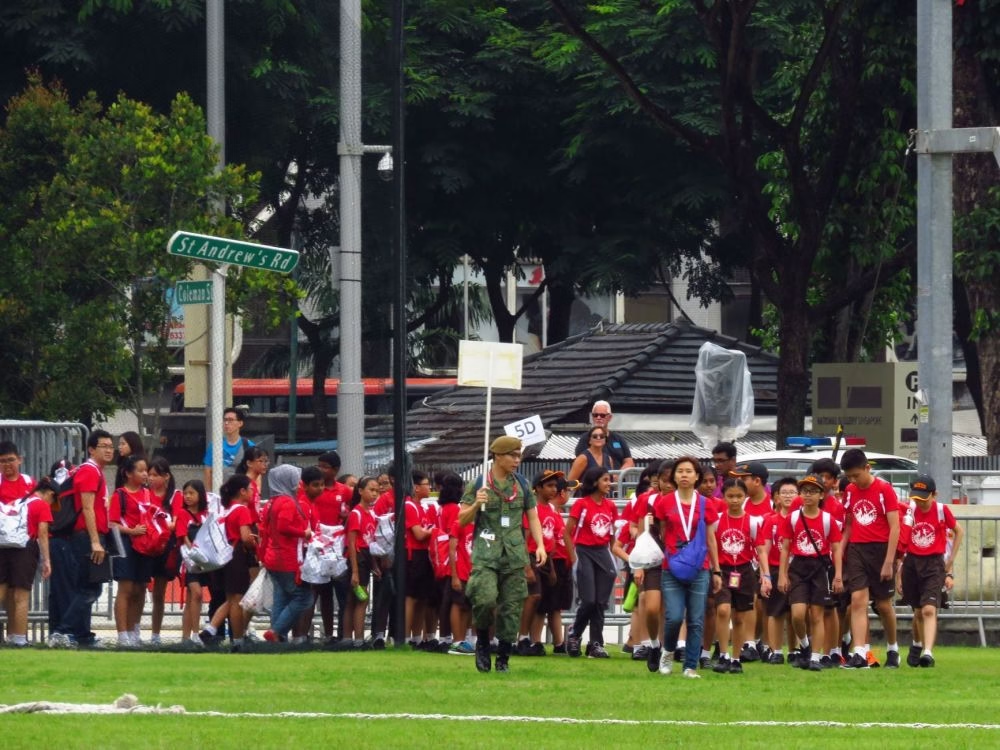
Walk in groups where possible, especially on the stretch between Exit A of Marymount MRT and Raffles Institution. If someone seems to be following you or positioning themselves unusually close, move towards a crowded area or into the station concourse where staff are present.
For students who use the Circle Line regularly, tapping in and out via SimplyGo or an EZ-Link card creates a timestamped record of your journey. That data, combined with station CCTV, has helped police reconstruct timelines in past cases. You can find more about how Singapore’s transit payment systems work, including the newer Apple Pay Express Mode now available at MRT and LRT fare gates, which went live in mid-August 2026.
Public transport safety is a shared responsibility. Singapore has made remarkable strides on the reliability side: our piece on MRT reliability hitting a record high in August 2026 shows the network is running better than ever. But a smooth, punctual train means nothing if commuters don’t feel safe walking to and from the station.
There’s also a broader conversation here about how authorities and the public deal with technology-enabled offences. Smart glasses are sold openly and legally. The same wearable that someone uses for navigation assistance or hands-free calls becomes a tool for harassment in the wrong hands. Singapore’s legal framework is ahead of many jurisdictions in addressing this, but enforcement depends heavily on the public’s willingness to notice and report. This incident is a reminder that vigilance isn’t paranoia.
For those interested in the wider context of safety and conduct on Singapore public transport, from noise violations to eating on trains, our transport news blog covers the full range. We also recently explored what happens when passengers play loud music on the bus, a separate but related question about public standards in shared transit spaces.
Stay Alert, Stay Connected
As of 25 September 2026, the SPF investigation into the Marymount MRT smart glasses incident is ongoing. No charges have been publicly announced. Check back here or follow the SPF’s official channels for updates as the case develops.
If you travel regularly on the Circle Line or live in the Bishan, Caldecott, or Upper Thomson area, bookmark our Circle Line guide for route information and our interactive Singapore MRT map to plan journeys quickly. Knowing your exits, your transfer points, and your surroundings is the simplest form of personal safety on any transit network.