

Last updated . Facts checked against LTA announcements.
The MRT is the backbone of getting around Singapore, connecting you from one end of the island to the other quickly and reliably. Knowing what has changed on the Singapore MRT map before you travel saves time and avoids wrong turns.
The Singapore MRT Map: What You Need to Know
Singapore’s MRT network has grown steadily over the years, with new lines and stations added to serve more of the island. The result is a system that now reaches most major residential areas, business districts and attractions without needing a car.
1. Recent Changes to the MRT Network
Several significant additions have reshaped the network in recent years. Key changes include:
- Thomson-East Coast Line (TEL): The TEL now links Woodlands in the north through the city centre and along the eastern coast. Stage 4 opened in June 2024, adding seven stations from Tanjong Rhu to Bayshore, and Stage 5 (Bedok South and Sungei Bedok) is due in the second half of 2026.
- Circle Line completed: Stage 6 opened on 12 July 2026, adding Keppel, Cantonment and Prince Edward Road. The Circle Line is now a full loop of 33 stations spanning about 39.5 km.
- North East Line extended: Punggol Coast opened in December 2024, bringing the NEL to 17 stations running from HarbourFront to Punggol Coast.
- Downtown Line expanded: Hume opened in February 2025, giving the DTL 35 stations across about 41.9 km. A further extension to Xilin and Sungei Bedok is planned for the second half of 2026.
These additions mean more of the island is within walking distance of an MRT station than ever before.
Getting around Singapore? Find any station on the interactive MRT map, or save the PDF map to use offline.
2. Reading the MRT Map Confidently
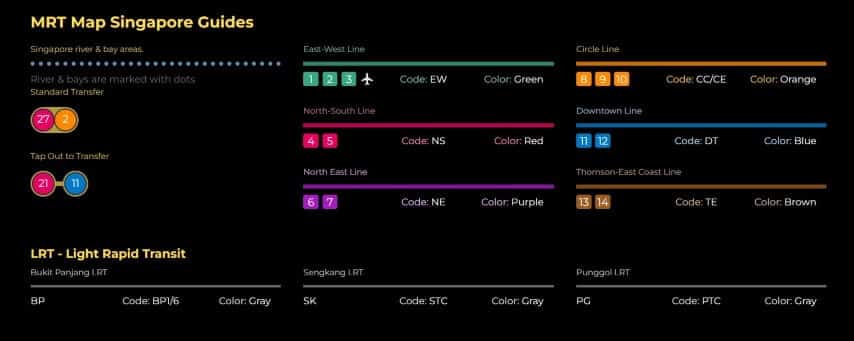
The MRT map looks complex at first, but each line has a distinct colour and every station carries a code that tells you the line and its position along it. Once you spot those codes, planning a route becomes straightforward.
Understanding the Colour Codes
Each line has a distinct colour, and knowing them makes reading the map much faster.
- North South Line (Red): Runs from Marina South Pier to Jurong East, passing through key stops like Orchard Road and Bishan.
- East West Line (Green): Covers the east and west of Singapore, including a branch to Changi Airport and a western terminus at Tuas Link.
- North East Line (Purple): Runs from HarbourFront to Punggol Coast, with stops through Chinatown and Little India. The line has 17 stations in total.
- Circle Line (Orange): Now a complete loop of 33 stations after Stage 6 opened in July 2026, it links the outer central areas without requiring a trip through the city centre.
- Downtown Line (Blue): Runs from Bukit Panjang to Expo, with 35 stations and good access to the city centre.
- Thomson-East Coast Line (Brown): Runs from Woodlands in the north through the city and along the eastern coast, currently as far as Bayshore.
- Cross Island Line (Lime Green): Still under construction. Phase 1, linking Aviation Park to Bright Hill, is targeted for 2030, with further phases to follow.
Planning Your Journey
Start by locating your origin and destination on the map. Find the most direct route and check whether you need to transfer at an interchange station. A journey planner app can give you a rough travel time before you set off.
3. Tips for Commuters
These pointers apply whether you are new to the network or just looking to travel more efficiently.
Use Mobile Apps for Real-Time Updates
Several apps show live train schedules, delay alerts and station information. Most include a digital MRT map so you can plan or adjust your route on the go.
Avoid Peak Hours When Possible
Trains get busy during the morning rush (roughly 7:00 to 9:00 AM) and the evening rush (roughly 5:00 to 7:00 PM), particularly on lines serving the central business district. If your schedule allows, travelling outside those windows makes for a noticeably more comfortable ride.
Use Interchange Stations for Transfers
Interchange stations are designed for switching between lines, and clear signage makes the process straightforward. Busy interchanges like Dhoby Ghaut, Raffles Place and Serangoon can get crowded during peak hours, so allow a little extra time if you are travelling then.
Explore the City by MRT
The MRT gives you direct access to Singapore’s neighbourhoods and attractions without the stress of traffic or parking. Chinatown and Little India are both a short ride on the Downtown Line, while the East West Line takes you through the city centre and out towards the east and west ends of the island. Download a free MRT map and plan your day around the stations closest to where you want to go.
4. Key Stations to Watch Out For
Some stations stand out because of their location, the number of lines they serve, or what surrounds them. These are worth knowing before you plan your trips.
Dhoby Ghaut (NSL/CCL/NEL)
Dhoby Ghaut is a three-line interchange connecting the North South Line, Circle Line and North East Line. It sits at the edge of Orchard Road, making it a useful starting point if you are heading to the main shopping belt or the museums and parks nearby.
Jurong East (NSL/EWL)
Jurong East connects the North South Line and the East West Line, making it the main interchange for the western part of the network. The area has several large shopping centres nearby, and it will eventually serve the Jurong Region Line when that opens around mid 2028.
Bayfront (CCL/DTL)
Bayfront is a transfer station between the Circle Line and the Downtown Line, making it straightforward to switch between the two. It sits close to Gardens by the Bay and Marina Bay Sands, so it is a practical stop if you are heading to that part of the waterfront. If you are plotting a downtown itinerary, this interchange gives you good options from either line.
Paya Lebar (EWL/CCL)
Paya Lebar is served by both the East West Line and the Circle Line, making it a useful interchange for east-side journeys. The station sits next to Paya Lebar Quarter, a large mixed-use development with shopping and dining nearby.
Conclusion
The Singapore MRT network is one of the most reliable ways to get around the city, and it keeps growing. Recent additions include Circle Line Stage 6 (which completed the full loop in July 2026), Thomson-East Coast Line Stage 4, Punggol Coast on the North East Line, and Hume on the Downtown Line. More is coming, with the Jurong Region Line expected around mid 2028 and the Cross Island Line targeting 2030.
Keeping up with the latest changes helps you plan faster, smarter journeys. A good grasp of the MRT map will save you time, whether you are commuting daily or exploring a new part of Singapore.
For official updates on the rail network, check the Land Transport Authority (LTA) website.
Frequently asked questions
How do I pay for MRT fares in Singapore?
You can pay using an EZ-Link or SimplyGo card, a contactless bank card, or a mobile wallet. If you are visiting Singapore for a few days, a Singapore Tourist Pass gives you unlimited MRT and bus travel for the duration you choose without needing to top up each time.
What MRT lines are still under construction or not yet open?
The Thomson-East Coast Line Stage 5 (Bedok South and Sungei Bedok) is due in the second half of 2026, as is the Downtown Line extension to Xilin and Sungei Bedok. Further ahead, the Jurong Region Line is targeted for around mid 2028 and the Cross Island Line Phase 1 for 2030, with later phases following in 2032 and the late 2030s.
Which MRT line should I take to get to Changi Airport?
Take the East West Line and switch to the Changi Airport branch at Tanah Merah station, then ride two stops to Changi Airport. The branch is marked on the map as CG and runs off the main East West Line, so check that your train is heading to Changi Airport rather than Pasir Ris before you board at Tanah Merah.