
Singapore MRT Reliability in July 2026: What You Need to Know
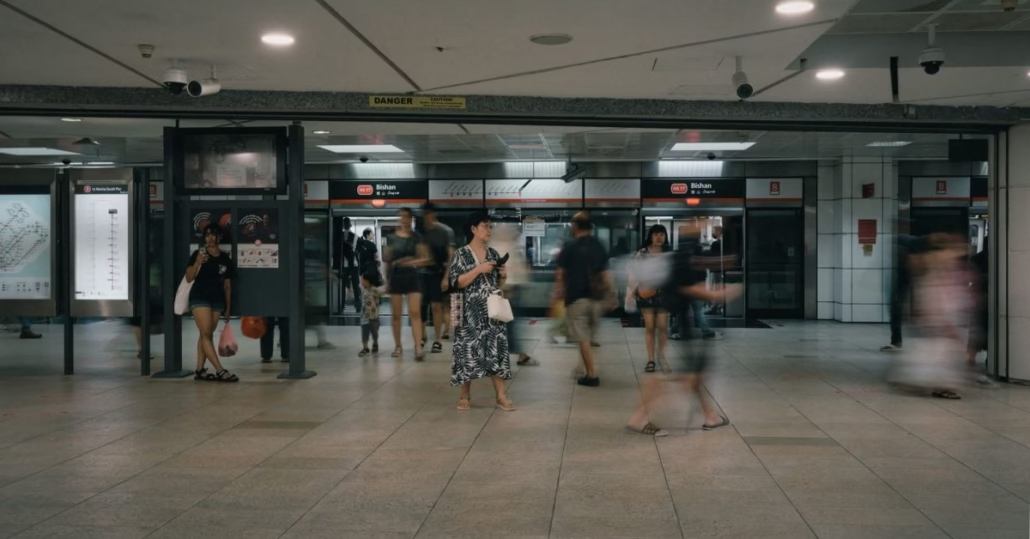
Nine months. That is how long Singapore’s MRT network has gone without a single delay lasting 30 minutes or more. As of August 2026, that streak is officially the longest the network has achieved since 2011, and it did not happen by accident.
- Singapore MRT Reliability in July 2026: What You Need to Know
- What Does the Two-Million Train-Kilometre Benchmark Actually Mean?
- How Does This Compare to Past MRT Performance?
- Which Lines Are Driving the Improvement?
- What Is Actually Keeping the Trains Running on Time?
- What Does a "Major Delay of 30 Minutes or More" Actually Mean for Commuters?
- How Does This Affect Passengers Who Rely on the Whole Network?
- What Is Still Being Built: The Bigger Reliability Picture
- Should You Feel Confident About the MRT Right Now?
- What This Milestone Means for Singapore's Transport Reputation
- Before You Tap In
- FAQ
If you ride the MRT daily, you have probably noticed things running more smoothly. Trains that actually arrive on time. Fewer apologetic announcements about platform holds. The kind of boring, uneventful commute that we spent years wishing for. Well, it looks like that wish is being granted, at least for now.
Let’s break down what the numbers actually mean, why this matters, and what is quietly driving the improvement.
What Does the Two-Million Train-Kilometre Benchmark Actually Mean?
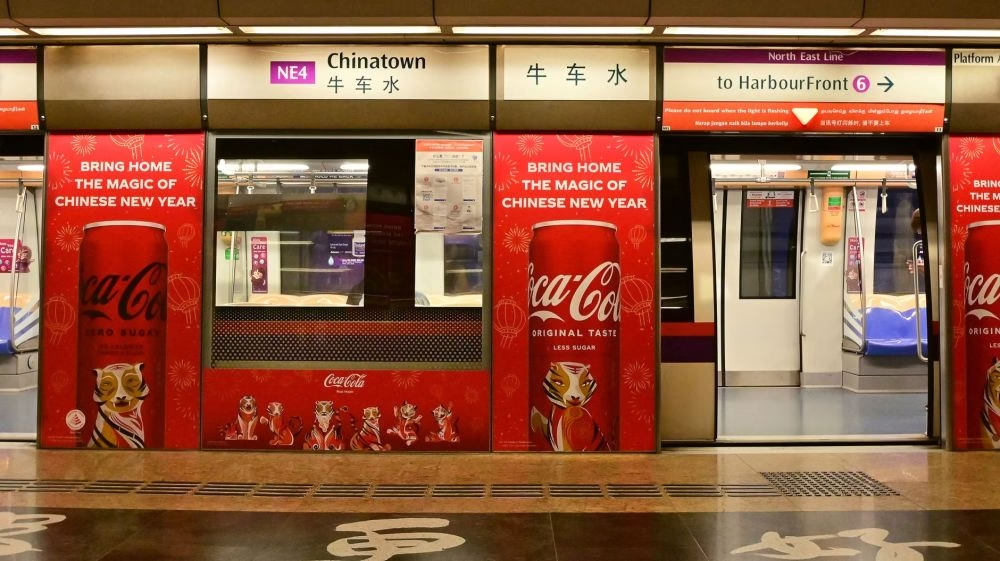
The Land Transport Authority (LTA) measures MRT reliability using a metric called mean kilometres between failures (MKBF), which tracks how many train-kilometres are clocked, on average, before a significant delay occurs. Crossing two million train-kilometres in a single month is considered a high-reliability threshold, and Singapore’s network has now done it four months in a row.
To put that in perspective: the MRT network runs across multiple lines, including the North South Line (NS), the East-West Line (EW), the Circle Line (CC), the Downtown Line (DT), the North East Line (NE), and the Thomson-East Coast Line (TE). Every train-kilometre across all of these is counted. Sustaining that figure above two million, month after month, across a network of this scale, is genuinely impressive.
According to reporting by The Straits Times in August 2026, the overall MKBF for July exceeded the two-million mark for the fourth consecutive month. That is not a fluke. That is a trend.
How Does This Compare to Past MRT Performance?
The nine-month streak without a major delay of 30 minutes or more is the longest since 2011, which was a very different era for Singapore’s MRT. Back then, the network was considerably smaller and less complex. The Downtown Line had not yet opened, the Thomson-East Coast Line existed only in planning documents, and the Circle Line had only recently been completed through its earlier stages.
The years between roughly 2011 and 2017 were difficult ones for the MRT’s public image. A series of high-profile disruptions, including the major December 2011 breakdowns on the North South and East-West Lines, eroded commuter confidence significantly. The LTA and operators SMRT and SBS Transit subsequently poured resources into maintenance upgrades, rail replacement programmes, and signalling system overhauls. Those investments are clearly paying off now.
You can track previous performance milestones in our earlier coverage of the third consecutive month above the two-million train-km mark, which gives useful context for how this current streak built up over time.
Which Lines Are Driving the Improvement?
The network-wide figure is the headline, but the picture across individual lines is worth examining. Operators SMRT and SBS Transit both manage different lines, and the reliability gains have not been uniform historically.
SMRT operates the North South Line, the East-West Line, the Circle Line, and the Thomson-East Coast Line. SBS Transit runs the North East Line and the Downtown Line. As of the most recent published data, both operators have been performing within the high-reliability range. The Thomson-East Coast Line, which is the network’s newest line and is still expanding southwards with its upcoming stages, has generally maintained strong reliability figures since its early stages opened.
The Circle Line is also worth noting: it only recently became fully complete when Circle Line Stage 6 (CCL6) opened in July 2026, adding three new stations at Keppel, Cantonment, and Prince Edward Road. Completing the loop after roughly three decades is a significant operational milestone, and the new infrastructure was built to current reliability standards from day one.
What Is Actually Keeping the Trains Running on Time?
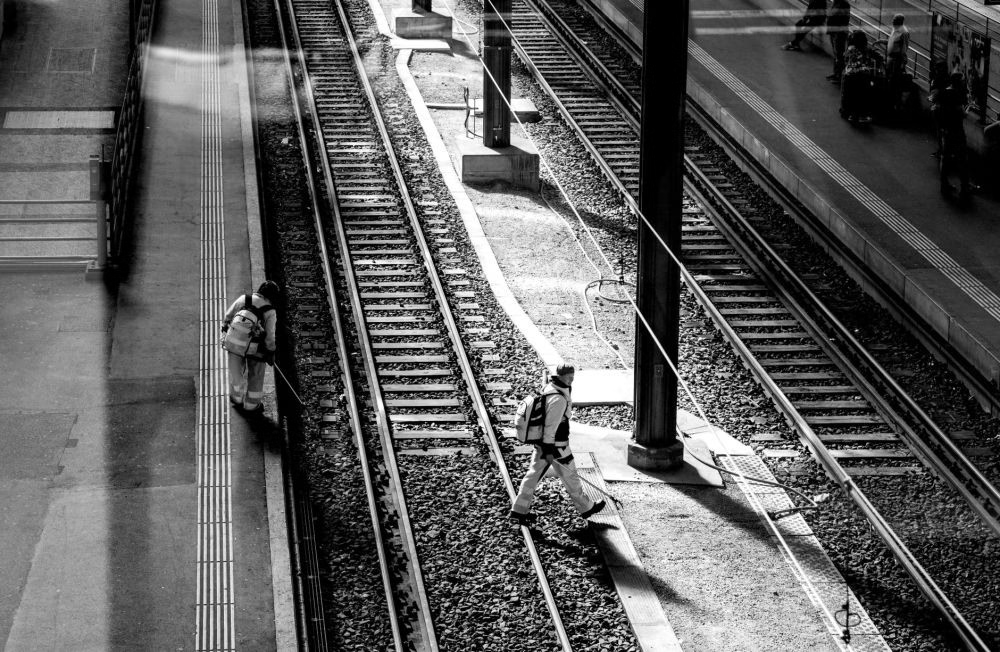
Several factors are working together behind the scenes. The most significant is the completion of major rail renewal programmes. The North South and East-West Lines underwent extensive sleeper and rail replacement works over multiple years, which directly reduced the frequency of track-related incidents. Older trains on these lines have also been progressively replaced or refurbished.
Technology has played a growing role too. Singapore has been deploying predictive maintenance systems, including axle-box monitoring technology that detects abnormal vibrations before a wheel or bearing failure can occur. We covered the rollout of this system in detail in our piece on the MRT axle-box monitoring system being rolled out across all lines by 2030. The early results are clearly showing up in these reliability numbers.
Artificial intelligence is also being applied to the metro network more broadly. According to our earlier reporting on Singapore’s use of AI on the metro network, machine learning tools are now helping to anticipate fault patterns earlier than traditional inspection cycles would allow.
What Does a “Major Delay of 30 Minutes or More” Actually Mean for Commuters?
A delay of 30 minutes or more affecting more than 30 trains in a single direction is the official threshold the LTA uses to classify a significant disruption. When such an event happens, operators are required to activate free bus bridging services and make formal announcements across affected stations.
From a commuter’s perspective, a 30-minute-plus delay during morning peak hours is genuinely disruptive. If you are travelling from, say, Woodlands or Jurong East towards the CBD for a 9am start, a 30-minute hold can easily translate into being late for work even after accounting for bus bridging. The fact that this has not happened across the entire network for nine months is meaningful in everyday terms, not just as a statistic.
Shorter delays, those under 30 minutes, do still occur from time to time and are not captured by this headline figure. That is worth keeping in mind. The network is not perfect. But the absence of catastrophic, network-halting events for this long is a genuine sign of improved underlying infrastructure health.

How Does This Affect Passengers Who Rely on the Whole Network?
For most commuters in Singapore, the MRT is not just one line. You might tap in at a North South Line station in Yishun, change at Dhoby Ghaut to the North East Line, and alight near Chinatown. A disruption on any one of those lines cascades across your entire journey. So when the whole network stays clean for nine months, the compound benefit for multi-line commuters is larger than the single number suggests.
This is also relevant for commuters who use the LRT feeder networks. The Bukit Panjang LRT, the Sengkang LRT, and the Punggol LRT all feed passengers onto MRT trunk lines. A smooth MRT network means those feeder journeys actually connect reliably at the interchange end.
Payment has also gotten considerably smoother. With SimplyGo now fully established, you can tap in and tap out using contactless bank cards or your phone without needing a separate EZ-Link card. Fewer fumbles at the fare gate mean smoother passenger flow, which indirectly reduces platform crowding and dwell time at busy stations. Our guide on how to pay for the MRT covers all the current options.
What Is Still Being Built: The Bigger Reliability Picture
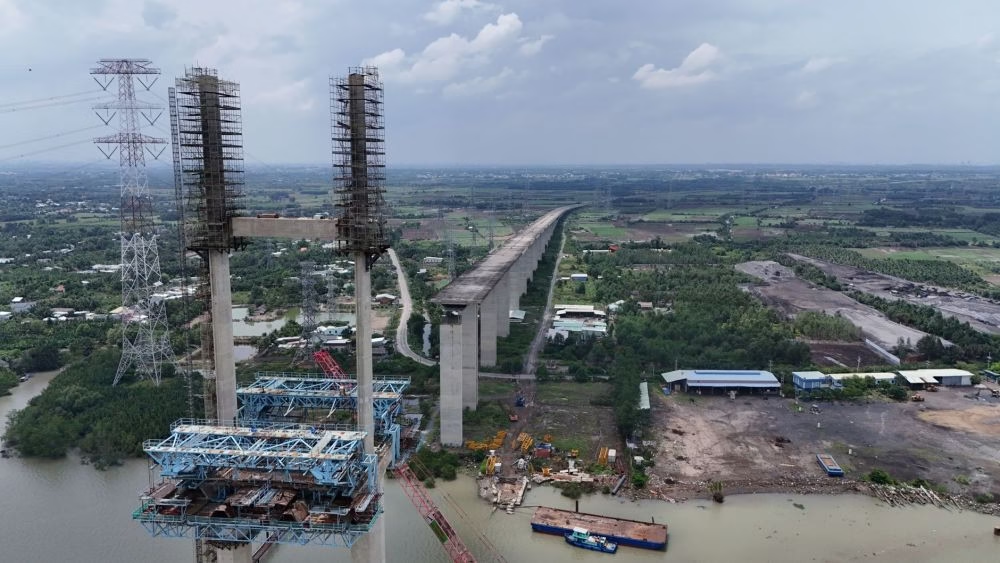
The current strong performance comes at a point when Singapore’s rail network is also mid-expansion. The Cross Island Line (CRL) is under construction, with Phase 1 scheduled to open and further phases extending the line through the coming years. In July 2026, Mothership reported that four additional CRL stations are planned by the late 2030s to serve Taman Jurong and western industrial estates. Our detailed coverage of Cross Island Line Phase 3 and its four new stations has the full breakdown.
On the infrastructure side, South Korean firm Gaon Cable won its first Singapore MRT power cable contract in August 2026, supplying components that will eventually feed into the expanded network. Reliable power supply is foundational to train reliability, so investments at this level matter for the long-term trajectory. Read more in our piece on the Gaon Cable MRT power grid contract.
| Milestone | Detail | Significance |
|---|---|---|
| 9 months no major delay | November 2025 to July 2026 | Longest streak since 2011 |
| MKBF above 2 million train-km | 4 consecutive months as of July 2026 | High-reliability threshold sustained |
| CCL6 opened | July 2026 (Keppel, Cantonment, Prince Edward Road) | Circle Line now fully complete |
| Axle-box monitoring rollout | Target: all lines by 2030 | Predictive fault detection before failures occur |
| CRL Phase 3 expansion | 4 new stations, late 2030s target | Network growth with Jurong and western industrial access |
Should You Feel Confident About the MRT Right Now?
Honestly? More so than at any point in the past decade. Nine months without a major disruption is a statistic worth celebrating, but the more meaningful signal is the sustained improvement in MKBF. That metric tells you something about the underlying health of the infrastructure, not just whether you happened to be lucky on a given day.
That said, complacency is the enemy of reliability. The network is growing. The CRL will add significant new complexity when it opens. More passengers are using the system post-pandemic. The challenge for the LTA, SMRT, and SBS Transit is maintaining this standard while simultaneously integrating new infrastructure, new trains, and new technology.
What This Milestone Means for Singapore’s Transport Reputation
Singapore’s MRT has long been held up internationally as a model of urban mass transit. The disruptions of the mid-2010s dented that reputation at home, even if the system remained objectively better than most cities of comparable size. Getting back to a place where nine months pass without a single major breakdown restores something more than just commuter confidence. It restores the sense that the system is genuinely world-class again.
For visitors using a Singapore Tourist Pass to get around, or travelling from Changi Airport to town on the East-West Line, a reliable network means the experience matches the reputation Singapore works hard to project. That matters for tourism, for business, and for the everyday commuter in Tampines who just needs to get to work on time.
The full network overview, including all current lines and stations, is available on our complete MRT stations guide if you want to explore what the network looks like today versus where it is heading.
Before You Tap In
Nine months and counting. Singapore’s MRT reliability is at its best in over a decade, and the data from July 2026 confirms this is not a one-off result but a sustained trend built on real infrastructure improvements. Keep an eye on the monthly LTA figures, which are typically released mid-month, to see whether the streak extends into double digits. For more context on the full history of this reliability run, our dedicated piece on the nine-month no-major-delay streak has everything in one place.
FAQ
Keep exploring
- MRT Goes 9 Months Without a Major Delay: Longest Streak Since 2011
- MRT Reliability Above 2 Million Train-km for Third Month
- MRT Axle Box System Coming to All Lines by 2030