
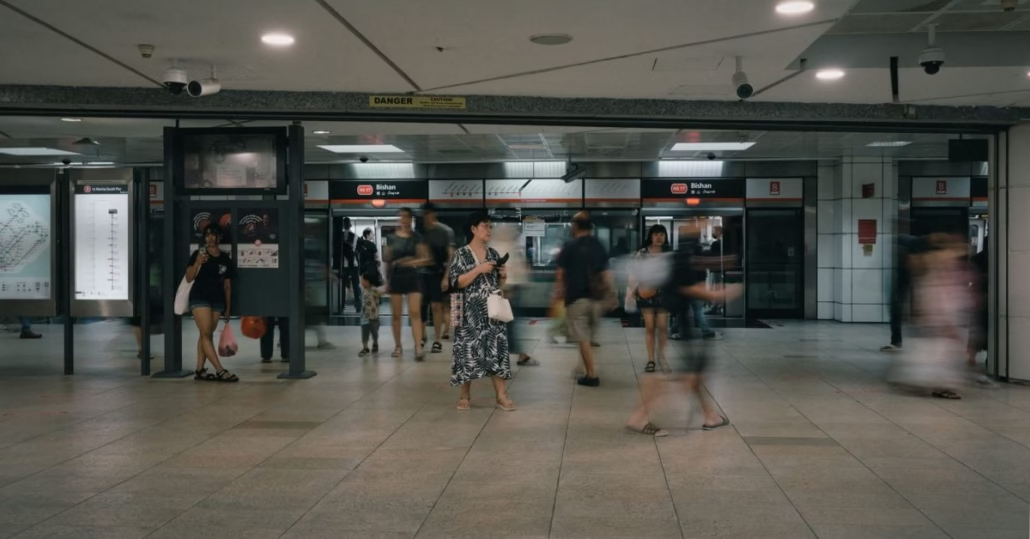
Singapore’s MRT Just Hit a Reliability Milestone You Should Actually Care About
Nine months. No delay longer than 30 minutes. And a mean kilometres between failure figure that has now crossed 2 million train-kilometres. If you ride the MRT every day, these numbers are not just press release statistics. They are the reason you have been reaching your office, your hawker centre lunch spot, and your evening plans on time without constantly refreshing service alerts on your phone.
- Singapore's MRT Just Hit a Reliability Milestone You Should Actually Care About
- What does "2 million train-km" actually mean?
- Which lines are driving the improvement?
- Nine months without a major delay: why that record matters
- What has changed behind the scenes?
- Does this mean the MRT is now delay-proof?
- How artificial intelligence and technology are supporting rail reliability
- What the 2 million train-km milestone means for your daily commute
- Before you tap in
- FAQ
On 14 August 2026, the Straits Times, CNA, and AsiaOne reported that the Land Transport Authority (LTA) had confirmed July 2026 as the fourth straight month of high reliability, pushing the no-major-delay streak to nine months. That matters because it surpasses what the network managed in the years immediately after some of the worst disruptions Singapore’s rail system has ever experienced.
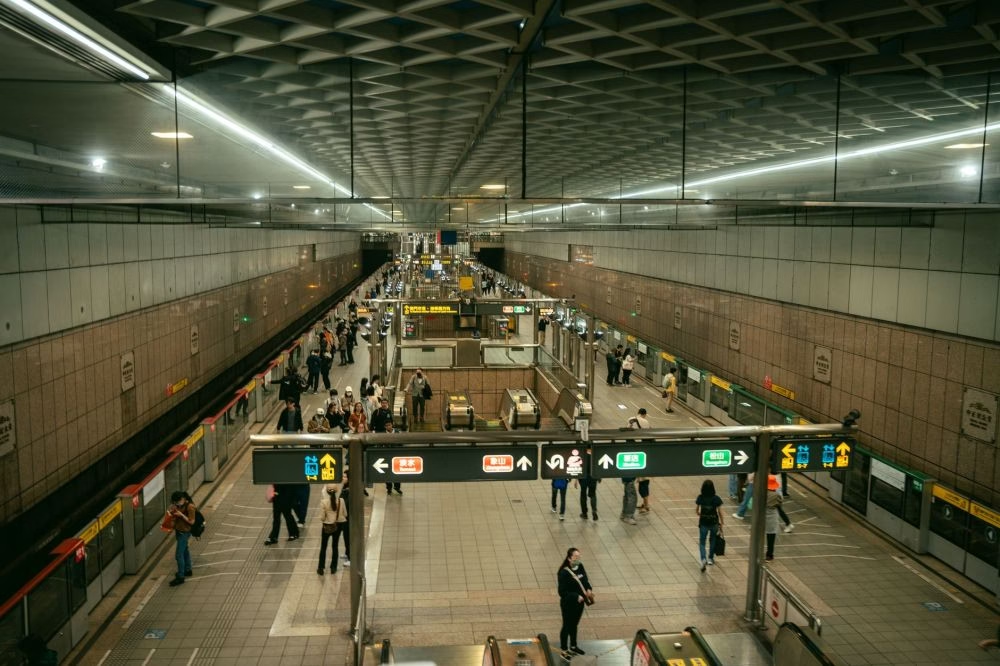
What does “2 million train-km” actually mean?
The MKBF figure tells you how many kilometres the entire fleet travels, collectively, before a failure serious enough to cause delays actually happens. Higher is better. Crossing 2 million train-km means the network runs long stretches of service before anything goes wrong enough to affect you.
Think about the scale. Singapore’s MRT trains operate from around 5.30am until just past midnight, with lines like the North South Line, the East-West Line, and the Thomson-East Coast Line running every two to five minutes during peak hours. The sheer daily mileage means a 2 million MKBF reflects genuinely consistent, well-maintained operations across the board.
For context, the LTA has progressively raised its MKBF benchmark over the years. Hitting 2 million train-km network-wide, rather than on a single line, is a collective achievement across both SMRT and SBS Transit, who operate different lines under the Network Licence framework.
Which lines are driving the improvement?
While the LTA reports MKBF as a network-wide figure, individual lines have their own performance stories. The Thomson-East Coast Line, steadily expanding over recent years, has posted strong reliability numbers as a newer line with modern rolling stock and infrastructure. The Downtown Line, operated by SBS Transit, has similarly benefited from being fully underground and fully automated.
Older lines like the North South Line and East-West Line have historically been tougher to maintain, given their age and station density, particularly at major interchanges like Jurong East, Raffles Place, and City Hall. That these lines are now contributing to a network-wide MKBF above 2 million reflects years of sustained investment in rail maintenance, asset renewal, and technology upgrades.
One technology worth noting: the MRT axle box monitoring system uses sensors to detect early wear before it becomes a failure. This system is on track to cover all MRT lines by 2030, and it is precisely the kind of predictive maintenance that keeps trains running smoothly without surprising you the next morning.
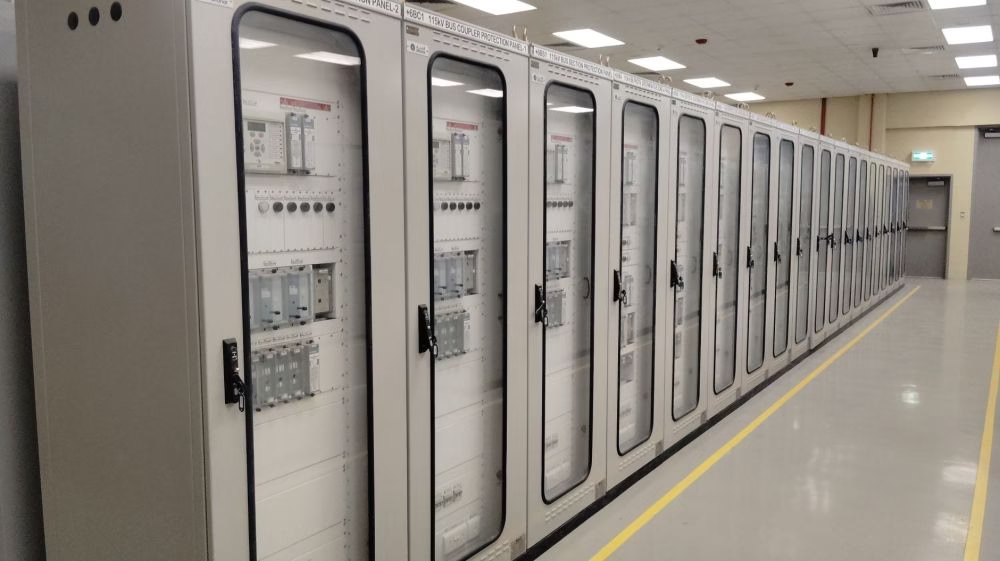
Nine months without a major delay: why that record matters
A major delay is defined as any service disruption lasting 30 minutes or more. Going nine consecutive months without one, from November 2025 through July 2026, is the longest streak since 2011. That is not a small detail. The early 2010s saw some of Singapore’s most severe MRT breakdowns, and the years that followed brought heavy investment, investigations, and a fundamental reset of network management.
The fact that the network is now matching and extending beyond pre-breakdown reliability levels signals that the recovery is genuine and structural, not just a lucky run of quiet months. For the full context of this streak, read our dedicated article on the nine-month record.
Practically speaking, if you commute daily between Woodlands and the CBD, or from Tampines to one-north, you have spent the last nine months not needing to budget in a worst-case 45-minute delay buffer. That is a genuine quality-of-life improvement, even if it feels invisible simply because nothing went wrong.
| Period | MKBF (approx.) | Months Without Major Delay | Notable Context |
|---|---|---|---|
| 2011 (pre-breakdown) | ~1 million+ | Previous record streak | Before major December 2011 disruptions |
| 2022-2023 | ~1.5 million | Improving but inconsistent | Post-COVID recovery, asset renewal ongoing |
| May-July 2026 | Over 2 million | 4th consecutive high-reliability month | New CCL6 stations open; TEL near full operation |
| Nov 2025-Jul 2026 | Sustained above target | 9 months (new record) | Longest streak since 2011 |
What has changed behind the scenes?
Better reliability does not happen by accident. Several structural changes over the past few years have quietly compounded into today’s strong results.
First, the rail financing framework was restructured so that the government owns the rail assets, while operators like SMRT and SBS Transit focus on operations and maintenance rather than managing capital expenditure for ageing equipment. This freed operators to invest in maintenance without pressure to squeeze margins from ageing assets.
Second, overnight maintenance has become far more rigorous. Every night after the last train runs, engineering teams work through a tight window to inspect tracks, replace worn components, and check signalling systems. More sophisticated diagnostic tools, including the axle box monitoring sensors mentioned earlier, catch problems before they become disruptions.
Third, the network itself now has more redundancy built in. The completion of Circle Line Stage 6 in July 2026, which added Keppel, Cantonment, and Prince Edward Road stations to complete the full loop, gives you more routing options. When one segment faces pressure, more passengers can reroute without any single line becoming overwhelmed.
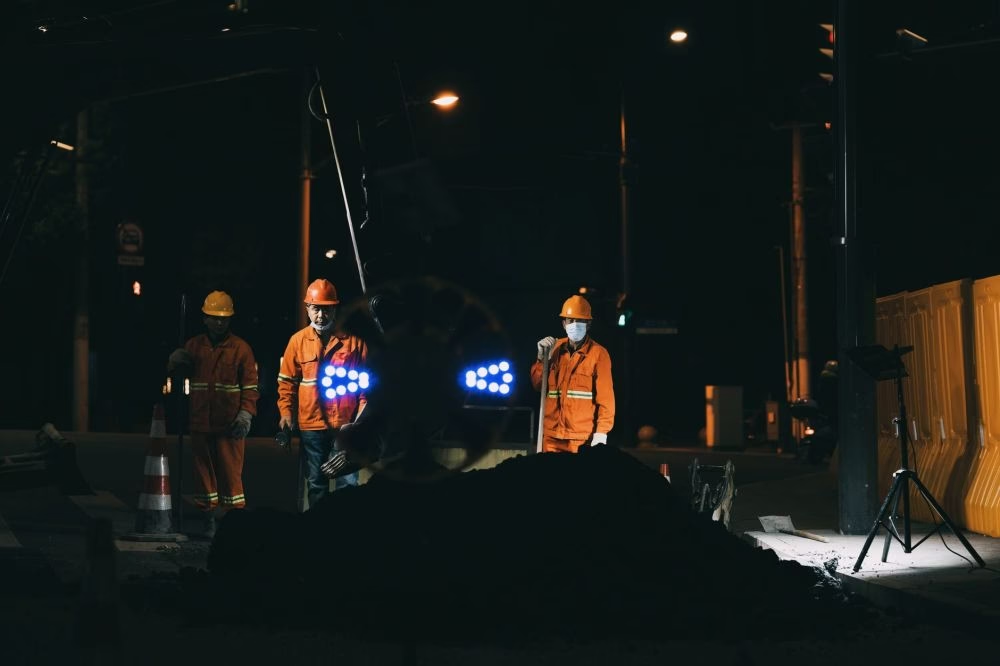
Does this mean the MRT is now delay-proof?
Honestly, no. No system is. What the data shows is that the probability of a disruption affecting your journey has fallen to historically low levels as of August 2026. But the MRT carries millions of passengers daily across hundreds of kilometres of track, and engineering reality means faults will still occur.
The goal is not perfection. It is consistency. A network that runs reliably 99% of the time is one you can plan around, and that is where Singapore appears to be right now. The nine-month streak will eventually end. What matters is how quickly the network recovers when it does, and whether underlying infrastructure investments continue.
There are also ongoing expansion projects that will test reliability in new ways. The Cross Island Line, Singapore’s eighth MRT line, is under construction and will eventually connect Jurong and the eastern suburbs. When its first phase opens, the CRL will bring significant new capacity, and integrating a major new line into an already-busy network always carries operational complexity. Additionally, four additional CRL stations serving Taman Jurong and western industrial estates are planned for the late 2030s.
How artificial intelligence and technology are supporting rail reliability
Beyond physical maintenance, Singapore is integrating artificial intelligence into MRT network management. AI-driven tools now predict faults, optimise train scheduling, and manage crowd flows at busy interchanges like Jurong East, Raffles Place, and Bugis. These systems do not replace human operators but give them significantly better information to act on.
On the passenger side, the shift to contactless payment through SimplyGo, EZ-Link cards, and bank contactless options has reduced friction at fare gates. Faster tap-in and tap-out means platforms clear more quickly during peak hours, keeping trains to their schedules. If you have not yet switched to SimplyGo for your daily commute, it is genuinely worth doing.
There is even a facial recognition fare payment trial underway at Punggol Coast MRT, which could eventually make the tap-in process faster still. Read more about how that trial works and what it might mean for future commuting.

What the 2 million train-km milestone means for your daily commute
The practical point is straightforward. As of August 17, 2026, the Singapore MRT is operating at the highest reliability levels it has seen in over a decade. Whether you commute on the North East Line, the Thomson-East Coast Line, or any other line in the network, the statistical likelihood of your journey being disrupted is lower than it has been in years.
For those planning visits to Singapore, this is also good news. A reliable MRT means the city’s public transport network is a genuine alternative to taxis and ride-hailing apps for getting around. Fares remain distance-based and, for most journeys within the city, cost well under S$2.50 for an adult. Check our complete guide to MRT fares and ticketing for 2026 for specifics on what different trips cost.
Before you tap in
Singapore’s MRT reliability hitting 2 million train-km MKBF in July 2026, while completing nine months without a major delay, is one of the most positive reliability stories the network has seen since before the disruption era of the early 2010s. It reflects sustained investment, smarter maintenance, and a network that keeps growing to serve more commuters. Head over to our full July 2026 MRT reliability breakdown for line-by-line numbers, or check our Singapore MRT map to plan your next journey across what is, right now, one of the world’s most reliably running metro systems.
FAQ
Keep exploring
- MRT Goes 9 Months Without a Major Delay: Longest Streak Since 2011
- MRT Reliability Above 2 Million Train-km for Third Month
- MRT Axle Box System Coming to All Lines by 2030