
Singapore Student Discovers He’s Trending for Being Noisy on MRT, While Already in Hong Kong
Most of us check our phones the moment we clear customs at a new airport. For one Singaporean student, that post-flight scroll delivered a very unexpected surprise: he had gone viral back home for being loud on the MRT, and the internet had already made its judgment before he even touched down in Hong Kong.
- Singapore Student Discovers He's Trending for Being Noisy on MRT, While Already in Hong Kong
- What Did the Student Actually Do on the MRT?
- Is Being Noisy on the MRT Actually Against the Rules?
- How Does Singapore's MRT Etiquette Compare to Hong Kong's MTR?
- Why Do These Viral MRT Videos Keep Happening?
- What Are the Actual Rules for Commuter Conduct on the MRT?
- Is the "Quiet Carriage" Concept Coming to Singapore?
- What Happened After the Student Found Out He Was Trending?
- Why This Story Matters Beyond the Laughs
- Before You Tap In
- FAQ
First reported by 8days.sg on 25 September 2026, the story struck a chord because it is both funny and oddly relatable. The student had no idea he was being filmed. By the time he was somewhere over the South China Sea, the clip had already racked up shares, comments, and hot takes from Singaporeans who ride the same trains every single morning.
So what exactly happened? Why did it spread so fast? And what does Singapore actually say about noise on the MRT? Let’s get into it.

Getting around Singapore? Find any station on the interactive MRT map, or save the PDF map to use offline.
What Did the Student Actually Do on the MRT?
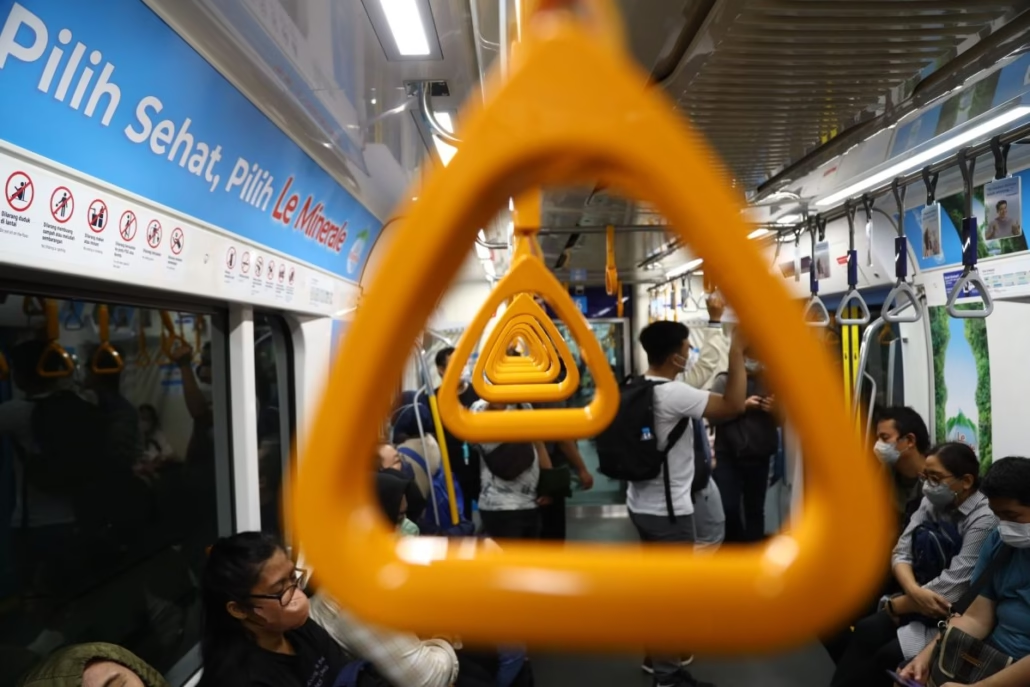
Based on reporting from 8days.sg, the student was filmed being noticeably noisy on board an MRT train. The video captured the kind of behaviour that tends to attract glares during a morning commute. The exact line and station have not been officially confirmed, but it happened in a typical train carriage during what appeared to be regular service hours.
The clip spread widely on local social media platforms. Singaporeans being Singaporeans, the conversation moved quickly from the clip itself to broader questions about commuter conduct. Some commenters were sympathetic, pointing out that the student likely did not realise how much sound carries in a quiet train cabin. Others were less forgiving.
What made the story particularly compelling was the timing. The student reportedly landed in Hong Kong, switched his phone back on, and discovered the trending posts. Finding out you are the subject of a national conversation while you are literally in another country would shake anyone.
Is Being Noisy on the MRT Actually Against the Rules?
There is no single dedicated rule that specifically bans noise on Singapore’s MRT, but that does not mean anything goes. The Land Transport Authority (LTA) oversees conduct on the network, and the Rapid Transit Systems Act covers a range of offences on trains and in stations. General disruptive behaviour can fall under the Miscellaneous Offences (Public Order and Nuisance) Act if it reaches a level that causes alarm or distress to fellow commuters.
The more commonly cited parallel is the rule on playing audio aloud. Singapore has taken a clear stance on buses: as reported by the BBC in late September 2026, playing loud music on a public bus can result in fines of several hundred Singapore dollars. While that specific enforcement relates to buses, the underlying principle applies across the network: do not disturb fellow commuters.
You can read more about the bus music fine rules and how they relate to broader public transport etiquette in our article on playing loud music on the bus and the fines involved. The MRT side of things is governed similarly in spirit, even if the penalty structure differs slightly in practice.
In practical terms, LTA and the train operators, SMRT on the North South Line (NSL), East West Line (EWL), Circle Line (CCL) and Thomson-East Coast Line (TEL), and SBS Transit on the North East Line (NEL) and Downtown Line (DTL), rely heavily on social pressure and staff intervention rather than on-the-spot fines for noise complaints. That is partly what makes viral videos so effective as a deterrent.
How Does Singapore’s MRT Etiquette Compare to Hong Kong’s MTR?
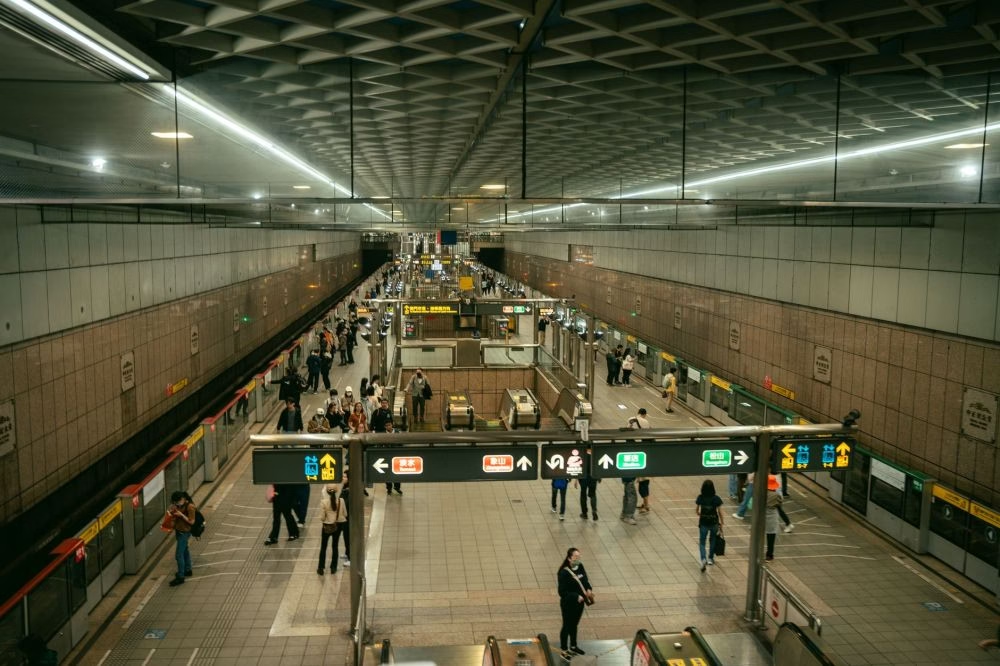
The irony of a student trending for MRT noise while travelling to Hong Kong is not lost on anyone familiar with both cities. Hong Kong’s Mass Transit Railway (MTR) is famously quiet. Announcements explicitly ask passengers to keep their voices down and to switch phones to silent. The cultural expectation of near-silence on the train is arguably even stronger in Hong Kong than in Singapore.
| Aspect | Singapore MRT | Hong Kong MTR |
|---|---|---|
| Noise rules | General conduct guidelines; no standalone noise ban | Explicit request to keep voices down in carriages |
| Eating and drinking | Banned; S$500 fine for first offence | Banned; fines apply |
| Mobile phone calls | Allowed; no legal restriction | Allowed but culturally discouraged |
| Enforcement style | Social pressure, staff intervention, viral videos | Social pressure, staff announcements, fines |
| Priority seats | Reserved; social norm to give up if needed | Reserved; same expectation |
So the student effectively swapped one quiet train culture for another. Whether he adjusted his volume for the MTR is not something the internet has weighed in on yet.
Why Do These Viral MRT Videos Keep Happening?
Singaporeans are among the most connected commuters in the world. Nearly everyone on a train has a capable smartphone. The trains themselves are well-lit, relatively quiet, and designed in a way that makes any disruption immediately obvious. That is the perfect recipe for viral content.
The social dynamics at play are interesting. Most Singaporeans will not say anything directly to a noisy commuter. It is not unique to Singapore, the same pattern plays out in Tokyo, Seoul and yes, Hong Kong. But where direct confrontation is rare, filming and sharing is increasingly common. The online audience then does what the physical carriage did not: it reacts loudly.
This is not a new phenomenon on the network. We have covered similar flashpoints before, including a heated confrontation over a backpack on the MRT and the ongoing debate about children eating on MRT trains. Each time, the comments section becomes a referendum on what counts as acceptable public behaviour in Singapore.
What Are the Actual Rules for Commuter Conduct on the MRT?
Singapore’s MRT conduct rules cover a specific list of prohibited actions. Noise from passengers falls into a grey area, but the clearer rules are worth knowing, especially if you are a student or first-time commuter.
Under the Rapid Transit Systems (Prohibited Conduct) Regulations, you cannot eat or drink on trains or in paid areas of stations. The fine for eating or drinking starts at S$500 for a first offence. Smoking is banned throughout the network. Littering, vandalism, and creating a public nuisance are all separately actionable offences. The Land Transport Authority publishes the full conduct guidelines on its website.
As of September 2026, there is no specific monetary penalty listed for general noise alone. But if noise becomes harassment or causes distress to other commuters, it can be escalated. Train staff from SMRT and SBS Transit are trained to manage these situations. Most platforms and concourses now have CCTV coverage that can be reviewed if a complaint is lodged.
Is the “Quiet Carriage” Concept Coming to Singapore?
Some countries designate specific quiet carriages on long-distance trains, but Singapore has never formally adopted the concept for its urban MRT network. Given that most journeys on the MRT are relatively short, typically under 30 minutes from one end of a line to the other, a formal quiet zone has not been seen as necessary by LTA or the operators.
That said, the conversation comes up periodically. Commuter forums and social media threads regularly suggest it, particularly on longer routes like the East West Line (EWL, Green Line), which runs from Tuas Link all the way to Pasir Ris, or the Thomson-East Coast Line (TEL, Brown Line), which is still expanding. You can check all current station listings on our MRT stations in Singapore page.
For now, the closest thing to a quiet standard on Singapore trains is the unspoken social contract that most commuters follow: headphones in, phone on silent, and voice at a volume you would use in a library. Most people get it right. The ones who do not occasionally end up trending.
What Happened After the Student Found Out He Was Trending?
According to 8days.sg’s reporting, the student found out about the viral clip after landing in Hong Kong. Details about any formal follow-up, whether he addressed the video publicly or whether any complaint was lodged with the authorities, had not been confirmed as of 27 September 2026.
What is confirmed is that the story generated significant engagement online. Many Singaporeans shared their own experiences of noisy fellow commuters and debated where the line sits between being loud and being genuinely disruptive. That debate is a healthy one. It reflects a community that genuinely cares about the quality of the shared commuting experience.
It is also a useful reminder that the MRT is a very public space. Our coverage of commuter complaints about feeding children on the MRT touched on the same tension: when does personal behaviour cross into a matter for the whole carriage? There are rarely easy answers, but the conversation itself matters.

Why This Story Matters Beyond the Laughs
There is a broader point beneath the entertainment value here. Singapore’s MRT network is genuinely world-class in 2026. As of August 2026, the network hit an all-time reliability high. The infrastructure continues to expand with the Cross Island Line (CRL) progressing steadily. What keeps the daily experience pleasant is not just engineering. It is also the collective behaviour of around three million commuter trips per day.
The informal social norms, keeping voices down, giving up priority seats, not rushing through closing doors, are part of what makes the system work so well in practice. When someone steps outside those norms, whether intentionally or not, the community notices. In 2026, it notices very quickly and very publicly.
The student’s story is funny because of the timing. It is also a perfectly modern parable: in a world where everyone has a camera and a following, the train carriage is not as anonymous as it used to be. For better or worse, commuter conduct is now community business.
Before You Tap In
The next time you board at any station across the network, whether you are tapping in with a SimplyGo card, an EZ-Link card, or a contactless bank card, remember that the person next to you might have just landed in another country and found out they are famous. Keep the volume reasonable, and you will be fine. For a full rundown of which lines connect where and how to plan your commute, our interactive Singapore MRT map has everything you need. And if you want to understand the full conduct rules before your next ride, the MRT no-drinking rule and how reporting actually works is a good place to start.
FAQ
Keep exploring
- Playing Loud Music on the Bus? It'll Cost You Hundreds
- Kids Eating on MRT Train: Who's Really to Blame?
- MRT Backpack Confrontation: What Really Happened