
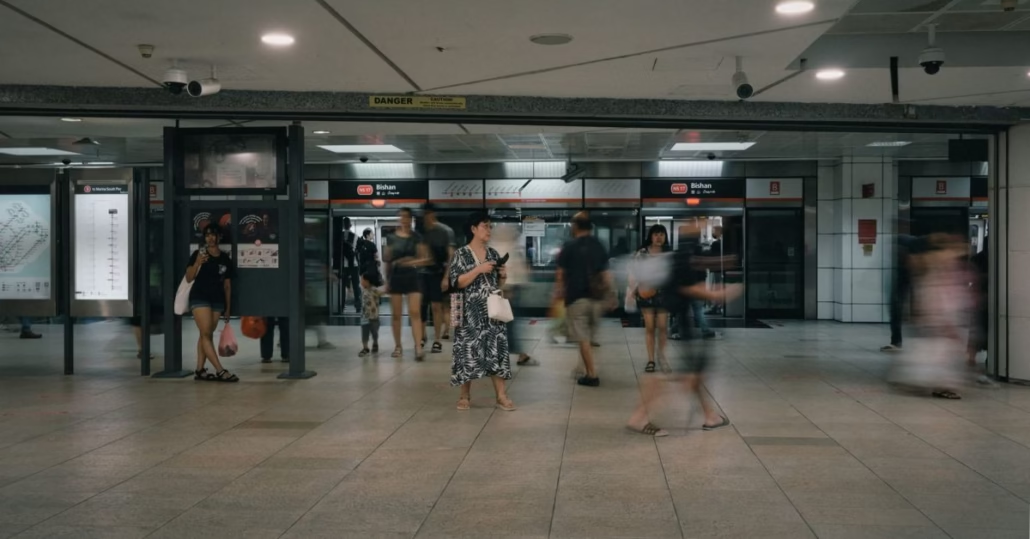
A video clip posted on 15 July 2026 went viral across Reddit, TikTok, and local Facebook groups in the way MRT videos tend to do: it set the internet on fire. The footage shows a mother on an MRT train with two young children visibly eating snacks while the train moves. Within hours, thousands of comments flooded in, and the debate has not cooled down since.
- What Are the Actual Rules on Eating on the MRT?
- What Did Netizens Actually Say About the Mum and Kids?
- Is Eating on the MRT Actually Harmful?
- How Does Singapore's No-Eating Rule Compare to Other Cities?
- What Should Parents Actually Do When Kids Need to Eat Mid-Journey?
- Does the Timing of This Story Matter?
- Is This a Sign of Worsening Commuter Standards?
- What Happens If You Are Caught Eating on the MRT?
- What Does This Tell Us About Singapore's Relationship With Its MRT?
- Before You Tap In
- FAQ
This is not the first time commuter behaviour has sparked online uproar. We covered the MRT backpack confrontation last year, which drew equally heated responses. But this one feels different. It involves children. And that, as any Singaporean parent knows, changes the emotional temperature of the entire conversation.
What Are the Actual Rules on Eating on the MRT?
Eating and drinking on MRT trains and in stations is prohibited under the Rapid Transit Systems Act. The Land Transport Authority (LTA) sets the maximum fine at S$500 for this offence. In practice, parents are expected to manage their children’s behaviour, and any penalty falls on the accompanying adult, not the child.
The rule covers eating, drinking, and even carrying durian onto trains or into paid areas of stations. SMRT and SBS Transit operators are authorised to enforce these rules, and staff or transit police can issue fines on the spot. That said, regular commuters know enforcement tends to be inconsistent, particularly during quieter off-peak hours.

What Did Netizens Actually Say About the Mum and Kids?
The comments split into two very clear camps, and honestly, both sides raised fair points. One group argued that rules are rules, full stop. Singapore’s MRT works partly because commuters follow a shared code of conduct, and parents normalising rule-breaking in front of children sets a poor example. Several commenters pointed out that no one gets a pass simply for having young kids in tow.
The second group pushed back hard. Parents noted that travelling with toddlers on public transport is already logistically challenging. Hungry children cry. Crying children disturb other commuters too. A quiet biscuit, they argued, is actually a net positive for everyone in the carriage. Some also questioned why a fellow passenger chose to film the family rather than speak to the mother directly, or simply look away.
A smaller third camp pointed the finger at whoever filmed and posted the clip. Interestingly, this conversation unfolded just two days after a separate incident where a woman confronted a man for allegedly photographing her without consent at Caldecott MRT, a station that only opened on 12 July 2026 as part of Circle Line Stage 6. The irony of filming strangers to shame them for a minor offence was not lost on readers.
Is Eating on the MRT Actually Harmful?
The practical concern behind the no-eating rule is straightforward. Food waste, crumbs, and spilled drinks attract pests and make cleaning harder. Pungent smells in an enclosed, air-conditioned carriage can make other passengers uncomfortable, especially during packed peak-hour services. With well over three million journeys on a typical weekday, keeping that many carriages clean requires everyone’s cooperation.
Snacks eaten by children, however, occupy a grey zone. A small packet of crackers creates far less disruption than, say, a plate of char kway teow carried on board. Most regular commuters would privately admit that the smell of someone’s takeaway lunch bothers them far more than watching a toddler quietly eat a cream cracker in a corner seat.
None of that changes the rule. But it does help explain why public reaction is mixed rather than unanimous. People are applying their own judgment about actual harm rather than treating the regulation as absolute.
How Does Singapore’s No-Eating Rule Compare to Other Cities?
| City / System | Eating Rule | Max Penalty |
|---|---|---|
| Singapore MRT | Strictly prohibited (trains and stations) | S$500 |
| Hong Kong MTR | Prohibited (trains and fare zones) | HK$2,000 (approx. S$350) |
| Tokyo Metro | Discouraged but not legally banned (some express trains permit it) | No fixed fine |
| London Underground | Permitted (no formal restriction) | None |
| New York Subway | Technically prohibited; rarely enforced | US$50 (approx. S$67) |
Singapore’s rule sits at the stricter end globally. The high maximum fine reflects the city-state’s broader approach to keeping public spaces clean, something that has long been both a point of local pride and occasional visitor mockery. Whether you agree with it or not, the standard is clear and has been in place for decades.
What Should Parents Actually Do When Kids Need to Eat Mid-Journey?
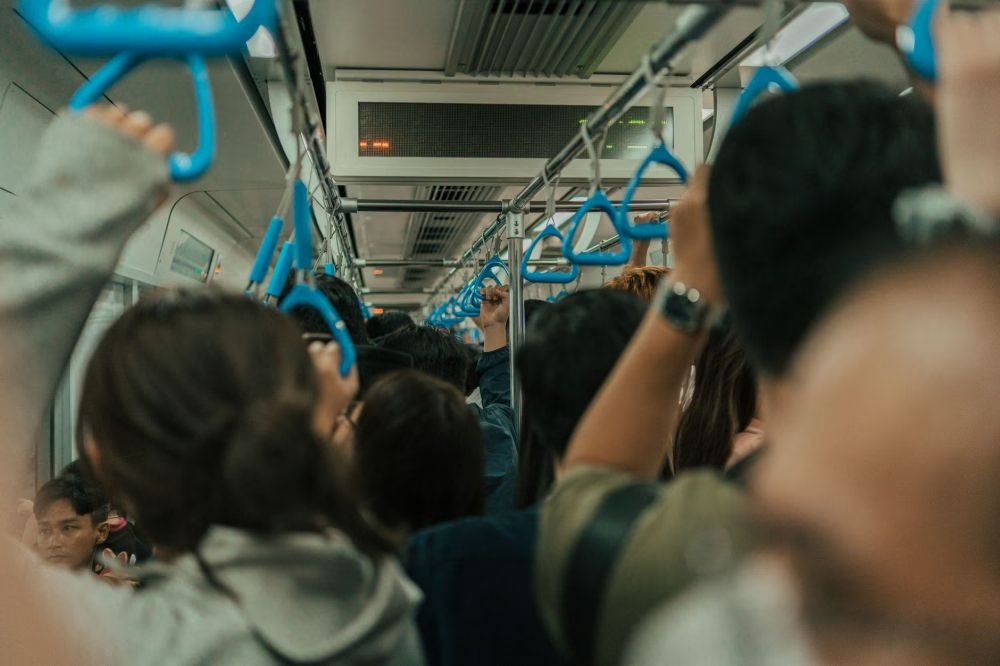
A little planning goes a long way. Singapore’s MRT network, particularly after the Circle Line completed on 12 July 2026, now covers an even wider spread of the island. Journeys that once required a transfer or a bus can now happen in a single continuous ride, which is great for convenience but can mean longer stretches on board for families travelling across town.
Here are a few practical approaches that work for most parents:
- Eat before you tap in. The unpaid areas of most stations have benches. Use them. Once you tap in and reach the paid zone, the rules apply.
- Pick a station mid-journey. On longer trips, plan a stop at an interchange where you can alight, grab something at the convenience store, eat outside the fare gates, and continue. This also lets energetic toddlers stretch their legs.
- Water is technically drinking. Yes, plain water is also subject to the rule. A covered bottle is harder to spot, but it is still not allowed. This surprises a lot of people.
Does the Timing of This Story Matter?
It absolutely does. The video emerged just three days after Circle Line Stage 6 officially opened on 12 July 2026, adding Keppel, Cantonment, and Prince Edward Road stations to the network. Our coverage of the CCL6 completion has all the details on those new stations.
More people are riding the MRT right now out of curiosity about the new additions, and ridership spikes in the weeks following a major network expansion. Higher footfall means more opportunities for incidents to be noticed and filmed. That context matters when a viral clip surfaces. This does not mean the behaviour shown is acceptable, just that we are in a period of heightened MRT attention right now.
There is also the broader question of digital MRT shaming. Filming fellow commuters and posting clips online has become a recurring pattern in Singapore, covering everything from backpack etiquette to seat hogging to children eating. Whether this kind of public accountability is useful or simply punitive deserves serious consideration.
Is This a Sign of Worsening Commuter Standards?
Probably not, though it is easy to feel that way when outrage clips flood your feed. Singapore’s MRT network is, by most global measures, exceptionally clean and well-managed. The Land Transport Authority continues to invest in the network, including recent rollout of AI monitoring tools across the metro system as of mid-2026. Our article on Singapore putting AI to work on the metro network covers what that technology actually does.
Most commuters follow the rules most of the time. Incidents that go viral are, by definition, exceptions. A mother making a judgment call in the moment is not the same as someone who treats the MRT as a dining room. Treating every incident as evidence of civilisational decline misses that distinction entirely.
That said, the rule exists for good reason, and parents do bear responsibility for managing their children’s behaviour in shared spaces. Both things are true simultaneously. The most measured take from the online discussion was probably this: the mum likely knew the rule, made a call she thought was low-impact, and most of us have probably done something similar on public transport. The filmed and posted version is what tipped it into controversy.
What Happens If You Are Caught Eating on the MRT?
If a station officer or transit police witness the offence, they can issue a composition fine on the spot. For eating and drinking, the maximum is S$500, though first-time offenders are sometimes issued a warning, particularly if they cooperate and stop immediately. Repeat offences or cases involving a mess are more likely to result in an actual fine.
Enforcement is carried out by officers from the respective operators: SMRT runs the North-South Line, East-West Line, Circle Line, and Thomson-East Coast Line (TEL), while SBS Transit operates the North East Line (NEL) and Downtown Line (DTL). You can find line-by-line details in our MRT lines overview. If you are unsure which operator runs a particular service, our list of MRT stations in Singapore will give you that information at a glance.
In the case of a parent travelling with children, the fine would be directed at the adult. There is no specific concession for families with young children written into the regulations, though individual officers may exercise discretion.
What Does This Tell Us About Singapore’s Relationship With Its MRT?
The fact that a short clip of children eating on a train generated thousands of comments within hours says something interesting about how deeply Singaporeans care about their MRT. This is not just a transport system; it is a shared public space that people feel genuine ownership over. That ownership is mostly positive. It is why the trains are so clean and why the queuing culture at platform doors is genuinely impressive by global standards.
But ownership can tip into policing in ways that are not always proportionate. A toddler eating a biscuit is not the same threat to the MRT as someone who leaves food waste on a seat or brings a meal of laksa on board during the evening peak. Treating them as equivalent because both technically break the same rule is a choice, and many Singaporeans clearly feel uncomfortable with it.
For a deeper look at how commuter conduct incidents play out on Singapore trains, our earlier piece on the boys who broke into an MRT train cabin offers a useful contrast in how authorities handle different kinds of rule-breaking.
Before You Tap In
Whether you are a parent planning a family outing or a regular commuter wondering where you stand, the rule is simple: no eating or drinking once you are inside the paid area of any MRT station or on board any train. Plan your snack stop before you tap in, and you avoid the issue entirely. For everything else you need to know about riding the network in 2026, including fares, operating hours, and payment options, our Singapore MRT fares and ticketing guide has you covered.
FAQ
Keep exploring
- MRT Backpack Confrontation: What Really Happened
- Boys Who Broke Into MRT Train Cabin: What Happened
- Fares, Ticketing & Practical Info: Your 2026 Singapore MRT Guide