
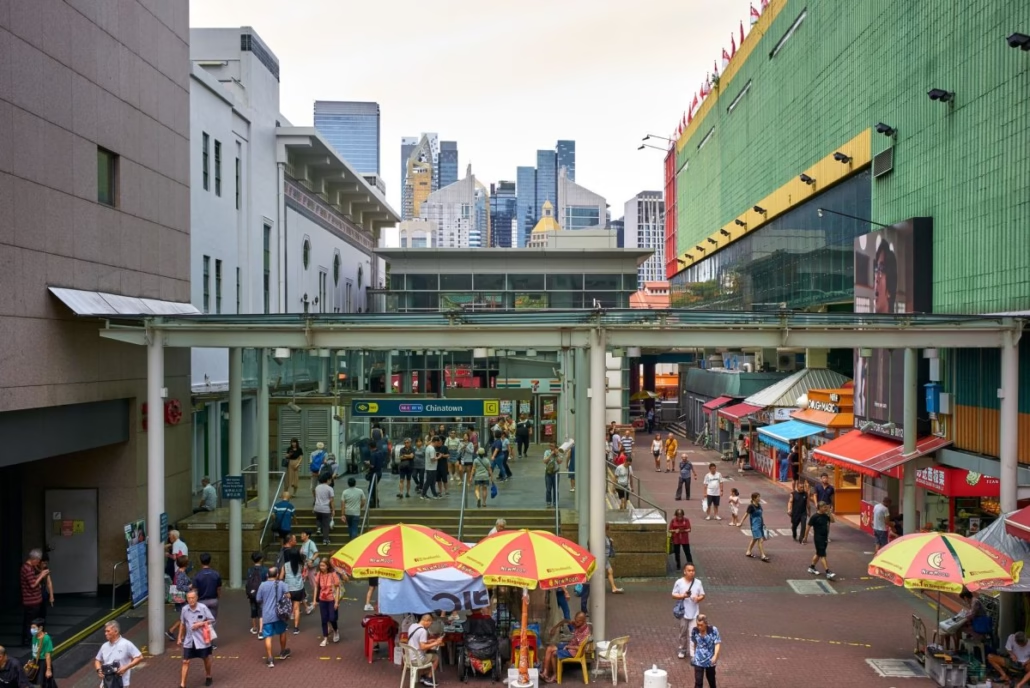
Every morning, several million Singaporeans tap in at a fare gate and expect the train to arrive on time, the air-conditioning to work, and the track to be clear. Most days, that expectation holds. But running a rail network this dense and this heavily trafficked is genuinely hard work, and increasingly, artificial intelligence is doing much of the heavy lifting.
In this guide
- What is AI actually doing on the Singapore MRT?
- How does AI help with train delays and disruptions?
- Crowd management: spreading the load across the network
- Which lines and technologies are most affected?
- The Circle Line completion: a live test of AI at scale
- What does this mean for the Cross Island Line and future lines?
- Is there any downside to AI running the trains?
- How Singapore compares to other metro networks using AI
- Before you tap in
- FAQ
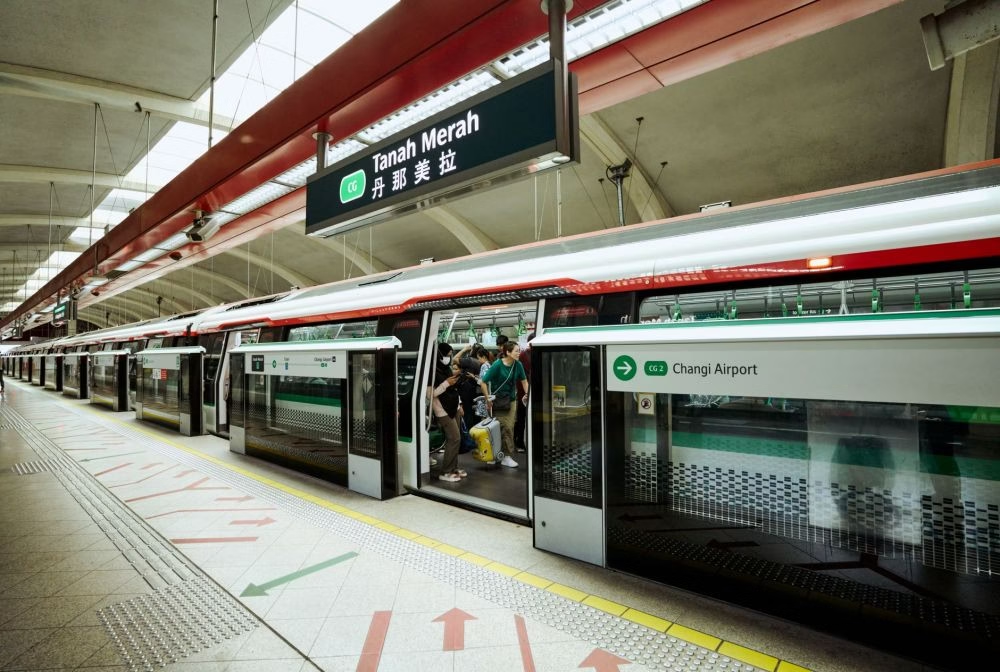
This push into AI-powered rail operations has been building quietly for years, but the pace has clearly quickened. Just two days ago, on 12 July 2026, the Circle Line finally completed its full loop with the opening of three new Stage 6 stations. Managing a closed rail loop with higher throughput demands smarter control systems, and that is exactly what the network is getting.
What is AI actually doing on the Singapore MRT?
AI on the Singapore metro is not one single system. It covers a broad range of applications, each targeting a different problem. The most consequential, from a reliability standpoint, is predictive maintenance.
Traditionally, rail components such as tracks, third rails, sleepers, and rolling stock were maintained on fixed schedules or replaced after a fault was detected. Both approaches are either wasteful or reactive. Predictive maintenance flips this: sensors embedded in the track and onboard the trains continuously feed data into machine-learning models that flag components likely to fail before they actually do. Engineers can then intervene during overnight hours, when trains are not running, rather than scrambling during the morning peak.
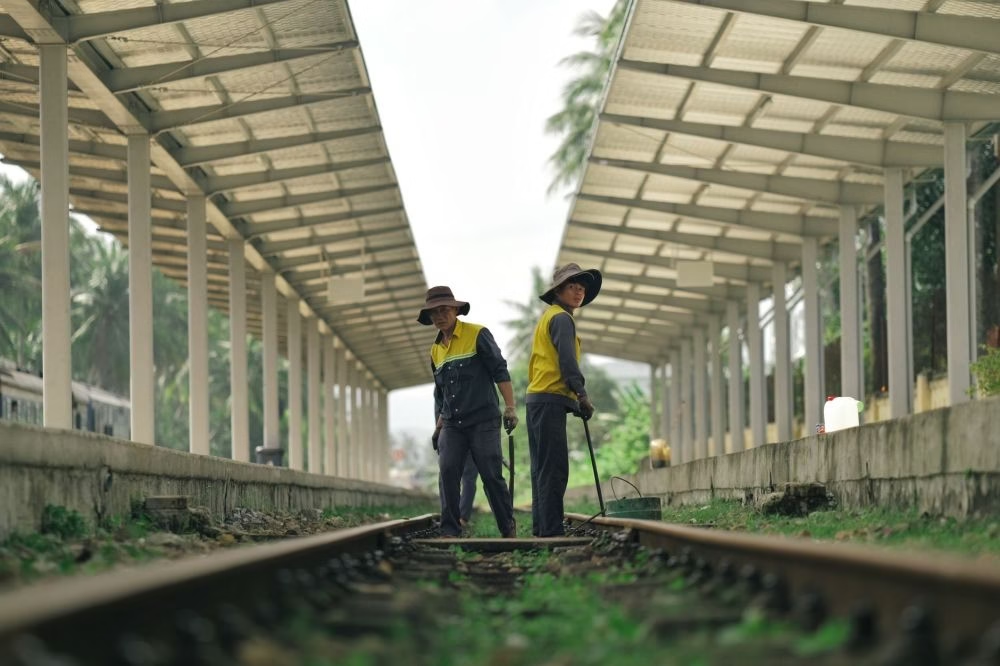
According to LTA, automated inspection technologies have been progressively rolled out across the network over recent years. Night-time track inspection robots, guided by computer vision, can cover kilometres of track in a single overnight window, spotting hairline cracks, rail wear, and fastener defects that a human inspector walking with a torch might easily miss. The data is logged, analysed, and prioritised automatically. This is especially important on older stretches of the North-South Line (NSL) and East-West Line (EWL), where infrastructure has been in service since the late 1980s.
How does AI help with train delays and disruptions?
AI-powered fault detection is now built into the train management systems used by both SMRT and SBS Transit. Onboard diagnostics on newer rolling stock, including the trains running on the Thomson-East Coast Line (TEL) and the Downtown Line (DTL), generate constant telemetry data covering door systems, traction motors, braking, and cabin climate. Machine-learning models watch for anomalies and alert maintenance teams before a fault spirals into a full service interruption.
For commuters, the practical result is fewer of those announcements you dread: “Attention passengers, due to a train fault at Bishan, train services are delayed.” Reducing their frequency has been a stated priority for LTA and SMRT for years, and AI is one of the main tools being used to achieve it.
On the signalling side, AI-assisted train control helps regulate headways, the gaps between trains, more precisely. During peak hours on the North-South Line, headways can drop to around two minutes. Maintaining that without AI is difficult; even minor variations ripple down the line and cause bunching. Smarter signalling keeps trains evenly spaced and platforms from becoming dangerously crowded.
Crowd management: spreading the load across the network
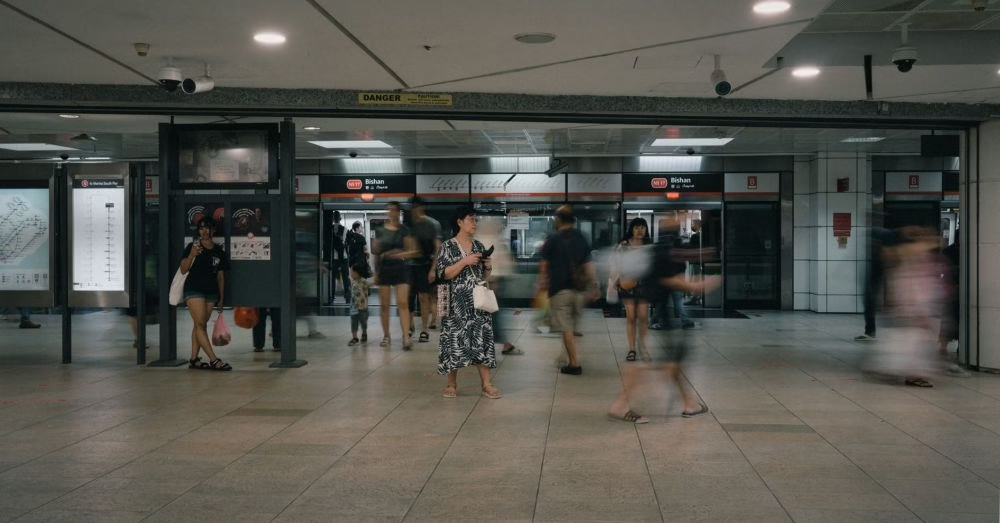
AI crowd management tools analyse real-time ridership data from tap-in and tap-out records, platform cameras, and fare gate throughput to predict where crowd build-ups will occur and adjust train frequency and platform announcements accordingly. This matters most at major interchanges like Dhoby Ghaut, Outram Park, and City Hall, where multiple lines converge and passenger volumes are highest.
The Circle Line’s completion adds another layer to this. With the CCL now a true loop, connecting Harbourfront through Marina Bay to Dhoby Ghaut and back again through the southern corridor, the network has more redundancy. If a section of another line is congested, AI can suggest the CCL as an alternative path. This only works, of course, if the system can detect the congestion and communicate the advice quickly, which is exactly what the AI tools do.
You can check the updated Circle Line map to see how the new southern stations at Keppel, Cantonment, and Prince Edward Road slot into the full loop and which interchanges they connect to.
Which lines and technologies are most affected?
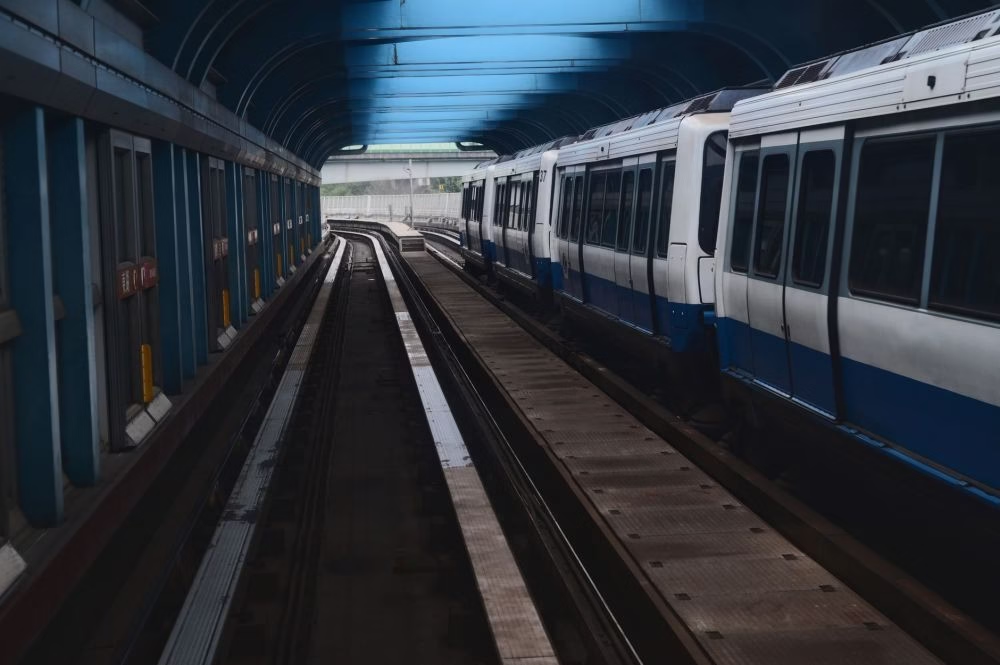
Not all lines are at the same stage of AI integration. The newer lines, built with digital infrastructure from the ground up, are further ahead. Here is a quick comparison based on what has been publicly reported as of July 2026:
| Line | Operator | AI / Automation Maturity | Key AI Application |
|---|---|---|---|
| Thomson-East Coast Line (TEL) | SMRT | High | Fully automated train operations, onboard AI diagnostics |
| Downtown Line (DTL) | SBS Transit | High | Automated operations, predictive door-fault detection |
| Circle Line (CCL) | SMRT | High | Fully automated, AI crowd flow at new CCL6 stations |
| North East Line (NEL) | SBS Transit | Medium-High | Automated operations, predictive maintenance rollout |
| North-South Line (NSL) | SMRT | Medium | AI track inspection, legacy signalling upgrade in progress |
| East-West Line (EWL) | SMRT | Medium | AI track inspection, rolling stock condition monitoring |
The TEL and DTL were built as fully automated, driverless lines, so AI was integrated from the start. The NSL and EWL, Singapore’s oldest lines, need more retrofitting, and that work is ongoing. The North-South Line in particular is mid-way through a signalling upgrade that will bring its capabilities closer to the newer lines.
The Circle Line completion: a live test of AI at scale
The opening of the three CCL6 stations, Keppel (CC28), Cantonment (CC29), and Prince Edward Road (CC30), on 12 July 2026 was a live test of AI-assisted operations at a network change event. Adding new stations to an operational automated line is non-trivial. Train dwell times, headway calculations, crowd flow at new platforms, and interchange walking patterns all shift.
Reports from the first weekday morning peak on 14 July 2026 indicate the ride was smooth. That did not happen by accident. Behind the scenes, the AI systems managing train control and platform occupancy would have been running updated models incorporating the new stations’ expected demand profiles well before commuters arrived.
For a closer look at what the new stations offer and how they connect to the rest of the network, our article on the Circle Line Stage 6 opening covers everything you need to know about CCL6.
What does this mean for the Cross Island Line and future lines?
The Cross Island Line (CRL), currently under construction and due to open its first phase in stages from 2030, is being designed from scratch with AI-native operations in mind. Every lesson learned from deploying AI on the existing network, from which sensor placements yield the most useful data to how machine-learning models handle unexpected passenger surges, feeds directly into the CRL’s design specifications.
This is the compounding advantage of being an early mover. Singapore started automating its rail lines with the Circle Line back in 2009, and each subsequent automated line has been more capable. By the time the CRL opens, the AI tools running it will be far more mature than what was available when the TEL launched its first stations in 2020.
It also matters for the LRT networks. The Bukit Panjang LRT, Sengkang LRT, and Punggol LRT are all automated light rail systems serving HDB estates in the heartlands, and they too benefit from AI maintenance and monitoring tools, given how critical they are to residents with fewer alternative transport options.
Is there any downside to AI running the trains?
Fair question. A few concerns come up regularly. One is cybersecurity: an AI-managed rail network is a networked system, and networked systems can be attacked. LTA and the operators are aware of this, and rail cybersecurity is a regulated requirement under Singapore’s Critical Information Infrastructure framework. The exact details of protections in place are not publicly disclosed, which is probably appropriate.
Another concern is what happens when the AI gets it wrong. Predictive models are probabilistic, not certain. They will occasionally flag components that were fine, leading to unnecessary maintenance, and may occasionally miss faults they were not trained to recognise. The operators treat AI outputs as decision-support tools, not autonomous decisions, particularly for safety-critical systems. Human engineers still make the final call on whether to remove a train from service or replace a track section.
For everyday commuters, the real question is simpler: will it make my trip more reliable? Based on the trajectory of MRT service performance over the past several years, the answer appears to be yes, gradually. Mean kilometres between failures, a standard rail reliability metric, has improved substantially across Singapore’s lines over the past decade, and predictive maintenance powered by AI is part of that story.
How Singapore compares to other metro networks using AI
Singapore is frequently cited alongside London, Tokyo, and Hong Kong as one of the world’s most technologically advanced metro networks. What sets Singapore’s approach apart is the tight integration between the regulator, LTA, and the operators, SMRT and SBS Transit. In many other cities, the regulator and operator have arms-length relationships that slow technology adoption. Here, there is a coordinated push, backed by government-level investment in transport technology, that allows AI tools to be deployed at system-wide scale rather than in isolated pilots.
According to LTA, the authority has been investing in data analytics and smart systems as part of its broader Land Transport Master Plan. The rail network generates enormous volumes of data every day, and the ability to act on that data in near-real-time is what separates a world-class metro from a merely adequate one.
You can explore the full network layout, including all lines and interchange stations, on our Singapore MRT interactive map, which is updated to reflect the CCL6 opening.
Before you tap in
AI on Singapore’s metro network is not a future ambition. It is already running quietly underneath every trip you take, checking tracks overnight, watching for door faults, and making sure the train pulling into the platform completes its journey without drama. The CCL completion this week adds fresh complexity to a system that is managing it well, partly because the technology behind it keeps getting sharper. For the full picture of every line on the network today, browse our complete list of MRT stations in Singapore or check the commute time savings from the new CCL6 stations to see if your journey just got faster.
FAQ
Keep exploring
- Circle Line Stage 6 Opens: CCL Now Complete After 30 Years
- New Circle Line Stations: Shorter Rides for 10,000+ Commuters
- Fares, Ticketing & Practical Info: Your 2026 Singapore MRT Guide