
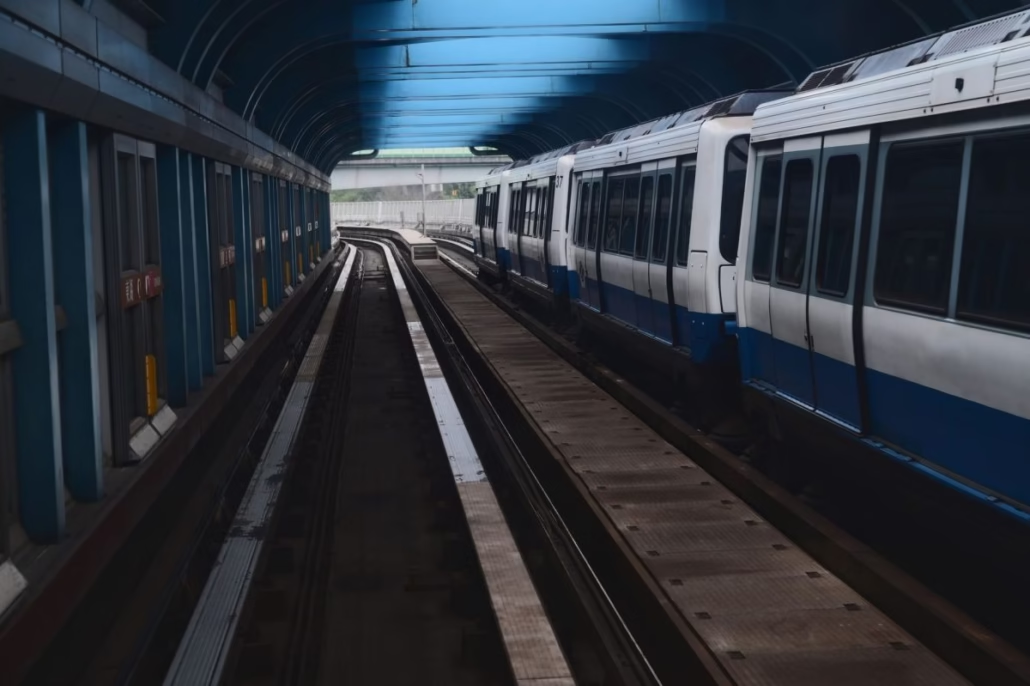
Singapore’s MRT Has Gone Eight Months Without a Major Delay. That’s Historic.
Remember the dark days of 2016 and 2017, when an MRT delay felt like an automatic part of your morning routine? You’d tap in at your home station, squeeze into a packed train, and brace yourself for the PA system to announce chaos somewhere between Jurong East and town. Those days feel very distant right now.
In this guide
- Singapore’s MRT Has Gone Eight Months Without a Major Delay. That’s Historic.
- What Does “2 Million Train-km Per Failure” Actually Mean?
- Which Lines Have Benefited the Most?
- What’s Actually Driving This Improvement?
- Does This Mean the MRT Is Now Truly World-Class?
- Fare Payment Options During This Period
- What’s Next for the Network?
- What Should Regular Commuters Take Away From This?
- Before You Tap In
- FAQ
LTA confirmed the figures on 17 July 2026. Not a single delay above 30 minutes across the entire network in roughly eight months. For a system moving millions of people every single day, that is genuinely striking. The Straits Times also reported that the 2 million train-km-per-failure benchmark has held steady across all lines simultaneously, which is an achievement the industry hasn’t seen before.
What Does “2 Million Train-km Per Failure” Actually Mean?
The 2-million-train-km benchmark is LTA’s definition of high reliability: trains must travel 2 million kilometres collectively for every failure that causes significant service disruption. It’s essentially a measure of how hard the system can work before something breaks.
Singapore’s network spans six lines in regular passenger service: the North South Line (NSL), East West Line (EWL), North East Line (NEL), Circle Line (CCL), Downtown Line (DTL) and Thomson-East Coast Line (TEL). SMRT operates the NSL, EWL and CCL, while SBS Transit runs the NEL, DTL and TEL.
Keeping all six lines above the 2-million mark simultaneously for three straight months has never happened before. In previous strong runs, one or two lines typically lagged. Not this time.
Which Lines Have Benefited the Most?
All six lines have contributed, but the improvement is especially noticeable on the North South Line and East West Line. These older lines were the source of the most disruptive breakdowns during the troubled mid-2010s.
| Line | Code | Operator | Key Interchange Stations |
|---|---|---|---|
| North South Line | NS | SMRT | Jurong East, City Hall, Raffles Place |
| East West Line | EW | SMRT | Raffles Place, Paya Lebar, Jurong East |
| North East Line | NE | SBS Transit | Dhoby Ghaut, HarbourFront, Serangoon |
| Circle Line | CC | SMRT | Dhoby Ghaut, MacPherson, Paya Lebar |
| Downtown Line | DT | SBS Transit | Bugis, Bukit Panjang, Expo |
| Thomson-East Coast Line | TE | SBS Transit | Woodlands, Stevens, Gardens by the Bay |
The East West Line had a particularly rough reputation for years. Flooding, signalling faults and track issues plagued it through the late 2010s. The fact that it’s now part of a record reliability streak shows how much progress has been made through heavy investment in sleeper replacement, third-rail upgrades and the new C151B trains.
What’s Actually Driving This Improvement?
Several factors have come together to make this streak possible, and no single one deserves all the credit.
Predictive Maintenance and AI Tools
The shift from fixed-schedule maintenance to condition-based and predictive approaches has been significant. As we covered in our piece on how Singapore is deploying AI across the metro network, the system now uses sensor data and machine-learning models to flag components that are likely to fail before they actually do. Technicians can replace a worn part on a quiet Sunday night instead of scrambling during the morning rush.
It sounds straightforward now. But rolling this out across a live network that never fully closes is genuinely complex engineering, and the results are showing in the numbers.
Fleet Renewal and Infrastructure Upgrades
SMRT’s long programme to replace ageing trains and refurbish track on the North South and East West Lines has been running for years. The cumulative benefit is now reaching a tipping point. Newer trains have fewer mechanical failure modes, and renewed track sections reduce the vibration-related wear that used to degrade components faster.
The Thomson-East Coast Line, being the newest mainline, operates on fully modern infrastructure and has consistently been among the strongest performers. Check the Thomson-East Coast Line map to see how far it now reaches, from Woodlands in the north to Sungei Bedok in the east.
The Completed Circle Line
July 2026 also saw the Circle Line finally completed with Stage 6, opening Keppel, Cantonment and Prince Edward Road stations. A full loop means the CCL can now distribute passenger loads more evenly, reducing crush at key interchanges like Dhoby Ghaut and HarbourFront. Fewer packed trains translate to fewer door-obstruction faults and smoother running overall. If you haven’t checked out the new stations yet, our full write-up on the completed Circle Line has all the details.
Does This Mean the MRT Is Now Truly World-Class?
It’s a fair question. Singapore’s MRT has long aimed for the reliability standards of Tokyo and Hong Kong’s MTR, which are global benchmarks. For daily commuters, the honest answer is: it’s getting there, and this streak is the strongest evidence yet.
That said, reliability statistics only measure major service disruptions. They don’t capture the smaller everyday frustrations: the occasional packed platform at Raffles Place during a big match, the air-conditioning that isn’t quite cool enough on a 35-degree afternoon, or the lift at your local station that’s out of service. Those things still happen. But a network that doesn’t strand you on the tracks for 45 minutes is a fundamentally different experience from one that does, and that difference matters hugely.
Fare Payment Options During This Period
A reliable network is only as useful as it is accessible, and Singapore’s fare payment system has matured considerably. As of July 2026, you can tap in and tap out using a SimplyGo-compatible EZ-Link card, a contactless Mastercard or Visa bank card, or a mobile wallet on your phone. The old stored-value card system still works, but SimplyGo’s account-based approach ties your travel history and concession eligibility to your account rather than the physical card.
For a full breakdown of which payment method suits you best, including tourist options like the Singapore Tourist Pass, our Singapore Tourist Pass vs EZ-Link vs SimplyGo comparison spells it all out.
What’s Next for the Network?
The reliability story doesn’t stop here. Several major projects already in the pipeline will reshape how commuters use the network over the next few years.
Woodlands Gateway by 2030
News this week confirmed that Woodlands Gateway, a major integrated transport hub combining MRT access, the Johor Bahru-Singapore Rapid Transit System (RTS) Link, commercial and leisure space, is on track to open in 2030. This is a genuinely transformative project for anyone in the north, and it’ll connect Singapore’s MRT directly to Malaysia’s rail system for the first time. The implications for cross-border commuters are substantial.
Cross Island Line Progress
The Cross Island Line (CRL), opening in phases from 2030 onwards, will add another layer of east-west connectivity through the central corridor. It’ll serve areas like Ang Mo Kio, Serangoon and Pasir Ris, taking pressure off the already-busy East West Line. If you’re thinking of moving or renting in those areas, the CRL is definitely worth watching.
AI Integration Expanding
The predictive maintenance tools currently deployed are just the early phase of a much broader AI integration programme, according to LTA. Expect more automated fault detection, smarter crowd management tools and possibly real-time rerouting suggestions in the MyTransport.SG app as the system develops. The groundwork being laid during this record reliability period makes that expansion possible.
What Should Regular Commuters Take Away From This?
If you’re a daily commuter, the main takeaway is straightforward: the risk of hitting a 30-plus-minute delay is at its lowest point ever recorded right now. That doesn’t mean you should stop building a buffer for job interviews or medical appointments. But it does mean you can rely on the system more than ever before.
It’s also worth noting that three months is a strong run, not a guarantee. Networks that sustain long reliability streaks sometimes hit a sharp setback when a component that’s been quietly degrading finally fails. The LTA and operators will be aware of this. Continued investment in predictive tools and infrastructure is what keeps the streak alive, and there’s no sign that investment is slowing.
For those of us who remember standing at taxi ranks after a major breakdown took out an entire line on a Friday evening, this current period feels worth appreciating. Check our full list of MRT stations in Singapore to plan your next journey, or use the interactive Singapore MRT map to see how all the lines connect today.
Before You Tap In
Singapore’s MRT has just hit the best sustained reliability performance in its 39-year history. The combination of AI-assisted maintenance, fleet renewal and a newly completed Circle Line suggests this streak is built on structural improvements, not luck. Head to our 2026 fares and ticketing guide to confirm you’re paying the smartest way for your regular journey, or explore the Circle Line map to see how the newly completed loop might improve your commute.
FAQ
Keep exploring
- Singapore Puts AI to Work on the Metro Network
- Circle Line Now Complete: CCL6 Opens July 2026
- Fares, Ticketing & Practical Info: Your 2026 Singapore MRT Guide