
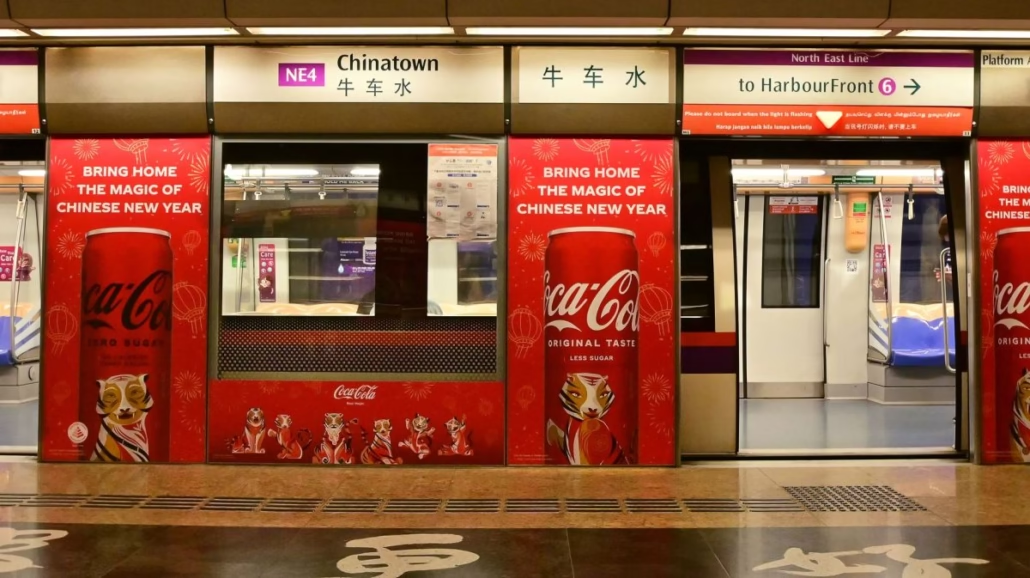
A power bank catching fire on the concourse of a busy MRT station is nobody’s idea of a normal Friday. But that is exactly what happened at Little India MRT on 12 September 2026, when a portable charger ignited and had to be extinguished by quick-thinking station staff before things could get worse. No injuries were reported, and train services on the North East Line (NEL) carried on without a hitch.
- What happened at Little India MRT on 12 September 2026?
- How did station staff put out the power bank fire?
- Why do power banks catch fire on the MRT?
- Are power banks banned from the MRT?
- Should commuters be worried about MRT safety?
- What's Little India MRT like for daily commuters?
- How can commuters prevent power bank incidents?
- Three MRT power bank fires in 2026: a pattern emerging
- Before you tap in
- FAQ
What happened at Little India MRT on 12 September 2026?
A commuter’s power bank caught fire at Little India MRT on the evening of 12 September 2026. Station staff responded straight away and used a portable fire extinguisher to put out the blaze. The fire didn’t spread to nearby fixtures or cause serious harm to other passengers.
Little India (station code NE7) sits on the North East Line, operated by SBS Transit. It’s one of the busier stations on the line, serving the historic Little India neighbourhood, Tekka Centre, and the surrounding HDB estates. On a typical Friday evening the concourse sees commuters, tourists, and residents flowing in and out steadily. The swift response from staff mattered enormously in a setting like that.
Train services were not affected. Commuters already on the platform or inside trains likely noticed nothing at all. The containment was that quick.
How did station staff put out the power bank fire?
Station staff at Little India MRT grabbed a portable fire extinguisher and put out the burning power bank before it could spread to nearby fixtures or affect other commuters. The whole thing was handled without needing major intervention from the Singapore Civil Defence Force (SCDF).
This isn’t the first time MRT station staff have dealt with a power bank fire. If you’ve been following local transport news, you might recall a similar incident at Buangkok MRT earlier this year. Staff acted fast there too. You can read more about that in our earlier coverage of the power bank fire at Buangkok MRT station. There was also a separate incident at Woodlands MRT, which we covered in our piece on the power bank fire at Woodlands MRT station.
The pattern is starting to stand out. This is at least the third confirmed power bank fire at a Singapore MRT station in 2026. That’s not a coincidence. It points to a real and growing risk as more commuters carry high-capacity portable chargers, many of them cheap third-party units with dodgy battery management systems.
Why do power banks catch fire on the MRT?
Lithium-ion batteries can enter a state called thermal runaway when they’re physically damaged, overcharged, short-circuited, or exposed to excessive heat. Once that process starts, it’s self-sustaining and extremely difficult to stop without a fire extinguisher or total isolation of the device.
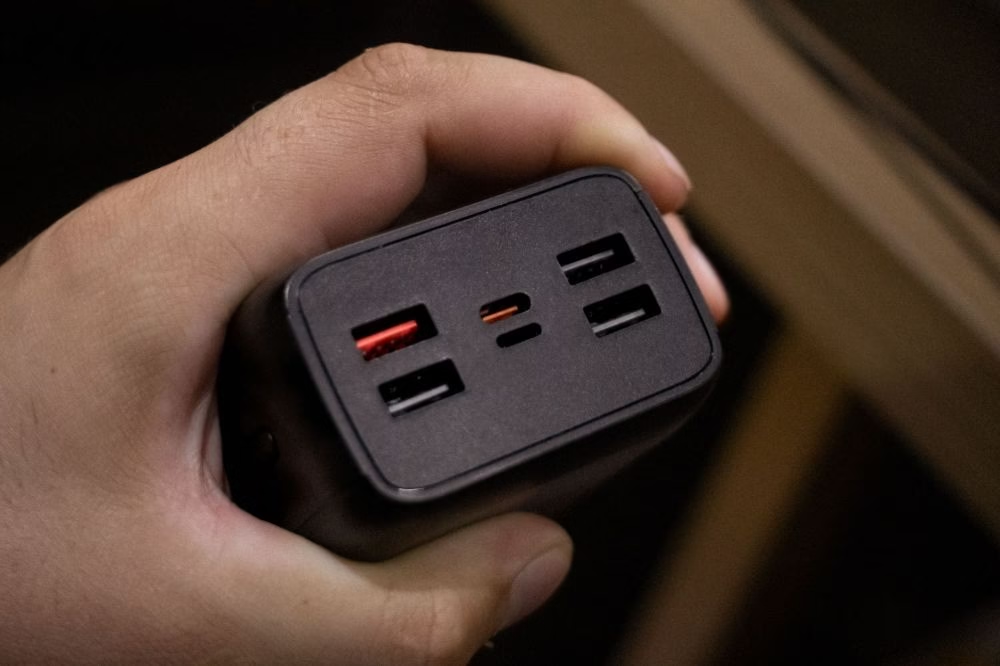
In an MRT station, the risk factors multiply fast. Power banks get knocked around inside bags during the morning rush. Cheap cables cause irregular charging behaviour. On a hot Singapore day, a bag left in direct sunlight before your commute can pre-heat a battery dangerously close to its failure threshold. The concourse at Little India is air-conditioned, but the walk from the street to the fare gates isn’t always short, especially if you alight from a bus at the Serangoon Road stops first.
Then there’s the capacity question. Many commuters now carry 20,000mAh or even 30,000mAh power banks. The larger the cell, the more energy stored, and the more catastrophic the failure when something goes wrong.
Are power banks banned from the MRT?
As of September 2026, power banks aren’t banned from the MRT, but the Land Transport Authority (LTA) and SMRT have issued guidelines advising commuters to keep them in carry-on bags rather than checked or stored luggage, and to avoid using damaged units. The rules broadly follow international aviation guidance, which prohibits large lithium batteries in checked baggage for exactly the same reasons.
Under the Rapid Transit Systems Act, station operators can direct passengers to remove items that pose a safety risk. If a power bank is visibly damaged, leaking, or generating heat, staff have the authority to ask you to take it off the premises. Refusing could technically put you in breach of station by-laws.
| Power Bank Capacity | MRT / Public Transport Status | Aviation (Carry-on) |
|---|---|---|
| Up to 10,000mAh (approx. 37Wh) | Permitted, no restriction | Permitted |
| 10,001 to 20,000mAh (approx. 37-74Wh) | Permitted; store safely | Permitted |
| 20,001 to 30,000mAh (approx. 74-111Wh) | Permitted; high-risk if damaged | Airline approval required |
| Visibly damaged or leaking unit | Staff may direct removal | Banned |
For official guidance on items permitted in the MRT system, the Land Transport Authority (LTA) website is the authoritative source. SBS Transit, which operates the North East Line where this incident occurred, follows the same framework.
Should commuters be worried about MRT safety?
A fire incident at a station, however minor, raises a fair question: should you be concerned? The short answer is no, but it’s worth understanding why.
Singapore’s MRT network has been on an extraordinary run of reliability. According to the Straits Times and CNA, overall MRT reliability hit an all-time high in August 2026, with the Downtown Line (DTL) posting a 99.3% improvement in mean kilometres between failures compared to July. The network has also extended its record of no major delays to ten consecutive months as of September 2026, a streak our team has been tracking closely in our article on MRT reliability hitting a record high in August 2026.
A power bank fire is a passenger-side incident, not a systems failure. It says nothing about the train fleet, the signalling, or the track. But it does say something about the need for better public awareness around lithium battery safety in enclosed public spaces.
What’s Little India MRT like for daily commuters?
Little India MRT (NE7) is one of the more interesting stations on the North East Line if you commute through or around the central region. It sits between Farrer Park (NE8) and Dhoby Ghaut (NE6/CC1/NS24), the latter being a major interchange. Heading to town from Little India? You’re just one stop away from changing at Dhoby Ghaut onto the Circle Line (CCL) or the North South Line (NSL).
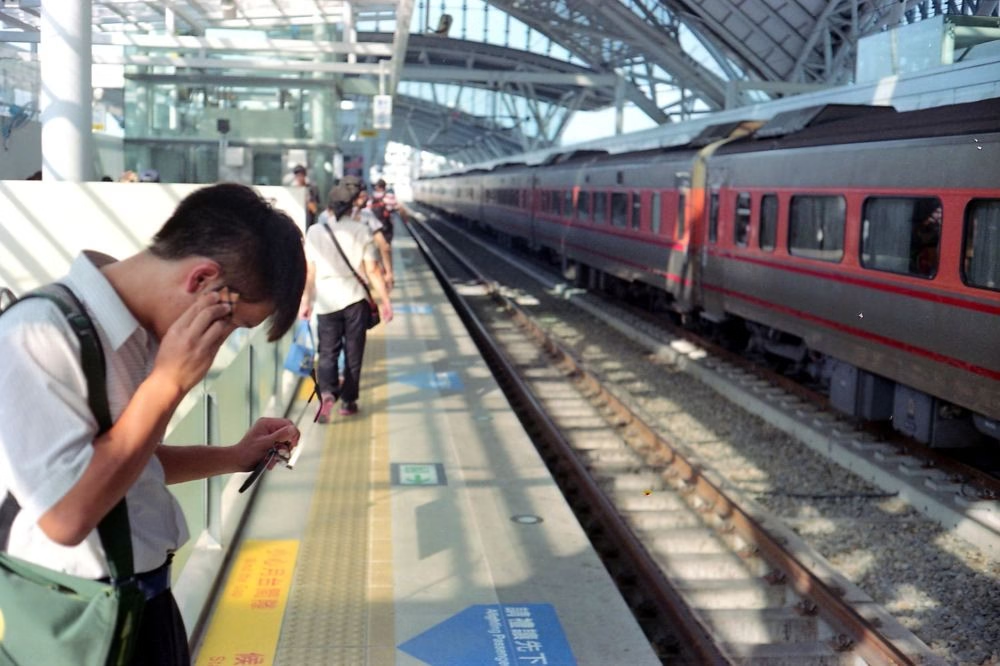
The station has multiple exits. Exit A and Exit B bring you out near Tekka Centre and the main stretch of Serangoon Road, which is typically most useful for the morning market, the hawker centre, and the surrounding shophouses. Exit C and Exit D are better if you’re heading towards Rochor Road or the Sim Lim area. During peak hours, the concourse can get quite congested as commuters flow between the North East Line platforms and the buses stopping along Serangoon Road above.
The station also recently hosted a rather different kind of visitor. Little India MRT was the site of a humanoid robot trial earlier this year. You can catch up on that in our coverage of the humanoid robot trial at Little India MRT station, which gives a good sense of how the station is being used as a testbed for new ideas alongside its everyday role as a community transport hub.
How can commuters prevent power bank incidents?
Prevention is straightforward, though not everyone follows through. Here are the practical steps that actually matter, not the obvious ones you already know.
First, check your power bank before you leave the house, not while standing on the platform. If it feels warmer than usual, or if the casing is swollen or cracked, don’t bring it out. A swollen battery is already in the early stages of failure. Second, never charge a power bank inside a closed bag. Heat needs to escape, and a zipped-up backpack is exactly the wrong environment. Third, buy brands that carry the Singapore Safety Mark. The CPSO maintains a list of certified products, and whilst it’s not a guarantee of perfection, certified units are tested to a standard that cheap off-brand units typically are not.
If you rely on public transport and want to understand all the ways you can pay and travel smarter, our guide on how to pay for the Singapore MRT covers everything from SimplyGo contactless cards to the newly launched Apple Pay Express Mode, which lets you tap in at fare gates without authenticating your phone each time.
Three MRT power bank fires in 2026: a pattern emerging
With at least three confirmed power bank fire incidents at Singapore MRT stations in 2026, including Buangkok, Woodlands, and now Little India, there’s enough of a pattern for transport authorities to consider whether current guidelines are sufficient. As of 14 September 2026, neither LTA nor SBS Transit has announced any new rules specifically targeting power bank use in stations or on trains. But repeated incidents in a short window typically prompt a policy review.
For context, similar patterns in other countries have led to outright bans on power banks above a certain capacity, or requirements for them to be stored in fireproof pouches. Singapore hasn’t gone that far, but the conversation is clearly beginning. For the latest on how the MRT network is managed and what authorities are doing to keep it safe, you can explore the full range of MRT news and analysis on our Singapore MRT blog.
If you want a broader look at the network as it stands today, including all lines, station codes, and interchange connections, our complete list of MRT stations in Singapore is kept up to date and is a good starting point.
Before you tap in
The Little India MRT power bank fire on 12 September 2026 ended without injury thanks to well-trained station staff, and that is genuinely reassuring. But three similar incidents in a single year is a signal worth taking seriously. Check your power bank before every commute, replace anything that shows signs of damage, and buy certified. For the latest updates on MRT safety, reliability, and everything else happening on Singapore’s rail network, keep an eye on our blog or check our interactive Singapore MRT map for real-time line and station information.
FAQ
Keep exploring
- Power Bank Fire at Buangkok MRT: What Happened
- Power Bank Fire at Woodlands MRT: What Happened
- MRT Reliability Hits Record High in August 2026