
A person died at Segar LRT station, and commuters have been asking the same question: why aren’t there proper platform barriers here? That question is no longer going unanswered. According to AsiaOne on 8 July 2026, the Land Transport Authority (LTA) has confirmed it will re-evaluate platform barriers across the LRT network following the fatal incident at Segar.
In this guide
- What Happened at Segar LRT Station?
- How Do LRT Platform Barriers Differ from MRT Screen Doors?
- Which LRT Lines and Stations Are Affected?
- What Has LTA Said About the Re-Evaluation?
- Why Has This Taken So Long to Come Up?
- What Does This Mean for Commuters Right Now?
- The Bigger Picture: Safety Reviews and Singapore’s Rail Network in 2026
- What Changes Could Actually Be Implemented?
- Before You Tap In
- FAQ
This hits close to home if you commute through the heartlands. Segar is a quiet station, the kind you barely notice unless you live in Fajar, Jelapang, or the surrounding Bukit Panjang neighbourhoods. But right now, it’s at the centre of a safety conversation that could reshape how we think about every LRT platform in Singapore.
What Happened at Segar LRT Station?
As of 9 July 2026, full details of the incident are still being investigated, and out of respect for the deceased and their family, we won’t speculate on the circumstances. What is confirmed: a death occurred at Segar LRT station, and the LTA is treating it as a catalyst for a broader review of physical safety infrastructure at LRT platforms.
Segar sits on the Bukit Panjang LRT (BPLRT), operated by SMRT since 1999. It serves residential catchments, connecting HDB estates in Bukit Panjang to Choa Chu Kang and Bukit Panjang MRT interchanges. The line uses automated, driverless vehicles that run on a guided track. Several of its stations have platform setups that differ significantly from the MRT proper.
The concern is straightforward: the gap between platform edge protection at LRT stations compared to MRT stations. Both the literal gap and the figurative one are now under scrutiny.
How Do LRT Platform Barriers Differ from MRT Screen Doors?
On the MRT, full-height platform screen doors (PSDs) are standard across every line: North South, East-West, North East, Downtown, and Thomson-East Coast. They form a solid wall between you and the track, opening only when a train is perfectly aligned. It’s a non-negotiable feature of the modern MRT experience.
The LRT is different. The Bukit Panjang LRT, along with the Sengkang LRT and Punggol LRT, uses a lighter rail system with smaller vehicles. Some stations have half-height barriers or partial platform edge protection rather than the full sealed-off screen doors on the MRT. This reflects the original engineering design, lower platform speeds, and cost considerations during construction in the late 1990s.
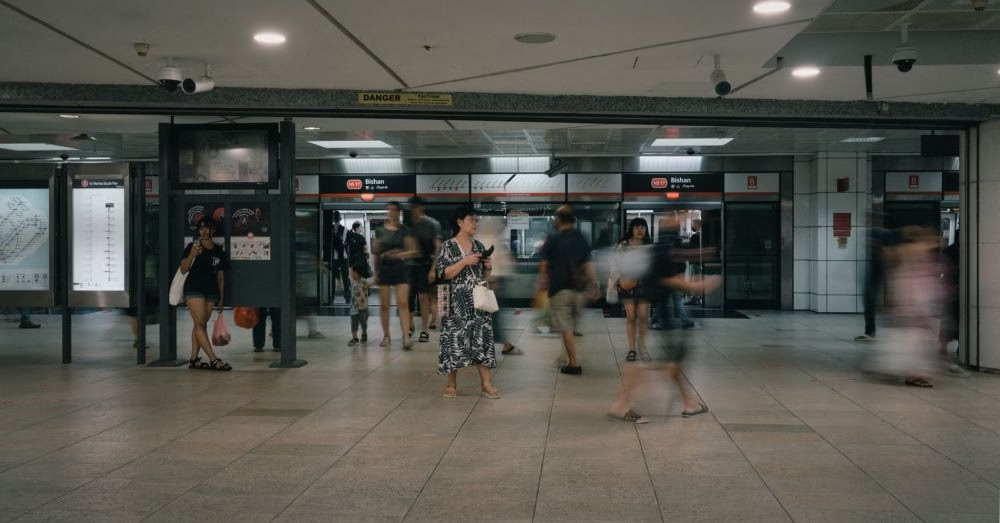
The practical result is more open space between a waiting commuter and the track edge at certain LRT platforms than you’d ever find at an MRT station today. Whether that gap is acceptable from a safety standpoint is exactly what the LTA says it will now re-evaluate.
| Feature | MRT Stations | LRT Stations (current) |
|---|---|---|
| Platform screen doors | Full-height, sealed | Half-height or partial at some stations |
| Gap to track edge | No open gap when doors closed | Some open exposure possible |
| Vehicle type | Heavy rail, high-capacity trains | Light automated vehicles |
| Operator | SMRT / SBS Transit | SMRT (BPLRT, Sengkang, Punggol) |
| Safety review triggered | Ongoing regulatory oversight | Active re-evaluation as of July 2026 |
Which LRT Lines and Stations Are Affected?
Singapore has three LRT systems, all feeding into the broader MRT network. Segar sits on the Bukit Panjang LRT, which loops through Bukit Panjang and connects to Choa Chu Kang and Bukit Panjang MRT stations. The Sengkang and Punggol LRT systems serve the north-eastern new towns, feeding passengers onto the North East Line at Sengkang and Punggol.
All three systems were built around the same era and share broadly similar design philosophies. That means the platform barrier question now being asked about Segar applies, to varying degrees, across all LRT stations in Singapore. Head to our LRT stations page for a full overview of each system.
As of 9 July 2026, the LTA hasn’t specified a timeline for the re-evaluation or named which stations will be prioritised. But the direction is clear: full platform screen doors, or an equivalent barrier standard, are going to be part of the conversation.
What Has LTA Said About the Re-Evaluation?
According to the AsiaOne report on 8 July 2026, the Land Transport Authority confirmed it will re-evaluate platform barriers following the Segar incident. As of now, it hasn’t released a detailed statement on specific engineering options or a proposed schedule for any modifications.
What matters is this: a public commitment to re-evaluate means the question of LRT platform safety has officially moved from background concern to active policy agenda. Singapore’s transport authorities typically move deliberately and thoroughly on safety matters. After any serious incident on the rail network, the process involves engineering assessments, consultation with operators like SMRT, and a review of whether existing standards match the infrastructure’s risk profile.
Expect the LTA to consider options ranging from physical barrier upgrades to enhanced platform markings and improved CCTV coverage. Full platform screen doors would be the most protective solution, but retrofitting stations that weren’t originally designed for them would require significant work.
Why Has This Taken So Long to Come Up?
Fair question. Singapore’s MRT network has had full platform screen doors since the earliest stations opened in 1987. The safety case for sealed platform edges has been understood for decades. The LRT systems, however, were engineered under different assumptions: lower speeds, lighter vehicles, automated operation, and a community-rail rather than mass-rapid-transit design intent.
That logic isn’t unreasonable. But the BPLRT has had a complicated operational history. SMRT undertook a significant upgrade programme between roughly 2019 and 2022, replacing ageing vehicles and refurbishing stations. Platform barrier standards weren’t the headline item during those works. In hindsight, the gap was always there, and the Segar incident has now made it impossible to overlook.
For BPLRT commuters, the feeling is probably one of frustrated recognition. The platforms at Segar, Fajar, Jelapang, and the other western loop stations feel noticeably more exposed than anything you’d find on the Downtown Line or the Thomson-East Coast Line. That contrast isn’t just aesthetic; it’s a safety differential that the re-evaluation must now address.
What Does This Mean for Commuters Right Now?
In practical terms, the Bukit Panjang LRT continues to operate normally as of 9 July 2026. No service suspensions, rerouting, or fare changes are linked to the review. If Segar is on your daily commute, you can still tap in as usual. The re-evaluation is a policy process, not an immediate operational change.
That said, a few things are worth keeping in mind if you use LRT platforms regularly. Always stand behind the yellow line marked on the platform floor, even where there’s no physical barrier. The yellow line marks the safe waiting zone for a reason. At stations with partial barriers, stay within the designated waiting areas rather than drifting towards the platform edge while waiting for your train.
If you have concerns about specific platform conditions at LRT stations, use the SMRT feedback channels and the LTA’s public feedback portal. Official channels are more likely to feed into the re-evaluation process than social media posts.
The Bigger Picture: Safety Reviews and Singapore’s Rail Network in 2026
The timing of this incident is worth noting. Singapore’s rail network is, as of mid-2026, in genuine expansion and positive momentum. The Circle Line completed its long-awaited Stage 6 loop closure on 4 July 2026, with three new stations opening and more than 10,000 commuters expected to benefit from shorter journeys. You can read our full coverage of that milestone on the new Circle Line stations opening article.
Against that backdrop of network growth and public goodwill, the Segar incident is a sharp reminder that safety infrastructure must keep pace with everything else. Singapore has earned its reputation as one of the world’s most reliable and safe urban rail systems. Protecting that reputation means taking every incident seriously, including the ones that happen on the quieter, less glamorous LRT lines that serve the heartlands rather than the CBD.
The Cross Island Line, currently under construction and expected to open progressively from the late 2020s, will incorporate the latest platform safety standards from day one. But existing LRT infrastructure, some of it approaching 30 years old, needs to be held to an evolving standard too. The re-evaluation announced after the Segar death is the right response. What matters now is what comes out of it, and how quickly.
What Changes Could Actually Be Implemented?
Engineering upgrades to LRT platform barriers aren’t trivial. Full platform screen doors require precise alignment between train door positions and platform door positions, which is straightforward on modern systems but more complex on older infrastructure. Retrofitting existing stations can involve track-side sensor upgrades, platform edge reconstruction, and changes to the train control system.
Shorter-term options that might be easier to implement include raised or extended physical edge barriers that stop short of full screen doors, improved sensor-based warning systems that alert station staff when a commuter is too close to the platform edge, and enhanced floor markings. These wouldn’t offer the same protection as sealed PSDs, but they could reduce risk meaningfully while longer-term works are planned and funded.
For anyone curious about the broader state of Singapore’s MRT and LRT infrastructure, our MRT lines guide is a useful reference for understanding how each line is structured and operated.
Before You Tap In
The Segar LRT death has rightly pushed platform safety back into the public conversation, and the LTA’s commitment to a re-evaluation is a step in the right direction. Keep an eye on official announcements from the LTA for updates on the review’s findings and any planned works at BPLRT and other LRT stations. In the meantime, check our transport news blog for the latest developments as this story continues to unfold.
FAQ
Keep exploring
- Bukit Panjang LRT: Complete Guide and Map
- New Circle Line Stations Open: CCL Finally Complete in 2026
- LRT Stations in Singapore: Full Guide