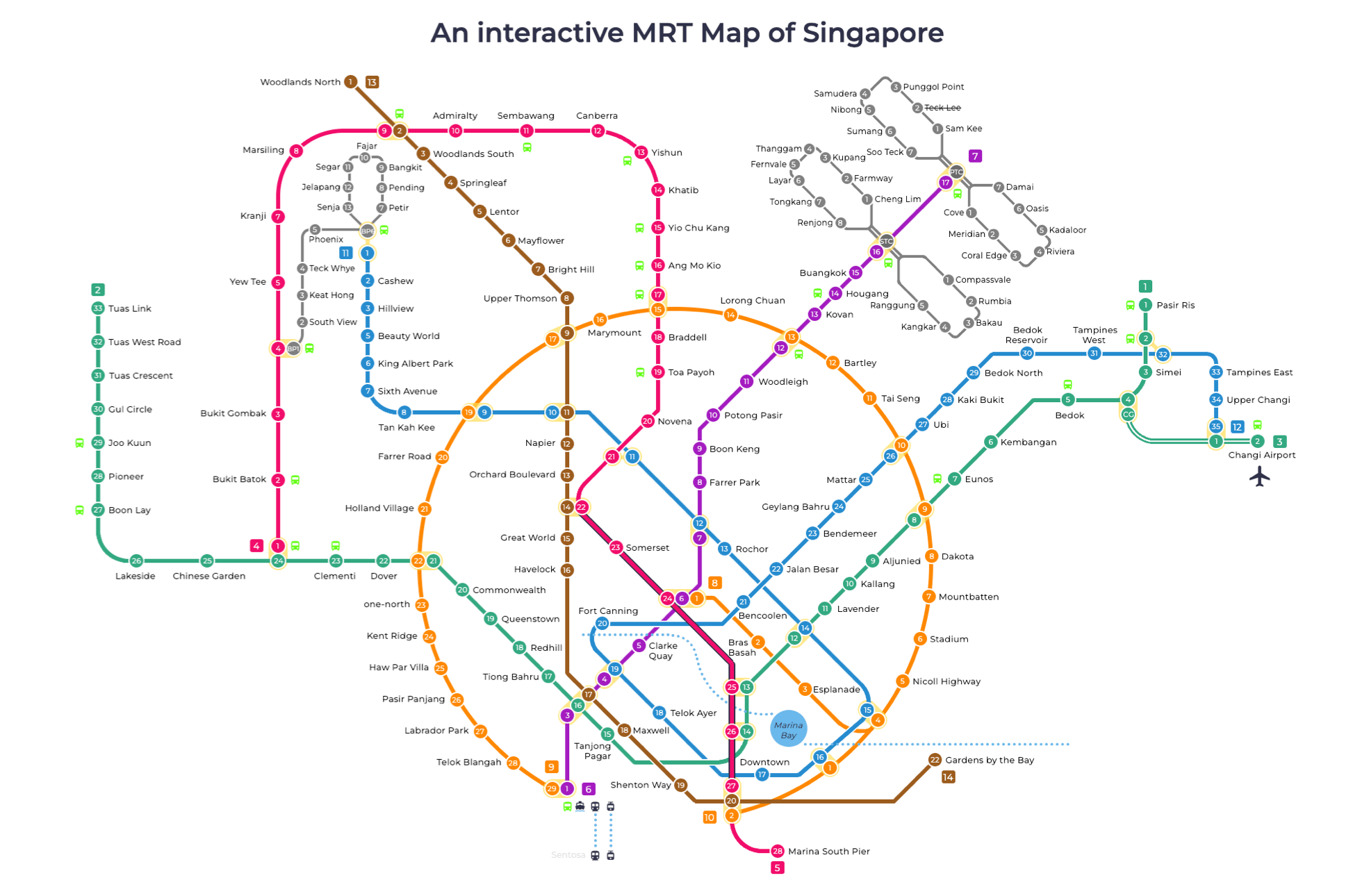
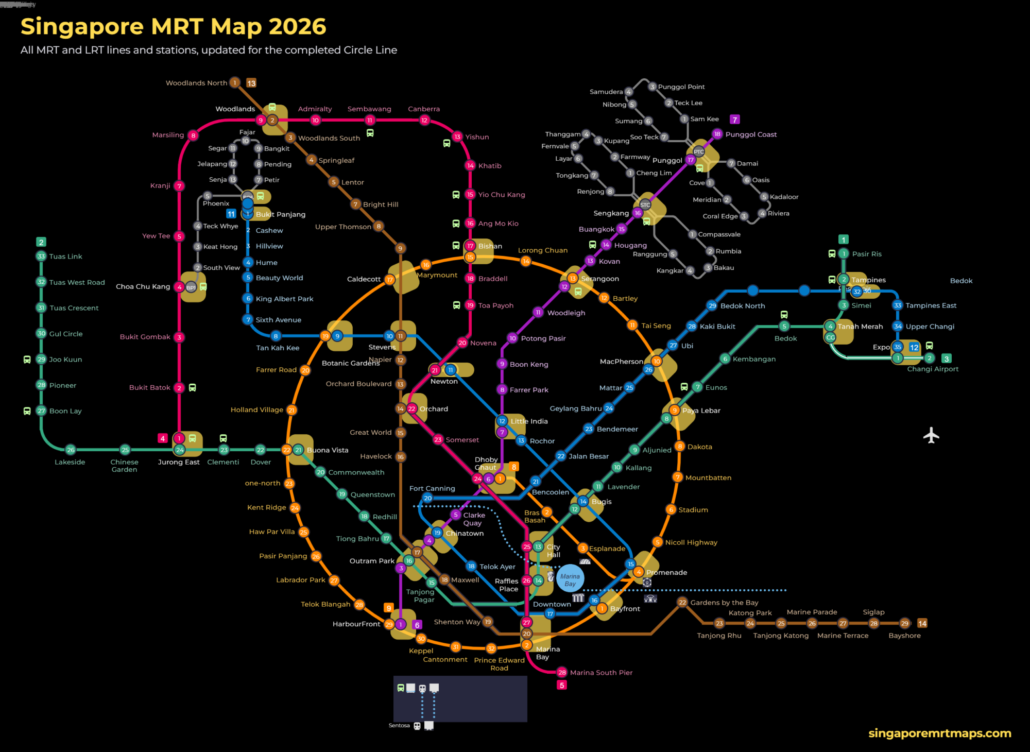
Singapore has six MRT lines and three LRT lines. Most MRT lines run underground, while the LRT lines run above ground on elevated viaducts as feeder services within large residential towns.
Select a line for more information about that MRT or LRT line and to view its specific line map with all stations listed.
The North-South Line runs through 27 stations from Jurong East in the west, up through the northern towns and down through Orchard to Marina South Pier.
The Circle Line is an orbital line with 30 stations, about a third of them interchanges, looping around the city centre and now forming a complete loop.
The Thomson-East Coast Line is the newest line, fully underground and driverless, running about 43 km from Woodlands North to the east coast, with the final stage opening in 2026.
The Mass Rapid Transit (MRT) is the backbone of public transport in Singapore, and one of the fastest, cleanest and most punctual metro systems in the world. It is run by two operators, SMRT Corporation and SBS Transit, under the planning and regulation of the Land Transport Authority (LTA). Today the rail network has six MRT lines and three Light Rail Transit (LRT) lines, linking the Central Business District (CBD), the residential heartlands, Changi Airport and the industrial estates into one connected system. For buses, see Bus Routes in Singapore, and the full interactive MRT Map of Singapore for every line and station.
For a first-time visitor the map can look busy, but the system is one of the most logical and well-signed metros anywhere. Most MRT lines run underground, while the LRT lines run above ground on elevated viaducts as feeder services within large towns. Paying is simple: you tap in and out at the fare gates with a contactless bank card, a SimplyGo EZ-Link card, or a mobile wallet such as Apple Pay, Google Pay or Samsung Pay, with no paper ticket required. Stations are air-conditioned, fitted with platform screen doors, and use clear, colour-coded wayfinding, so transfers at the bigger interchange stations are easy. With the Thomson-East Coast Line (TEL) and the closing of the Circle Line loop, almost the whole island is now within easy reach by rail.
Select a line below for the full route, all stations and the specific line map, or read on for a detailed guide to every MRT and LRT line in Singapore.
Key takeaways
Island-wide coverage: The MRT is the fastest and most affordable way to cross Singapore, reaching from the city centre out to the heartlands and beyond.
Easy to use: Air-conditioned stations, colour-coded signs, platform screen doors and step-free access make it straightforward for everyone, including families with prams, seniors and less mobile passengers.
Connects the sights: The lines link major attractions such as Marina Bay Sands, Gardens by the Bay and Sentosa with heritage districts like Chinatown, Kampong Glam and Little India.
Built for daily life: Whether you commute every day or are visiting for a week, the MRT and its bus and LRT connections form the core of getting around the island.
Everything in one place: Below you will find a breakdown of each line, its interchanges, fares and operating hours, plus tools to help you plan your journey.
The six MRT lines at a glance
Singapore’s six MRT lines each have a distinct colour and two-letter code, which forms the basis of the network’s colour-coded wayfinding system. Explore the interactive 2026 Singapore MRT map below, then read the detailed breakdown of every line that follows.
The North-South Line (NSL) was Singapore’s first MRT line, opening in 1987, and it remains one of the busiest corridors on the network. Marked in red, it runs about 44 km across 27 stations in a long horseshoe shape. It starts at Jurong East in the west, travels north through Bukit Batok, Choa Chu Kang, Yew Tee, Kranji, Woodlands, Admiralty, Sembawang, Yishun and Khatib, then turns south through Ang Mo Kio, Bishan, Toa Payoh and Novena, before heading down the Orchard Road shopping belt and through the city centre to Marina South Pier.
Because it crosses so many parts of the island and intersects with nearly every other line, the NSL is one of the most important transfer corridors in Singapore, linking the northern residential towns to the commercial core of the city.
Key stations and interchanges on the North-South Line:
Jurong East (NS1): Western terminus and a major interchange with the East-West Line, serving the fast-growing Jurong Lake District, planned as Singapore’s second CBD.
Woodlands (NS9): An interchange with the Thomson-East Coast Line, and a short ride from Woodlands Checkpoint and the Causeway to Johor Bahru, Malaysia.
Bishan (NS17): Connects to the Circle Line, useful for crossing town without going through the city centre.
Orchard (NS22): Sits in the middle of the Orchard Road shopping district and offers a direct interchange with the Thomson-East Coast Line.
City Hall (NS25) and Raffles Place (NS26): The civic and financial core, with cross-platform transfers to the East-West Line at both stations.
Marina Bay (NS27): An interchange with the Circle Line and Thomson-East Coast Line, right beside the Marina Bay waterfront.
Marina South Pier (NS28): The southern terminus, serving the ferry terminal for trips to the Southern Islands.
The East-West Line (EWL), shown in green, is the longest line on the network at around 57 km and one of the most heavily used. It runs across 35 stations from Pasir Ris in the east to Tuas Link in the far west, with a branch from Tanah Merah to Changi Airport. The line links commercial districts, the Tuas and Jurong industrial areas, and dense residential towns, making it the main east-west spine of the network.
Key stations and interchanges on the East-West Line:
Changi Airport (CG2): The station for Changi Airport and Jewel Changi Airport. Coming from the city, change at Tanah Merah for the airport branch.
Tanah Merah (EW4): The junction where the Changi Airport branch splits from the main line.
Paya Lebar (EW8): An interchange with the Circle Line, next to the Paya Lebar Quarter development.
Bugis (EW12): An interchange with the Downtown Line, close to Arab Street, Haji Lane and Bugis Junction.
City Hall (EW13) and Raffles Place (EW14): The civic and financial centre, with cross-platform transfers to the North-South Line.
Outram Park (EW16): A major three-line interchange connecting the East-West, North East and Thomson-East Coast lines, and a convenient stop for Singapore General Hospital.
Buona Vista (EW21): An interchange with the Circle Line, serving the one-north research and business area.
Jurong East (EW24): Interchange with the North-South Line, in the heart of the Jurong Lake District.
Boon Lay (EW27) and Joo Koon (EW29): Key stops for commuters heading to the western industrial parks.
The North East Line (NEL), shown in purple and run by SBS Transit, opened in 2003 as Singapore’s first fully underground and driverless line. It runs diagonally from HarbourFront in the south up to Punggol Coast in the north-east, covering 17 stations. Several are major interchanges, and the line passes through Chinatown, Little India and other well-known neighbourhoods, so it gets busy throughout the day.
Key stations and interchanges on the North-East Line:
HarbourFront (NE1): The southern terminus, interchange with the Circle Line, and the starting point for trips to Sentosa via the boardwalk or Sentosa Express.
Outram Park (NE3): A three-line interchange with the East-West and Thomson-East Coast lines.
Chinatown (NE4): An interchange with the Downtown Line, right in the middle of the Chinatown conservation area.
Dhoby Ghaut (NE6): A triple interchange with the North-South and Circle lines, convenient for Orchard Road and Plaza Singapura.
Little India (NE7): An interchange with the Downtown Line, serving the Little India cultural district.
Serangoon (NE12): An interchange with the Circle Line, close to NEX shopping mall.
Punggol (NE17): Interchange with the Punggol LRT for the surrounding residential estate.
Punggol Coast (NE18): The northern terminus, opened December 2024.
The Circle Line (CCL), shown in orange and run by SMRT, is an orbital line that loops around the city centre rather than cutting through it. At about 39.5 km and 33 stations, with roughly a third of them serving as interchanges, it lets you switch between the radial lines without going all the way into town. Stage 6 opened on 12 July 2026, adding Keppel, Cantonment and Prince Edward Road to complete the loop between HarbourFront and Marina Bay.
Key stations and interchanges on the Circle Line:
Dhoby Ghaut (CC1): A triple interchange with the North-South and North East lines.
Paya Lebar (CC9): An interchange with the East-West Line.
MacPherson (CC10): An interchange with the Downtown Line.
Serangoon (CC13): An interchange with the North East Line.
Bishan (CC15): An interchange with the North-South Line.
Buona Vista (CC22): An interchange with the East-West Line, convenient for the one-north business and research district.
HarbourFront (CC29): An interchange with the North East Line, completing the loop.
The Downtown Line (DTL), in blue and operated by SBS Transit, is one of the longest fully underground driverless lines in the world at about 41.9 km with 35 stations. It connects the north-west and east of the island to the city centre, running from Bukit Panjang through the CBD and Marina Bay, then east to Expo near Changi.
Key stations and interchanges on the Downtown Line:
Bukit Panjang (DT1): The north-western terminus, with a connection to the Bukit Panjang LRT.
Botanic Gardens (DT9): An interchange with the Circle Line, right beside the UNESCO-listed Singapore Botanic Gardens.
Newton (DT11): An interchange with the North South Line, close to Newton Food Centre.
Little India (DT12): An interchange with the North East Line.
Bugis (DT14): An interchange with the East West Line.
Chinatown (DT19): An interchange with the North East Line.
Expo (DT35): An interchange with the East West Line, serving Singapore Expo and a short ride from Changi Airport.
The Thomson-East Coast Line (TEL) is Singapore’s sixth MRT line, shown in brown on the map. It is fully underground and driverless, operated by SMRT, and has opened in stages from 2020. It starts at Woodlands North (TE1) near the Causeway, runs south through Upper Thomson, Caldecott and the city centre, then curves east along the coast towards Sungei Bedok. A future extension to Changi Airport is planned for the 2030s.
For commuters in the east especially, the TEL has made a real difference, offering a fast, direct alternative to the East West Line and a one-seat ride into town. Stage 4 opened in June 2024, bringing rail to Marine Parade and Bayshore. The final eastern stage (Bedok South and Sungei Bedok) is due in the second half of 2026 and has not opened yet. Once complete, the line will have 33 stations.
Useful stations on the Thomson-East Coast Line:
Woodlands North (TE1): The northern terminus and the future link to the Johor Bahru-Singapore Rapid Transit System (RTS) Link.
Woodlands (TE2): An interchange with the North South Line.
Caldecott (TE9): An interchange with the Circle Line.
Stevens (TE11): An interchange with the Downtown Line.
Orchard (TE14 / NS22): Right in the middle of the main shopping belt, with an interchange to the North South Line.
Outram Park (TE17): A three-line interchange with the East West Line and North East Line.
Maxwell (TE18): A short walk from the popular Maxwell Food Centre.
Marina Bay (TE20): An interchange with the North South Line and Circle Line.
Gardens by the Bay (TE22): Direct access to the Supertree Grove and the flower conservatories.
Marine Parade (TE26) and Bayshore (TE29): The eastern stations that finally bring rail to the East Coast Park area.
Key information
Details
Final stage opens
2026
Number of stations
32
Total length
About 43 km
Connects
Woodlands, the city centre, Marina Bay and the eastern coast
The LRT lines and upcoming MRT lines
Alongside the MRT, three Light Rapid Transit (LRT) lines run as automated feeder services within large residential towns, carrying passengers from their estates to the nearest MRT interchange:
Bukit Panjang LRT (BP): Opened in 1999 as Singapore’s first LRT line, connecting the Bukit Panjang and Choa Chu Kang estates to the Downtown and North South lines.
Sengkang LRT (STC): Serves the Sengkang new town, with an interchange at Sengkang on the North East Line.
Punggol LRT (PTC): Serves the Punggol estate, with an interchange at Punggol on the North East Line.
The network is still growing. Two major lines are under construction: the Jurong Region Line, which will serve the west and the Jurong Lake District (Stage 1 targeted around mid 2028), and the Cross Island Line, which will eventually link the east and west of the island fully underground (Phase 1 targeted 2030, Phase 2 and Punggol extension 2032, Phase 3 in the late 2030s). Both are part of the LTA’s long-term goal of a “45-minute city and 20-minute towns.”
Reading the colour-coded MRT map
If this is your first time looking at the Singapore MRT map, the mix of colours can seem like a lot. The colour coding is exactly what makes it easy to use. You do not need to memorise station names or compass directions: match the colour, follow the line, and change where you see an interchange circle. Each interchange is where two or more lines meet, and the larger ones allow cross-platform transfers without leaving the fare gates.
Source: Wikipedia
Planning a route on the MRT
Heading to Maxwell Food Centre, Orchard Road or Changi Airport? You do not need to guess your way there. Official tools like the MyTransport.SG app, or transit apps such as Citymapper and Google Maps, let you enter your start and end points and get the most direct route in seconds. A good route planner will also show the estimated travel time, the best interchange to use, and a fare estimate before you even tap in.
Feature
What it does
Route planning
Works out the most efficient route from your start point to your destination.
Travel time
Estimates how long each journey will take.
Interchanges
Shows where you need to change trains so you know where to switch lines.
Fare calculation
Estimates the distance-based fare for your trip.
Useful MRT apps
The right app makes getting around much easier. The official MyTransport.SG app and the SimplyGo app are both worth having, on iOS or Android. They offer live train timings, service alerts, interactive station maps, and fare calculators based on the distance you travel.
Operating hours and fares
MRT operating hours
The Singapore MRT runs from early morning until late at night, every day. Exact first and last train times vary slightly by station and line, but in general:
Operating hours: Daily from about 5:30 AM to around midnight.
Train frequency: Every 2 to 3 minutes at peak times (roughly 7:00 to 9:00 AM and 5:00 to 7:30 PM), and every 5 to 7 minutes during off-peak hours, aided by Communications-Based Train Control (CBTC) signalling.
Festive periods: Hours are sometimes extended past midnight during events such as New Year’s Eve, Chinese New Year and Deepavali.
Tip: check the platform display boards or your transit app for the exact last-train time so you do not get caught out.
Days
Operating hours
Weekdays (Monday to Friday)
5:30 AM to 12:00 AM
Weekends (Saturday and Sunday)
5:30 AM to 12:00 AM
Public Holidays
5:30 AM to 12:00 AM
How fares and SimplyGo work
Singapore uses a distance-based fare structure, so you pay only for the distance you actually travel. You are not charged extra for transferring between MRT lines or onto a connecting public bus, as long as you do so within the time limit.
Paper single-trip tickets have been phased out. The network now runs on SimplyGo, an Account-Based Ticketing (ABT) system managed through TransitLink. You can pay with:
Contactless bank cards: Tap a Visa, Mastercard or NETS contactless card directly at the fare gate.
Mobile wallets: Apple Pay, Google Pay or Samsung Pay on a phone or smartwatch.
SimplyGo EZ-Link cards: A dedicated transit card you can top up via the SimplyGo app or at station ticketing machines, available through EZ-Link.
There is also a Pre-Peak Fare discount for tapping in before 7:45 AM on weekdays. Concession fares are available through TransitLink for students, senior citizens and persons with disabilities.
The Singapore Tourist Pass (STP)
If you are visiting Singapore and plan to travel a lot, the Singapore Tourist Pass is worth considering. It offers unlimited travel on MRT, LRT and basic bus services, and is sold at major MRT stations and Changi Airport. Check the current prices before you travel, as they can change.
Frequently asked questions
How many MRT lines does Singapore have?
Singapore has six MRT lines: the North South, East West, North East, Circle, Downtown and Thomson-East Coast lines. There are also three LRT lines (Bukit Panjang, Sengkang and Punggol) that act as feeder services within residential towns. The Jurong Region Line and Cross Island Line are under construction and not yet open.
What are the MRT line colours in Singapore?
Red is the North South Line, green is the East West Line, purple is the North East Line, orange is the Circle Line, blue is the Downtown Line, and brown is the Thomson-East Coast Line.
Which is the longest MRT line in Singapore?
The East West Line is the longest, running about 57 km from Pasir Ris in the east to Tuas Link in the west, with a branch to Changi Airport.
What time does the MRT start and stop?
Trains generally run from around 5:30 AM to around midnight every day. Exact first and last train times vary by station and line, so check the platform boards or a transit app like MyTransport.SG for the details you need.
How do I pay for the MRT in Singapore?
The MRT is cashless. You tap in and out at the fare gate with a contactless bank card, a SimplyGo EZ-Link card, or a mobile wallet such as Apple Pay or Google Pay. Fares are charged by distance travelled.
Is the MRT 24 hours in Singapore?
No. The MRT does not run 24 hours. It operates from roughly 5:30 AM to midnight, though hours are sometimes extended during major festive periods.
Which MRT lines connect to Changi Airport?
The East West Line serves Changi Airport via a branch from Tanah Merah. A Thomson-East Coast Line extension to the airport is also planned for the 2030s.
What is the difference between MRT and LRT?
The MRT (Mass Rapid Transit) is the main heavy-rail network, mostly underground, that spans the island. The LRT (Light Rapid Transit) lines are smaller, fully automated systems that run above ground, connecting residential areas like Bukit Panjang, Sengkang and Punggol to the nearest MRT interchange.
In summary
Singapore is a straightforward city to get around once you know the MRT map. From the red North South Line and green East West Line to the newer brown Thomson-East Coast Line, the colour-coded network covers almost the whole island, with LRT feeders filling in the gaps and new lines on the way. To get the most out of it, download the 2026 MRT map PDF for an offline reference, use a transit app for live journey planning, and pay by tapping a SimplyGo card, contactless bank card or mobile wallet at the fare gate.